
Methodology · Data sources · The people behind it
About This Asphalt Calculator
We built the most complete free asphalt calculator on the internet because every existing one had the same problem: they gave you a number but never showed you the math, never adjusted for your mix type, and never told you whether to trust the result.
The origin
Why this tool exists
I started this project after spending hours trying to get a straight answer to a simple question: how much asphalt do I need and what will it cost?
Every calculator I found gave me a tonnage number with no explanation. No formula shown. No mix type selection. No regional pricing. No way to tell if the tool was using 145 lb/ft³ or 150 or some rounded guess. Most used outdated pricing ($40 to $80 per ton, which has not been accurate for years). Several had broken unit conversions. One popular tool did not even account for thickness properly.
So I built a better one.
My name is Shawaiz Hassan. I am the founder of StackAura, a digital growth agency, and I have spent years researching how people search for tools online, what makes a calculator actually useful, and where existing tools fail their users. I am not an asphalt contractor. I am a researcher, a UI/UX specialist, and a builder who solves real problems with technology. The gap I found in asphalt calculators was not a paving problem. It was a design and data problem. The tools were either too simple (just a tonnage widget with no context), too cluttered (buried in ads and company pitches), or too inaccurate (wrong densities, old pricing, missing waste factors).
This site is my fix. Every calculator on getasphaltcalculator.com is built to give you the most accurate, transparent, and useful estimate available online, for free, with no signup, and with the math shown so you can verify it yourself.
The methodology
How the calculators work
Every calculator on this site follows the same core methodology.
The density standard
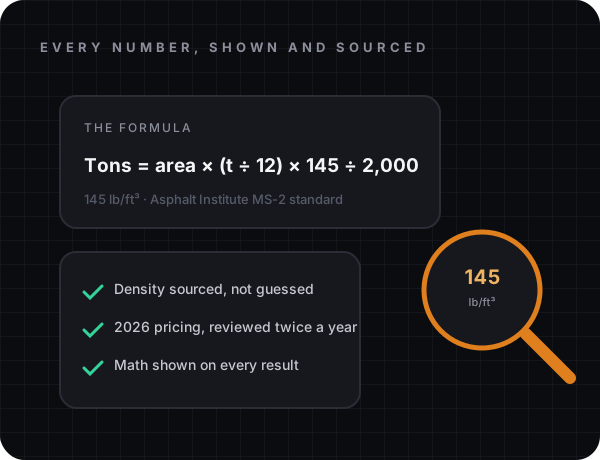
All tonnage calculations use the industry-standard compacted density of 145 pounds per cubic foot for hot mix asphalt, which equals approximately 110 pounds per square yard per inch of thickness. This is the same density used by the National Asphalt Pavement Association, the Asphalt Institute, state departments of transportation, and professional paving estimators across the United States.
Real HMA density ranges from about 140 to 155 lb/ft³ depending on the mix design and compaction level. Our default of 145 sits at the accepted midpoint. The hot mix calculator lets you select specific mix types (surface course, binder course, base course, SMA, polymer-modified) that adjust the density automatically, and every calculator lets you override the density with a custom value if your supplier provides one.
The formula
Every calculator uses the same base formula:
Tons = (area in sq ft × thickness in ft × density in lb/ft³) ÷ 2,000
For the square yardage calculator, the equivalent form is:
Tons = (area in SY × thickness in inches × 110) ÷ 2,000
Both formulas produce the same result. The 110 figure is derived from the 145 lb/ft³ density applied to a square yard at one inch of depth.
Waste and compaction allowance
Every calculator includes a waste factor (defaulting to 5% to 7%) that adds a buffer for compaction loss, edge trimming, and spillage. This is the step most competing tools skip, and it is the reason their estimates leave users short on material. A 5% allowance on a 15-ton order is 0.75 tons, which is the difference between finishing the job and stopping mid-pour to wait for another delivery.
Cost data
Material pricing is based on 2026 US market data sourced from published supplier quotes across multiple US regions, contractor cost surveys, and industry reports from NAPA and the Asphalt Institute. Regional adjustments reflect the real differences in labor, material transport, and plant proximity across eight US regions.
The cost figures on this site are estimates for planning. They are not quotes. Always confirm pricing with your local asphalt plant or contractor before placing an order.
What the calculators do not do
Freshness
How we keep the data current
Outdated pricing is the single biggest accuracy problem with online asphalt calculators. Most competing tools still show $40 to $80 per ton, pricing that has not been accurate since 2021. We maintain a concrete update schedule to prevent that from happening here.
Pricing data
Q1 + Q3 yearlyreviewed and updated in Q1 and Q3 of each year. Each review cross-references published supplier quotes, NAPA industry reports, and regional contractor surveys. The last full pricing review was July 2026.
Density values
Verified annuallystable and verified annually against the Asphalt Institute MS-2 standard and NAPA published specifications. Density values change only when the underlying industry standard changes, which is rare.
Coverage and tonnage math
Physics-fixedthe formulas are derived from physics (density × volume = weight) and do not change. We verify the calculator output against manual calculations annually to confirm no code errors have been introduced.
FAQ and content
Quarterlyreviewed quarterly. New questions are added from Google People Also Ask, Reddit, and user submissions. Outdated claims are removed or corrected.
Every page on the site shows a "Last updated" date in the footer. That date reflects the most recent content or data review for that page.
Check us
How to verify our numbers
Pick any number on this site and check it yourself. Every claim is traceable to a published source or a transparent calculation.
- Density (145 lb/ft³): matches the Asphalt Institute MS-2 Asphalt Mix Design Methods reference and the value used by state DOTs across the United States. Open any state DOT standard specification for HMA and you will find compacted density in the 140 to 155 range, with 145 as the accepted planning value.
- The 94% roads figure: comes from the National Asphalt Pavement Association's published fact sheets at asphaltpavement.org.
- The 99% recycled figure: also from NAPA's published data on reclaimed asphalt pavement (RAP) reuse rates.
- Cost ranges ($100 to $150 per ton for HMA in 2026): cross-referenced against published supplier quotes from multiple US markets and validated against HomeAdvisor, Angi, and HomeGuide published cost data as comparison benchmarks.
- Coverage (55 sq ft per ton at 3 inches): derived directly from the density. 145 lb/ft³ × 0.25 ft thickness × 1 sq ft = 36.25 lb per sq ft. 2,000 lb per ton ÷ 36.25 = 55.2 sq ft per ton. The math is open.
If you find an error in any density, formula, pricing, or coverage number on this site, email hello@getasphaltcalculator.com and we will investigate and correct it within 48 hours. Accuracy is the entire point of this project.
Six calculators
The tools
This site offers six free calculators, each built for a specific use case.
Receipts
Our data sources
The technical data and pricing on this site comes from published, verifiable sources.
Density and material standards
- National Asphalt Pavement Association (NAPA) — asphaltpavement.org
- Asphalt Institute — asphaltinstitute.org
- State DOT standard specifications (used to validate density ranges by mix type)
Cost and pricing data
- Published contractor cost surveys and industry reports
- Supplier price sheets from multiple US regions
- Cross-referenced with HomeAdvisor, Angi, and HomeGuide published cost ranges (used as comparison benchmarks, not as primary sources)
Original research
- Asphalt Price Index — a state-by-state and region-by-region reference of US asphalt prices, compiled from state DOT indices, industry reports, and supplier surveys. Updated monthly.
Questions and FAQs
- Google People Also Ask (live SERP research)
- Reddit communities (r/asphalt, r/HomeImprovement, r/DIY)
- FindQuestions research from real user queries
We do not invent statistics, fabricate user counts, or claim endorsements that do not exist. If a data point cannot be sourced, it does not appear on the site.
Shawaiz Hassan
Researcher · UI/UX specialist
Founder, StackAura✓ No hidden supplier relationships
✓ Does not sell asphalt
✓ Free, no signup, math shown
The builder
Who built this
Shawaiz Hassan is a researcher, UI/UX specialist, and the founder of StackAura, a digital growth agency that builds tools and content systems for businesses. He has spent years studying how people search for and use online calculators, where existing tools fail, and how to build tools that are genuinely more accurate, more transparent, and more useful than what already exists.
Shawaiz identified the asphalt calculator niche through systematic research across hundreds of online tool categories, looking for markets where the existing tools were outdated, inaccurate, or designed to sell a service rather than serve the user. Asphalt calculators stood out as one of the clearest gaps: a $100+ billion US industry where most online tools still used pricing from 2022, densities that varied randomly between 140 and 155 with no explanation, and layouts designed to push a contractor's phone number rather than help someone plan a project.
He is not a paving contractor. He does not sell asphalt. This site has no hidden commercial relationship with any supplier, contractor, or manufacturer. The calculators are free because the value is in the tool itself. A genuinely useful calculator earns trust, traffic, and links on its own merit.
Coverage
Press and citations
This is a new site. As we publish original research (starting with the 2026 US Asphalt Price Index) and earn external coverage, we will list press mentions, citations, and third-party references here.
If you are a journalist, blogger, or researcher and want to cite data from this site, you are welcome to do so. Please link to the specific calculator or page you are referencing. For press inquiries, email hello@getasphaltcalculator.com.
Contact
Have a question about the calculators, found an error in the data, or want to suggest a feature?
We read every message. If you spot a density, formula, or pricing error, we fix it fast. Accuracy is the whole point.
Last updated July 12, 2026.