Free · No signup · 2026 US pricing
Asphalt Parking Lot Calculator
Estimate the full cost of paving an asphalt parking lot in seconds. Enter the number of parking spaces or total area, pick your project type, and get a breakdown of material, labor, base prep, striping, and total installed cost. Built for property owners, contractors, and commercial estimators. Free, no signup.
By number of spaces or total area · Material + labor + striping · Regional 2026 pricing · New, resurface, or overlay · Updated July 2026
Estimate your parking lot cost
ADA spaces are included automatically: 25 spaces → 1 ADA accessible (federal minimum of 1 per 25).
Total installed
$0
range $45,400 to $84,900
Total area
0
sq ft (972 SY)
Asphalt needed
0
tons at 4" · incl. 5% waste
Planning estimate only. Get contractor quotes and site-specific engineering for your project.
Pricing
How much does it cost to pave an asphalt parking lot?
Paving an asphalt parking lot costs $3 to $8 per square foot fully installed in 2026, including material, base prep, labor, and basic striping. A 10 space lot (about 3,500 square feet) typically runs $12,000 to $28,000. A 50 space lot (about 17,500 square feet) runs $52,000 to $140,000. A 100 space lot approaches $100,000 to $280,000 depending on site conditions and region.
Paving an asphalt parking lot costs $3 to $8 per square foot installed in 2026, or $4.50 to $12 per square foot for a full commercial build with drainage, curbing, and lighting.
Those ranges are wide because parking lot pricing depends on variables that residential driveways rarely face: heavier thickness requirements, more complex drainage, ADA compliance, striping, signage, lighting, and curbing. This page and the calculator above help you narrow that range down to your specific job.
For residential driveway estimates instead, use the asphalt driveway cost calculator. For material-only tonnage, use the asphalt calculator.
By spaces
Parking lot cost by number of spaces
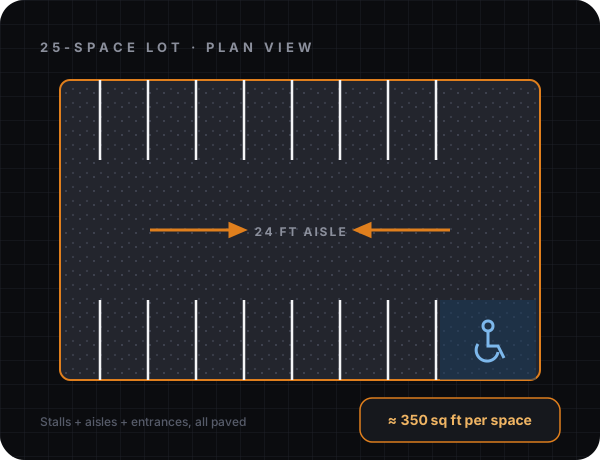
Each standard parking space needs about 300 to 350 square feet when you include the stall plus its share of the drive lane. This table uses 350 sq ft per space (the industry planning standard) at 4 inches of compacted asphalt over 8 inches of crushed stone base.
The industry planning standard is 350 square feet per parking space, including the stall plus its proportional share of the drive lane and access area.
| Spaces | Total area | Asphalt (tons) | Installed cost |
|---|---|---|---|
| 5 | 1,750 sq ft | about 32 | $5,250 to $14,000 |
| 10 | 3,500 sq ft | about 64 | $10,500 to $28,000 |
| 25 | 8,750 sq ft | about 159 | $26,250 to $70,000 |
| 50 | 17,500 sq ft | about 318 | $52,500 to $140,000 |
| 100 | 35,000 sq ft | about 636 | $105,000 to $280,000 |
| 200 | 70,000 sq ft | about 1,273 | $210,000 to $560,000 |
Larger lots pay less per square foot because the fixed cost of mobilizing the crew and equipment spreads across more area. A 5 space lot may cost $7 to $8 per square foot while a 200 space lot may run closer to $3 to $4.
Per sq ft
Parking lot cost per square foot (2026)
The cost per square foot breaks into clear components. Understanding each line helps you compare contractor quotes fairly.
| Cost component | Per sq ft | Notes |
|---|---|---|
| Asphalt material (4 inches) | $2.50 to $4.50 | Based on $100 to $150 per ton at 4 inch commercial thickness |
| Crushed stone base (8 inches) | $1.00 to $2.50 | Thicker base than residential for heavier traffic |
| Labor (grading, paving, rolling) | $1.50 to $3.00 | Varies by region and crew |
| Striping and marking | $0.15 to $0.40 | Stalls, handicap, fire lanes, arrows |
| Total installed (basic) | $3.00 to $8.00 | Paving + base + labor + striping |
| Add-ons (drainage, curbing, lighting, ADA) | $1.00 to $4.00+ | If needed, adds significantly |
| Total installed (full build) | $4.50 to $12.00 | With drainage, curbs, lighting, ADA |
The $3 to $8 range that most cost guides quote is the basic paving number. A full commercial lot build with drainage, curbing, ADA compliance, and lighting can push well above that.
Tonnage
How much asphalt do I need for a parking lot?
A parking lot uses more asphalt per square foot than a driveway because commercial traffic demands a thicker layer. Standard parking lot thickness is 4 inches of compacted asphalt for car traffic and 6 inches or more for areas with truck and delivery traffic.
| Lot size (sq ft) | 3 inches | 4 inches | 6 inches |
|---|---|---|---|
| 3,500 (10 spaces) | 48 tons | 64 tons | 95 tons |
| 8,750 (25 spaces) | 119 tons | 159 tons | 239 tons |
| 17,500 (50 spaces) | 239 tons | 318 tons | 477 tons |
| 35,000 (100 spaces) | 477 tons | 636 tons | 955 tons |
| 70,000 (200 spaces) | 955 tons | 1,273 tons | 1,909 tons |
Add 5% to 10% for waste and compaction before ordering. The calculator above includes this automatically.
To convert these numbers to material cost, multiply the tonnage by your local price per ton ($100 to $150 for hot mix). For detailed per-ton pricing by region, use the asphalt cost calculator.
Thickness
How many inches of asphalt does a parking lot need?
The thickness depends on the traffic load. Using too little asphalt on a commercial lot is the single most common mistake in parking lot paving, and it leads to premature cracking, rutting, and early resurfacing.
Most commercial parking lots use 4 inches as the standard. If you have delivery truck lanes, loading docks, or dumpster areas, those sections need 6 inches even if the rest of the lot uses 4. The calculator lets you set different thicknesses for different zones.
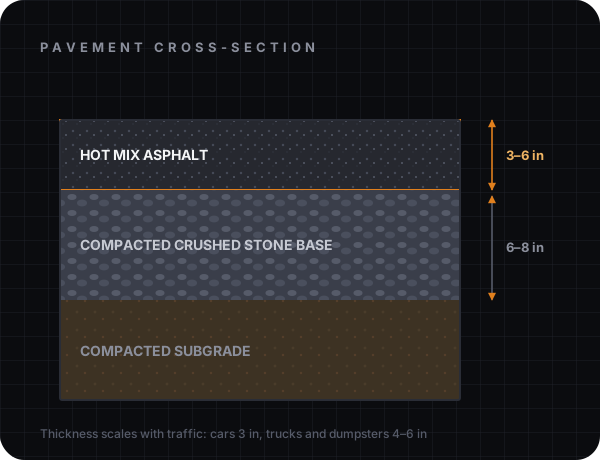
| Traffic type | Asphalt thickness | Base thickness | Examples |
|---|---|---|---|
| Light car only | 3 inches | 6 to 8 inches | Small office, church, low traffic retail |
| Standard mixed | 4 inches | 8 inches | Most retail, restaurant, medical office |
| Heavy / delivery | 5 to 6 inches | 8 to 12 inches | Loading zones, dumpster pads, drive-through |
| Truck traffic | 6+ inches | 10 to 12+ inches | Warehouse, distribution, heavy equipment |
Per space
How much does a parking space cost to build?
A single asphalt parking space costs $900 to $2,800 to build in 2026. That price covers the stall itself (about 162 square feet for a standard 9 by 18 space) plus its proportional share of the drive lane, curbing, and drainage.
| Space type | Dimensions | Area per space (with drive lane) | Cost per space |
|---|---|---|---|
| Standard | 9 ft × 18 ft | 325 to 350 sq ft | $975 to $2,800 |
| Compact | 8 ft × 16 ft | 275 to 300 sq ft | $825 to $2,400 |
| ADA accessible | 12 ft × 18 ft + 5 ft aisle | 450 to 500 sq ft | $1,350 to $4,000 |
ADA spaces cost 20% to 40% more because they are wider and require access aisles, signage, and compliant slope. Federal law requires a minimum of 1 ADA accessible space for every 25 standard spaces. Factor this into any lot with 25 or more spaces.
Capacity
How many parking spaces fit in my lot?
If you know the total area but not the space count, divide by the planning standard to get a rough count.
| Total area | Standard spaces (at 350 sq ft each) | With ADA spaces included |
|---|---|---|
| 5,000 sq ft | about 14 | 14 standard |
| 10,000 sq ft (about 1/4 acre) | about 28 | 27 standard + 1 ADA |
| 20,000 sq ft (about 1/2 acre) | about 57 | 55 standard + 2 ADA |
| 43,560 sq ft (1 acre) | about 124 | 119 standard + 5 ADA |
| 87,120 sq ft (2 acres) | about 249 | 239 standard + 10 ADA |
These are planning-level estimates. Actual capacity depends on the lot shape, entrance/exit layout, drive lane width, median islands, and local zoning setback requirements. An irregularly shaped lot or one with landscaped islands will fit fewer spaces than a simple rectangle.
The 350 square foot per space figure includes the stall, one side of the drive lane, and a share of the turning radius. Some municipalities require 325 sq ft, others 400. Check your local zoning code for the exact standard.
The method
How to estimate parking lot cost
Here is the step-by-step method estimators and contractors use to build a parking lot quote. The calculator runs all seven steps automatically, but knowing the method helps you read a quote and spot errors.
- 1
Count the spaces or measure the area. If you know the space count, multiply by 350 sq ft. If you have the total area, divide by 350 to get approximate spaces.
- 2
Pick the thickness by traffic load. 3 inches for light car traffic, 4 inches for standard mixed, 6 inches for heavy trucks and deliveries.
- 3
Calculate the asphalt tonnage. Area in square feet times thickness in feet times 145, divided by 2,000. A 50 space lot (17,500 sq ft) at 4 inches needs about 318 tons.
- 4
Price the material. Multiply tons by your regional price per ton. At $125 per ton, 318 tons costs about $39,750.
- 5
Add base, labor, and striping. Base runs $1 to $2.50 per sq ft. Labor runs $1.50 to $3 per sq ft. Striping runs $0.15 to $0.40 per sq ft. For 17,500 sq ft, that adds $46,375 to $103,250.
- 6
Add ADA, drainage, curbing, and removal. ADA ramps, drainage systems, curbing, and old surface removal (if replacing) are line items. Get these quoted separately.
- 7
Total it up. Material + base + labor + striping + add-ons = your installed estimate. Add 5% to 10% contingency for site surprises.
The calculator runs all seven steps the moment you enter your space count or area, with regional pricing adjustments, so you get the full breakdown without the arithmetic.
Project type
New lot vs resurfacing vs overlay
The project type changes the price significantly, just like on a driveway but at commercial scale.
| Project type | Per sq ft | What it includes | When to use |
|---|---|---|---|
| New construction | $3 to $8 | Grading, base, asphalt, striping | Unpaved land, new build |
| Full replacement | $4 to $10 | Remove old surface + new base + asphalt | Lot with failed base, major potholes |
| Resurfacing (overlay) | $2 to $5 | New 1.5 to 2 inch layer over existing | Existing lot with solid base, surface cracks only |
| Mill and overlay | $2.50 to $6 | Mill old surface, apply new layer | Existing lot needing level correction |
Resurfacing costs 40% to 60% less than full replacement because it skips the demolition and base rebuild. But it only works when the existing base is structurally sound. If water is pooling, the base has failed, or potholes go deeper than the surface layer, a full replacement is the better long-term investment.
Regional
Parking lot cost by region (2026)
Commercial paving prices vary by region due to labor costs, proximity to asphalt plants, and local demand. Southern and Gulf states sit closer to refineries and typically pay less.
| Region | Installed per sq ft (basic) | 50 space lot estimate |
|---|---|---|
| Gulf Coast (TX, LA, MS) | $2.50 to $5.50 | $44,000 to $96,000 |
| Southeast (FL, GA, NC, SC, TN) | $3.00 to $6.00 | $52,500 to $105,000 |
| Midwest (OH, MI, IL, IN, WI) | $3.00 to $6.50 | $52,500 to $114,000 |
| South Central (OK, AR) | $2.50 to $5.50 | $44,000 to $96,000 |
| Mountain West (CO, AZ, NV, UT) | $3.00 to $7.00 | $52,500 to $122,500 |
| Mid-Atlantic (PA, VA, MD, NJ) | $3.50 to $7.50 | $61,250 to $131,250 |
| Northeast (NY, MA, CT, RI) | $4.00 to $8.00 | $70,000 to $140,000 |
| West Coast (CA, WA, OR) | $4.50 to $9.00 | $78,750 to $157,500 |
These are basic paving prices. Add $1 to $4 per square foot for full commercial build-out with drainage, curbing, and lighting.
Parking lot paving cost in major US cities (50 space lot, basic install)
| City | 50 space lot estimate |
|---|---|
| Houston, TX | $44,000 to $87,500 |
| Dallas, TX | $44,000 to $87,500 |
| Atlanta, GA | $52,500 to $96,000 |
| Charlotte, NC | $52,500 to $96,000 |
| Nashville, TN | $52,500 to $96,000 |
| Columbus, OH | $52,500 to $105,000 |
| Phoenix, AZ | $52,500 to $114,000 |
| Denver, CO | $52,500 to $114,000 |
| Chicago, IL | $61,250 to $122,500 |
| Philadelphia, PA | $61,250 to $131,250 |
| Boston, MA | $70,000 to $140,000 |
| New York, NY | $70,000 to $140,000 |
| Miami, FL | $52,500 to $105,000 |
| Seattle, WA | $78,750 to $148,750 |
| Los Angeles, CA | $78,750 to $157,500 |
Get at least three local quotes. City pricing varies by neighborhood, site access, and soil conditions even within the same metro.
Price drivers
What factors affect parking lot paving cost?
Eight things drive the price. Understanding them helps you read a quote and ask the right questions.
1. Lot size (economies of scale)
Larger lots cost less per square foot. The fixed cost of mobilizing equipment (paver, rollers, trucks) is the same whether you pave 3,500 sq ft or 35,000 sq ft. On a small lot, mobilization can add 10% to 15% to the total. On a large lot, it adds 1% to 2%.
2. Asphalt thickness
Going from 3 inches to 4 inches adds roughly 33% more material. Going to 6 inches doubles it versus 3. Commercial lots need 4 inches minimum, and heavy-traffic areas need more.
3. Base preparation
A parking lot is only as strong as what is underneath it. Clay soil requires a deeper gravel base (10+ inches) and possibly geotextile fabric. Sandy, well-draining soil may need only 8 inches. If the existing ground is a former lot, you may need demolition and removal before rebuilding the base.
4. Drainage
Commercial lots must manage stormwater. Catch basins, storm drains, French drains, and grading to proper slope all add cost. Poor drainage is the fastest way to destroy an asphalt lot because standing water softens the base and accelerates cracking.
5. ADA compliance
Accessible spaces, ramps, truncated domes, proper slope (max 2% cross-slope), and signage are legally required on commercial lots. The cost depends on the number of ADA spaces and the site's existing grade.
6. Striping, signage, and lighting
Line striping costs $0.15 to $0.40 per linear foot. Each stall needs about 46 linear feet of striping. Signs, bollards, fire lane markings, and directional arrows add up. Lighting is often a separate electrical contract but needs to be budgeted together.
7. Regional labor rates
Northeast and West Coast contractors charge 40% to 80% more than Gulf Coast and Southeast crews for the same job, driven by local wage scales and cost of living.
8. Old surface removal
If replacing an existing lot, demolition and hauling adds $1 to $3 per square foot. Concrete removal costs more than asphalt removal because it is heavier and harder to break.
Compare
Asphalt vs concrete parking lot cost
| Factor | Asphalt | Concrete |
|---|---|---|
| Installed cost per sq ft | $3 to $8 | $4 to $10 |
| 50 space lot (installed) | $52,500 to $140,000 | $70,000 to $175,000 |
| Lifespan | 15 to 25 years | 25 to 40 years |
| Maintenance | Sealcoat every 3 to 5 years | Minimal, joint sealing |
| Repair ease | Simple, fast, inexpensive | Harder, slower, more expensive |
| Cold climate | Excellent, flexes with freeze thaw | Can crack and heave |
| Hot climate | Can soften in extreme heat | Excellent |
| Best for | Most commercial lots, cold climates, budget | High-traffic retail, hot climates, premium look |
Asphalt is typically 25% to 40% cheaper than concrete to install for the same parking lot, and it installs faster: a 50 space lot can be paved in 2 to 3 days.
Asphalt is the default for most commercial parking lots because it costs less upfront, installs faster (a 50 space lot can be paved in 2 to 3 days), and is easy to repair. Concrete wins when the lot needs to last 30+ years with minimal maintenance or when the climate regularly exceeds 100°F.
ROI
Is it worth paving a parking lot?
For most commercial properties, a paved parking lot pays for itself through three measurable returns.
Property value. A paved, striped, well-maintained lot adds 5% to 10% to the assessed value of a commercial property compared to gravel or dirt. On a $500,000 building, that is $25,000 to $50,000 in added value for a lot that might cost $50,000 to $80,000 to build.
Tenant retention and customer experience. Retail and office tenants cite parking quality as a top 3 factor in lease renewal. A lot with potholes, poor drainage, or no striping signals neglect and drives tenants and customers to competing properties.
Liability reduction. An unpaved or poorly maintained lot increases slip-and-fall and vehicle damage claims. ADA non-compliance on a commercial lot can result in federal fines of $75,000 to $150,000 for first violations. Paving with proper ADA spaces is risk mitigation, not just cosmetics.
Gravel alternative. If budget is the primary constraint, a gravel lot costs $1 to $3 per square foot but requires regrading every 1 to 2 years, creates dust, turns muddy in rain, and does not support ADA compliance. For lots with fewer than 10 spaces in rural areas, gravel can work. For anything larger or customer-facing, asphalt is the floor.
Upkeep
Parking lot maintenance costs
Building the lot is the beginning, not the end. Budgeting for maintenance keeps it lasting 20+ years and avoids an early full replacement.
| Maintenance item | Cost | Frequency |
|---|---|---|
| Sealcoating | $0.15 to $0.30 per sq ft | Every 2 to 3 years |
| Crack sealing | $0.50 to $1.50 per linear foot | Annually as needed |
| Pothole patching | $50 to $300 per patch | As needed |
| Re-striping | $0.20 to $0.50 per linear foot | Every 2 to 3 years |
| Full resurfacing | $2 to $5 per sq ft | After 12 to 18 years |
For a 50 space lot (17,500 sq ft), annual maintenance averages $2,600 to $5,250 in sealcoating years and $500 to $1,500 in non-sealcoating years. Over 20 years, plan roughly $35,000 to $60,000 in maintenance, which is 25% to 40% of the original build cost.
Permits
Permits and zoning for parking lots
Commercial parking lots almost always require permits. Unlike a residential driveway repave, a commercial lot involves stormwater management, ADA compliance, and sometimes environmental review.
When a permit is required: New lot construction on vacant land (always), expansion of an existing lot (almost always), major grading changes, and any project that adds impervious surface area. Simple resurfacing of an existing lot with no grade changes typically does not require a permit, but check with your local building department.
Typical permit costs and timeline: A commercial site plan review and grading permit runs $500 to $5,000 depending on the municipality and lot size. In larger cities, expect $2,000 to $5,000. Timeline is 4 to 12 weeks for approval, longer if environmental review or planning board hearings are involved.
Stormwater requirements. Many municipalities require a stormwater management plan for new impervious surface. This can mean retention ponds, permeable pavers on a portion of the lot, or bioswales. These add $1 to $4 per square foot to the project but are non-negotiable in regulated areas.
ADA compliance. Every commercial parking lot must meet ADA requirements regardless of whether a permit is pulled. ADA is federal law, not local code. Minimum 1 accessible space per 25 standard spaces, with proper signage, access aisles, and slope. Non-compliance exposes the property owner to federal fines and private lawsuits.
Timing
Best time to pave a parking lot
Asphalt needs ground temperature above 50°F and stable weather to cure properly. For most of the US, the paving season runs May through October.
Best value window: September to early October. Contractor demand drops before winter, wait times shorten, and some crews discount to fill their schedule. The asphalt still cures properly in fall warmth.
Peak season: July and August. Longest wait times, highest demand, sometimes 5% to 10% price premium.
Off-season risk: Paving in November or later in cold climates risks poor compaction and curing failures. In the South and Southwest, winter paving is possible on warmer days.
Business timing tip: Schedule paving over a weekend or holiday when the lot sees the least traffic. A 50 space lot takes 2 to 3 days to pave and another 24 to 48 hours before cars can drive on it.
Why this one
Why use this asphalt parking lot calculator
- By spaces or by area. Enter the number of parking spaces and the tool calculates the area automatically (350 sq ft per space), or enter your own dimensions.
- Commercial thickness presets. Pick light car, standard mixed, or heavy truck traffic and the tool sets the right thickness.
- Full cost breakdown. See material, labor, base, striping, drainage, and curbing as separate line items, not one lump number.
- New, replacement, or resurfacing. Pick the project type and the estimate adjusts automatically.
- Regional pricing. Select your region and the numbers reflect local rates, not a national average that could be off by 50%.
- ADA spaces included. The tool auto-adds the required number of ADA spaces based on your total count.
- Free, instant, no signup. Enter your numbers and get a result in seconds.
Pick your tool
Which calculator should you use?
One tool does not fit every job. Use this quick guide to jump to the right one.
- You are sizing a commercial parking lot. You are on the right page. Enter your space count or area above.
- You need tonnage and material cost for any paving job. Use the main asphalt calculator on the homepage.
- You are estimating a residential driveway, not a lot. Use the asphalt driveway cost calculator.
- You want to compare material prices by asphalt type and region. Use the asphalt cost per ton calculator.
- Your DOT or supplier quotes in square yards. Use the asphalt square yardage calculator.
- Your job is standard hot mix and you want a mix-specific estimate. Use the hot mix asphalt calculator.
If the job crosses two of these, start here for the commercial installed cost, then click into the specific calculator for the material breakdown.
For site owners
Embed this calculator on your website (free)
Commercial paving contractors, property management companies, and construction estimating blogs can add this parking lot calculator to their own site with one line of code. It stays current with 2026 pricing and gives your visitors a real installed-cost estimate by space count.
What you get: the full parking lot calculator, mobile responsive, with a small "Powered by Asphalt Calculator" link back to getasphaltcalculator.com. No sign-up, no fee.
<iframe src="https://getasphaltcalculator.com/asphalt-parking-lot-calculator/embed/" width="100%" height="800" frameborder="0" style="border:0;" title="Asphalt Parking Lot Calculator"></iframe>FAQ
Frequently asked questions
14 questions answered
An asphalt parking lot costs $3 to $8 per square foot for basic installation in 2026, or $4.50 to $12 per square foot for a full commercial build with drainage, curbing, and lighting. A 10 space lot typically runs $10,500 to $28,000. A 50 space lot runs $52,500 to $140,000. The final price depends on lot size, thickness, region, and site conditions.
A single asphalt parking space costs $900 to $2,800 to build in 2026. That includes the stall (9 by 18 feet) plus its share of the drive lane, curbing, and drainage. ADA accessible spaces cost 20% to 40% more because they are wider and require access aisles and signage.
Most commercial parking lots need 4 inches of compacted asphalt over an 8 inch crushed stone base. Light-traffic lots (small office, church) can use 3 inches. Areas with truck traffic, delivery lanes, or dumpster pads need 5 to 6 inches or more. Using too little thickness is the most common reason parking lots fail early.
Plan 300 to 350 square feet per standard parking space. That includes the stall itself (9 by 18 feet, or 162 sq ft) plus each space's proportional share of the drive lane, turning radius, and access area. Compact spaces use about 275 to 300 sq ft. ADA spaces use 450 to 500 sq ft.
A 10 space lot (3,500 sq ft) at 4 inches thick needs about 64 tons. A 50 space lot (17,500 sq ft) needs about 318 tons. A 100 space lot (35,000 sq ft) needs about 636 tons. Add 5% to 10% for waste. Multiply the tonnage by your local price per ton ($100 to $150) for the material cost.
Parking lot striping costs $0.15 to $0.40 per linear foot. A standard space needs about 46 linear feet of striping, so each stall costs $7 to $18 to stripe. A 50 space lot costs roughly $350 to $900 for full striping including stalls, handicap markings, fire lanes, and directional arrows. Re-striping costs 30% to 50% less.
Resurfacing an asphalt parking lot costs $2 to $5 per square foot for a new 1.5 to 2 inch overlay. For a 50 space lot (17,500 sq ft), that is $35,000 to $87,500. Resurfacing only works when the existing base is structurally sound. If there are deep potholes, drainage failures, or base movement, a full replacement at $4 to $10 per square foot is needed.
Asphalt is typically 25% to 40% cheaper than concrete to install. A 50 space lot costs $52,500 to $140,000 in asphalt versus $70,000 to $175,000 in concrete. Asphalt installs faster and is easier to repair, but concrete lasts longer (25 to 40 years vs 15 to 25) and needs less maintenance. Over 30 years, total cost of ownership is often similar.
An asphalt parking lot lasts 15 to 25 years with proper maintenance. Sealcoating every 2 to 3 years, prompt crack sealing, and timely pothole repair extend the life toward the upper end. Without maintenance, expect 8 to 12 years before major problems develop. Climate matters too. Lots in freeze-thaw zones age faster than those in mild climates.
A good quote should itemize material (asphalt and base stone), labor, grading and site preparation, compaction, striping, and disposal of old material (if replacing). Add-ons like drainage, curbing, ADA ramps, signage, and lighting should be listed separately. If the quote is a single lump number with no breakdown, ask for an itemized version before signing.
Sealcoating costs $0.15 to $0.30 per square foot for commercial lots. A 50 space lot (17,500 sq ft) costs $2,625 to $5,250 per application. Sealcoating should be done every 2 to 3 years starting 6 to 12 months after initial paving. It protects the surface from water, UV, and oil damage and extends the lot's life by 5 to 8 years.
Yes. Larger lots pay less per square foot because of economies of scale. The fixed cost of mobilizing equipment (paver, rollers, trucks, crew) is the same whether you pave 3,500 or 70,000 square feet. On a 10 space lot, mobilization can add $1 to $2 per square foot. On a 200 space lot, it adds pennies. Material suppliers also offer volume discounts on orders above 15 to 20 tons.
One acre (43,560 square feet) fits roughly 124 standard parking spaces at 350 square feet per space, including drive lanes. After accounting for ADA spaces, entrance/exit lanes, landscaped islands, and setbacks, a realistic count is 90 to 110 usable spaces per acre. Irregularly shaped lots and local zoning requirements reduce the number further.
Yes for new construction and expansions, usually not for simple resurfacing with no grade changes. New lot permits typically cost $500 to $5,000 and take 4 to 12 weeks for approval. Most municipalities also require a stormwater management plan when adding impervious surface. ADA compliance is required on all commercial lots regardless of permit status.
Enter the number of spaces or your lot dimensions above and see the full cost breakdown in seconds. Material, labor, base, striping, and add-ons, all itemized. Free, instant, no signup.
Every number on this page follows the methodology documented on our About page: 145 lb/ft³ density per the Asphalt Institute MS-2 standard, facts cross-checked against the National Asphalt Pavement Association. Found an error? Email hello@getasphaltcalculator.com.
Last updated July 12, 2026.