
Free · No signup · 2026 US pricing
Asphalt Square Yardage Calculator
Convert square yards to tons of asphalt instantly. Enter your area in square yards, pick your thickness, and get the exact tonnage, cubic yards, and material cost for your paving project. Built for contractors and estimators who work in square yards on large-scale jobs.
SY to tons in seconds · Works for any thickness · Includes waste allowance · Free, no signup
By Shawaiz Hassan · Updated October 28, 2026
Convert square yards to tons
Thickness (in)
Order quantity
17.7
tons · incl. 7% waste
Tonnage (no waste)
16.5
tons
Volume
8.3
cubic yards
At 3 inches, 1 ton covers about 6.1 SY (55 sq ft). Your tonnage covers 100 SY at this thickness.
Estimate for planning only. Confirm thickness, density, and order quantity with your supplier.
The basics
What is an asphalt square yardage calculator?
An asphalt square yardage calculator converts a paving area measured in square yards into the weight of asphalt you need in tons. You enter the area in square yards and the compacted thickness, and it returns the tonnage, the volume in cubic yards, and the material cost.
Square yards are the standard unit on commercial site plans, DOT contracts, and large-scale paving specs. If your survey or blueprint shows the area in square yards, this tool saves you from converting to square feet first. It takes your SY number, applies the industry-standard density of 110 pounds per square yard per inch of thickness, and gives you the order quantity in tons so you can call your supplier with a real number.
For projects measured in square feet instead, use our asphalt calculator on the homepage. Our guide to converting square yards to tons of asphalt works the same conversion through by hand.
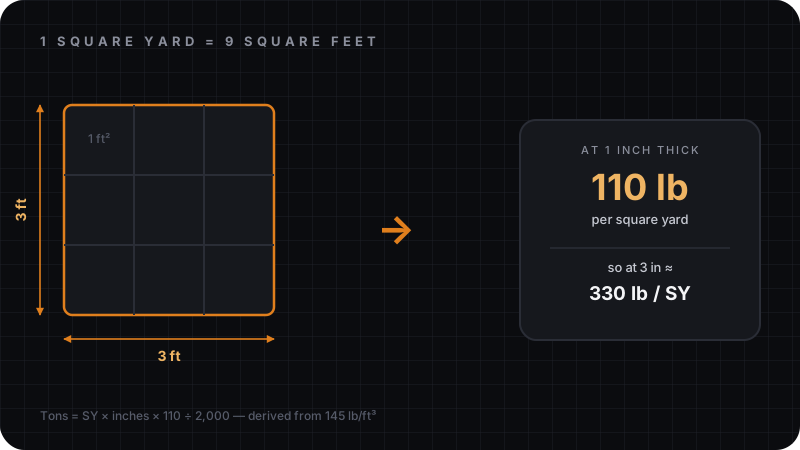
Illustration: getasphaltcalculator.com
The method
How to convert asphalt square yards to tons
The conversion from square yards to tons uses a simple formula that every paving estimator should know. Here is the step-by-step method.
- 1
Start with your area in square yards. If you only have square feet, divide by 9. A 900 square foot parking lot is 100 square yards.
- 2
Pick the compacted thickness in inches. Most driveways use 2 to 3 inches. Parking lots and roads use 3 to 6 inches.
- 3
Multiply SY by thickness by 110. The 110 figure is the industry-standard weight of one square yard of compacted hot mix asphalt at one inch thick, measured in pounds.
- 4
Divide by 2,000. That converts pounds to tons.
- 5
Add a waste allowance. Add 5% to 10% for compaction loss and spillage so your order covers the real-world job.
The calculator runs all five steps the moment you enter your numbers.
Worked example
A parking lot measures 500 square yards and needs 3 inches of hot mix asphalt.
- 500 SY × 3 inches × 110 lb = 165,000 lb
- 165,000 ÷ 2,000 = 82.5 tons
- With 7% waste: 82.5 × 1.07 = 88.3 tons (order 88.5 tons)
At $100 per ton, the material cost is $8,830.
The formula
The asphalt square yards to tons formula
Tons = (square yards × thickness in inches × 110) ÷ 2,000
The typical application spread rate for asphalt mixtures is 110 lbs. per square yard per inch of thickness.
The 110 figure comes from the standard compacted density of hot mix asphalt. One square yard of HMA at one inch thick weighs 110 pounds. That density assumes proper compaction to about 145 pounds per cubic foot, which is the accepted value across the US paving industry. Our guide to how much asphalt weighs reconciles the three density figures you will see quoted.
If you know the exact density of your mix (your supplier can tell you), you can swap the 110 for a custom value. The calculator lets you do this. For planning and ordering, 110 is the common round figure, and it will get you within a few percent of the real weight. State DOT tables list their own values by mix, so use the plant or project figure when you have one.
Coverage
How many square yards does 1 ton of asphalt cover?
One ton of hot mix asphalt covers about 18.4 square yards at 1 inch thick, about 9.2 square yards at 2 inches, and about 6.1 square yards at 3 inches. Coverage drops as thickness rises because a deeper layer uses more material over the same area.
| Thickness | Coverage per ton (SY) | Coverage per ton (SF) | Common use |
|---|---|---|---|
| 1 inch | 18.4 SY | 165 sq ft | Thin overlay, top coat |
| 1.5 inches | 12.3 SY | 110 sq ft | Light resurfacing |
| 2 inches | 9.2 SY | 83 sq ft | Standard residential driveway |
| 3 inches | 6.1 SY | 55 sq ft | Heavy driveway, light parking lot |
| 4 inches | 4.6 SY | 41 sq ft | Commercial lot, heavy traffic |
| 6 inches | 3.1 SY | 28 sq ft | Roads, truck traffic |
Read it the other way when you plan a job. A 100 SY parking lot at 3 inches needs about 16.4 tons by this table (100 ÷ 6.1), or 16.5 tons by the 110 rule, plus waste.
Why the two methods differ by about 1%: this coverage table uses 145 lb/ft³ exactly, which is 108.75 pounds per square yard per inch. The ordering formula rounds that up to 110 pounds (0.055 tons per square yard per inch), so it returns slightly more tonnage. Use the 110 rule when you order, because it errs on the side of not running short.
Quick lookup
Asphalt tonnage table by area and thickness
This table gives you a quick lookup for common job sizes. All figures use the standard 110 lb per SY per inch density, with no waste added. Add 5% to 10% to the tonnage before ordering.
| Area (SY) | Area (SF) | 2 inches | 3 inches | 4 inches | 6 inches |
|---|---|---|---|---|---|
| 50 | 450 | 5.5 tons | 8.3 tons | 11.0 tons | 16.5 tons |
| 100 | 900 | 11.0 tons | 16.5 tons | 22.0 tons | 33.0 tons |
| 200 | 1,800 | 22.0 tons | 33.0 tons | 44.0 tons | 66.0 tons |
| 500 | 4,500 | 55.0 tons | 82.5 tons | 110.0 tons | 165.0 tons |
| 1,000 | 9,000 | 110.0 tons | 165.0 tons | 220.0 tons | 330.0 tons |
| 2,000 | 18,000 | 220.0 tons | 330.0 tons | 440.0 tons | 660.0 tons |
| 5,000 | 45,000 | 550.0 tons | 825.0 tons | 1,100.0 tons | 1,650.0 tons |
For a quick mental estimate: at 2 inches thick, every 100 SY needs about 11 tons. For the equivalent lookup in square feet, see how much a ton of asphalt covers, and for a full SY conversion chart with worked examples, see square yards to tons of asphalt.
Weight
How much does 1 square yard of asphalt weigh?
One square yard of compacted hot mix asphalt weighs about 110 pounds at 1 inch thick. At the standard residential driveway thickness of 3 inches, one square yard weighs about 330 pounds, or 0.165 tons.
The 110 figure is not a round number chosen for convenience. It comes from the real density of compacted HMA. One cubic foot of compacted asphalt weighs about 145 pounds. One square yard is 9 square feet, so at 1 inch thick (0.0833 feet) the volume is 0.75 cubic feet. Multiply 0.75 by 145 and you get about 109 pounds, which the industry rounds to 110.
Reverse it
How to convert tons to square yards (reverse conversion)
Sometimes you need to go the other way. You know how many tons you have (or can afford), and you need to know how much area that covers. The reverse formula is:
Square yards = (tons × 2,000) ÷ (thickness in inches × 110)
| Tons available | 2 inches (SY covered) | 3 inches (SY covered) | 4 inches (SY covered) |
|---|---|---|---|
| 5 | 45.5 SY | 30.3 SY | 22.7 SY |
| 10 | 90.9 SY | 60.6 SY | 45.5 SY |
| 15 | 136.4 SY | 90.9 SY | 68.2 SY |
| 20 | 181.8 SY | 121.2 SY | 90.9 SY |
| 50 | 454.5 SY | 303.0 SY | 227.3 SY |
| 100 | 909.1 SY | 606.1 SY | 454.5 SY |
This is useful when you are working backward from a budget. If you can afford 20 tons of hot mix at $100 per ton ($2,000 in material), that covers about 121 square yards at 3 inches. Knowing the coverage helps you decide whether to pave the full area or reduce the scope to stay within budget.
The calculator handles this reverse conversion too. Enter your tonnage and thickness, and it shows the area in square yards and square feet.
Units
Square yards vs square feet vs cubic yards: which unit to use
Three different units show up in paving, and they measure different things. Mixing them up is the most common mistake in asphalt ordering.
One square yard equals 9 square feet (3 ft × 3 ft). Dividing square feet by 3 instead of 9 is the most common conversion error in paving estimates and triples the order.
| Unit | What it measures | When you use it | How to convert |
|---|---|---|---|
| Square yards (SY) | Area (surface) | Site plans, DOT specs, commercial bids | 1 SY = 9 SF |
| Square feet (SF) | Area (surface) | Residential driveways, small jobs | 1 SF = 0.111 SY |
| Cubic yards (CY) | Volume (3D) | Supplier orders, mixing, hauling | 1 CY = 27 cubic feet ≈ 1.96 tons of HMA |
Square yards and square feet are area. They tell you the surface you are covering, but not how much material you need until you add the thickness.
Cubic yards are volume. They tell you how much space the material fills, which is closer to what you actually order, but suppliers still sell by the ton because weight is easier to measure at the plant scale.
Tons are weight. This is what you order and what you pay for. Every other unit has to be converted to tons before you call the supplier. Thickness is the other input you have to settle first, covered in how thick an asphalt driveway should be.
The calculator accepts all three area units and outputs tons, cubic yards, and cost, so you can start from whatever your plans give you.
Pricing
Asphalt cost per square yard (2026)
| Cost type | Per SY at 3 inches | Notes |
|---|---|---|
| Material only (HMA) | $11.55 to $21.45 | Based on $70 to $130 per ton at the plant, 2026 public bids |
| Material + delivery | $12.21 to $22.94 | Adds $4 to $9 per ton delivery (HomeGuide) |
| Installed driveway | $27 to $135 | Published range of $3 to $15 per sq ft, times 9 |
Material-only cost per square yard is useful when you are buying asphalt directly and placing it with your own crew. The installed figure applies when hiring a contractor for the complete job (HomeGuide and Bob Vila, updated May 2024; read October 2026, not 2026 prices). The bids behind the per-ton price are listed in the 2026 asphalt price index.
For installed pricing by driveway size and region, use the asphalt driveway cost calculator. For material cost per ton, use the asphalt cost calculator.
Context
When to use square yards in asphalt projects
Not every job uses square yards. Here is when you will encounter them and when square feet are more practical.
Use square yards when:
- Your site plan or survey is in square yards (common on commercial and municipal projects)
- The DOT or county spec sheet lists the area in SY
- You are bidding a road, parking lot, or public project where SY is the standard unit
- Your contractor or supplier quotes by the square yard
Use square feet when:
- You are measuring a residential driveway or walkway with a tape measure
- The numbers are small enough that square feet are easier to visualize (most people can picture 20 feet but not 2.22 yards)
- Your contractor quotes by the square foot
The calculator accepts both and converts between them automatically.
Estimating multi-lift jobs in square yards
Commercial and DOT paving is rarely a single layer. A typical parking lot or road section is built in two lifts: a coarser binder course for structure, then a finer surface course for the wearing layer. Bid sheets list each lift as its own line item in square yards, and each lift is usually a different mix at a different price per ton, so you run the SY-to-tons conversion once per lift and order them separately.
| Lift | Typical thickness | Tons per 1,000 SY | Notes |
|---|---|---|---|
| Binder (base) course | 2 to 3 inches | 110 to 165 tons | Larger aggregate, cheaper per ton |
| Surface (wearing) course | 1.5 to 2 inches | 82.5 to 110 tons | Finer mix, higher price per ton |
| Full section | 3.5 to 5 inches | 192.5 to 275 tons | Sum of both lifts, ordered separately |
Worked example: a 1,000 SY lot specced at a 2 inch binder plus a 1.5 inch surface course. The binder is 1,000 × 2 × 110 ÷ 2,000 = 110 tons; the surface is 1,000 × 1.5 × 110 ÷ 2,000 = 82.5 tons. With 7% waste that is roughly 118 tons of binder mix and 88.5 tons of surface mix: two separate orders, often delivered days apart because the binder has to be compacted before the surface lift goes down. Pricing differs by mix too; the asphalt price per ton by mix type guide covers the spread.
Run the calculator once per lift with that lift’s thickness, rather than once with the combined depth. The total tonnage is the same either way, but per-lift numbers are what your supplier quotes against and what the bid sheet asks you to price.
Avoid these
Common conversion mistakes (and how to avoid them)
Three errors cause most asphalt ordering problems. They seem simple but they cost real money on large jobs.
Mistake 1: dividing by 3 instead of 9. A square yard is 3 feet by 3 feet, which is 9 square feet, not 3. Dividing 900 sq ft by 3 gives you 300, but the correct answer is 100 square yards. This error triples your order.
Mistake 2: mixing loose and compacted thickness. The paver lays the loose mat about 25% thicker than the compacted depth. If the spec calls for 3 inches compacted, the loose layer before rolling is about 3.75 inches. Always use the compacted thickness in the formula, then let the waste allowance cover the difference.
Mistake 3: forgetting the waste allowance. The formula gives you the theoretical weight. Real jobs lose 5% to 10% to spillage, edge trimming, and compaction variation. Order 5% extra for a clean rectangular lot and 10% extra for irregular shapes.
Why this one
Why use this asphalt square yardage calculator
- Square yards in, tons out. No detour through square feet.
- Three ways to enter the area. Square yards, square feet, or length and width.
- Density you can change. The default is 110 lb per square yard per inch, and you can type the figure from your plant.
- Run it once per lift. Enter the binder course and the surface course separately, the way a bid sheet lists them.
Pick your tool
Which calculator should you use?
- Plans in square yards, answer in tons. Stay here.
- Tonnage from feet, meters, or a circle. Use the main asphalt calculator.
- Installed driveway cost with labor and base. Use the asphalt driveway cost calculator.
- Material price by type and region. Use the asphalt cost calculator.
- A commercial lot sized by spaces. Use the asphalt parking lot calculator.
- Hot mix with a specific mix density. Use the hot mix asphalt calculator.
- Not sure which fits? Compare all seven on the asphalt calculators page.
For site owners
Embed this calculator on your website (free)
Estimators and paving contractors can add this square yards to tons calculator to their own site with the one line of code below. It is free and needs no account. The embed is the full tool in a 680 pixel tall frame, with a small "Powered by Asphalt Calculator" link back to getasphaltcalculator.com.
<iframe src="https://getasphaltcalculator.com/asphalt-square-yardage-calculator/embed/" width="100%" height="680" frameborder="0" style="border:0;" title="Asphalt Square Yardage Calculator"></iframe>FAQ
Frequently asked questions
10 questions answered
About 6.1 square yards. One ton of hot mix asphalt covers about 18.4 square yards at 1 inch thick, about 9.2 square yards at 2 inches, and about 6.1 square yards at 3 inches. The coverage drops as thickness increases because a deeper layer uses more material per unit of area. Use the coverage table above to look up your exact thickness.
Multiply the square yards by the thickness in inches, then multiply by 110 pounds, and divide by 2,000. The 110 figure is the standard weight of one square yard of compacted hot mix asphalt at one inch thick. For example, 100 square yards at 3 inches is 100 times 3 times 110 divided by 2,000 equals 16.5 tons before waste.
One square yard of compacted hot mix asphalt weighs about 110 pounds per inch of thickness. At a standard 3 inch driveway thickness, one square yard weighs about 330 pounds, or 0.165 tons. The weight comes from the industry-standard density of 145 pounds per cubic foot.
Add 5% to 10% for waste and compaction before placing your order. Apply it to the neat quantity: square yards times thickness in inches times 110, divided by 2,000. For 100 square yards at 3 inches that is 16.5 tons, or about 17.3 to 18.2 tons to order.
Asphalt material costs about $11.55 to $21.45 per square yard at 3 inches thick, based on the $70 to $130 per ton seen for hot mix at the plant in 2026 public bids. An installed asphalt driveway runs about $27 to $135 per square yard, which is the published range of $3 to $15 per square foot multiplied by 9.
One square yard equals 9 square feet. A square yard is a 3 foot by 3 foot area. To convert square feet to square yards, divide by 9. To convert square yards to square feet, multiply by 9. This is the most commonly confused conversion in paving estimates.
Square yards are standard on commercial and municipal projects, DOT contracts, and large-scale site plans. Square feet are more common on residential driveways and small jobs. The unit does not change the math or the final tonnage. It only changes the starting number. This calculator accepts both and converts automatically.
Measure the length and width of your paving area in feet, multiply them together to get square feet, then divide by 9 to get square yards. For example, a lot that is 90 feet by 100 feet is 9,000 square feet, or 1,000 square yards. Then use the SY to tons formula to find your asphalt tonnage.
Multiply the area in square yards by the thickness in inches, then divide by 36 to get cubic yards. For example, 100 square yards at 3 inches is 100 times 3 divided by 36 equals 8.33 cubic yards, which weighs about 16.3 tons. Most suppliers sell by the ton, so convert cubic yards to tons by multiplying by 1.96.
Ten tons of hot mix asphalt covers about 90.9 square yards at 2 inches thick, about 60.6 square yards at 3 inches, and about 45.5 square yards at 4 inches. Use the reverse formula: tons times 2,000, divided by thickness in inches times 110. This is useful when you are working backward from a budget or a supplier's available inventory.
Enter your square yardage above and get your asphalt tonnage and cost in seconds. Free, instant, no conversion math required.
The tonnage math on this page uses 145 lb/ft³ for compacted hot mix, as documented on our About page. Prices come from one shared data file where each figure carries its source and the month it was checked; the sources are listed on the asphalt price index. Found an error? Email hello@getasphaltcalculator.com.