
Free · No signup · 2026 US pricing
Hot Mix Asphalt Calculator
Calculate exactly how much hot mix asphalt you need, in tons, cubic yards, and cost. Enter your dimensions, pick your HMA mix type, and get an instant estimate tuned to hot mix density. Built for contractors and homeowners ordering from an asphalt plant.
HMA density built in · All mix grades · Tons + cubic yards + cost · Waste allowance included · Free, no signup · Updated July 2026
Calculate hot mix tonnage
Thickness (in)
Order quantity
0.0
tons · incl. 5% waste
Volume
0.0
cu yd (200 ft³)
Material cost
—
enter price per ton
At 3 inches, 1 ton of this mix covers about 55 sq ft.
Estimate for planning. Confirm mix type and density with your supplier's Job Mix Formula.
The basics
What is hot mix asphalt?
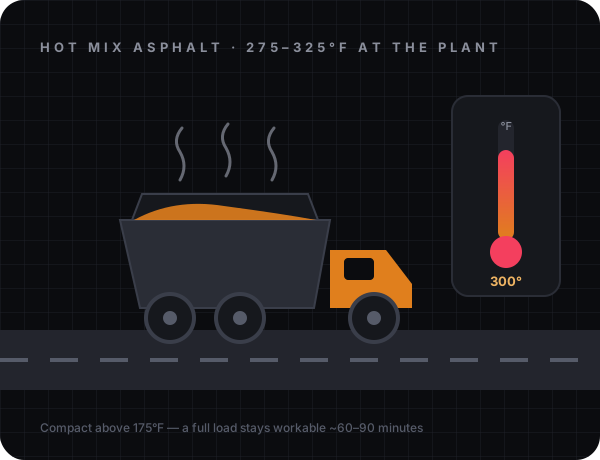
Hot mix asphalt is the standard paving material used on roads, driveways, and parking lots across the United States. It is a combination of roughly 95% stone aggregate and sand mixed with about 5% liquid asphalt binder (a petroleum-based cement), heated to 275°F to 325°F at the plant, and laid while still hot.
About 94% of paved roads in the United States are surfaced with asphalt, and the vast majority of that is hot mix.
It is called "hot mix" because it must be produced, transported, and compacted at high temperatures. Once it cools and hardens, it forms the smooth, dark, durable surface you drive on every day.
HMA is different from cold mix (which comes in bags and is used for patches), warm mix (produced at lower temperatures), and recycled asphalt millings (crushed reclaimed pavement). This calculator is specifically tuned to HMA density and pricing.
The method
How much hot mix asphalt do I need?
To find how much hot mix you need, multiply the area by the thickness to get the volume, then multiply by the density of compacted HMA to get the weight in tons. Standard compacted hot mix asphalt weighs about 145 pounds per cubic foot, or about 110 pounds per square yard per inch of thickness.
A 20 by 40 foot driveway at 3 inches thick needs about 14.5 tons of hot mix. A 10 space parking lot at 4 inches needs about 64 tons. The calculator runs this math the moment you enter your dimensions.
How to calculate hot mix asphalt step by step
- 1
Measure the area. Record the length and width in feet. For irregular shapes, break the area into rectangles and add them together.
- 2
Pick the compacted thickness. Residential driveways use 2 to 3 inches. Parking lots use 3 to 4 inches. Roads and heavy traffic areas use 4 to 6 inches or more.
- 3
Convert thickness to feet. Divide inches by 12. Three inches is 0.25 feet.
- 4
Find the volume. Multiply length by width by thickness in feet to get cubic feet.
- 5
Convert to tons. Multiply cubic feet by 145 pounds, then divide by 2,000.
- 6
Add waste. Add 5% to 10% for compaction loss and edge trimming.
The 145 lb/ft³ figure is the compacted density of standard HMA. If your supplier uses a different mix (like a polymer-modified or stone matrix asphalt), they can give you the exact design density. The calculator lets you override the default.
Density
Hot mix asphalt density
The density of hot mix asphalt depends on the specific mix design, but all standard HMA falls within a narrow range. Here is a reference table for the most common mixes.
The industry standard compacted density for hot mix asphalt is 145 pounds per cubic foot (110 pounds per square yard per inch of thickness). This is the value used by contractors and state DOT specs for tonnage calculations.
For planning and ordering, 145 lb/ft³ (110 lb per SY per inch) is the accepted standard. It will get you within 2% to 3% of the real weight for any standard HMA mix. The calculator uses this default but lets you enter a custom density if your supplier provides one.
| Mix type | Compacted density (lb/ft³) | Per SY per inch | Per cubic yard |
|---|---|---|---|
| Standard surface course (9.5mm / 12.5mm) | 145 to 148 | 110 to 112 lb | 3,915 to 3,996 lb |
| Binder course (19mm / 25mm) | 142 to 147 | 108 to 112 lb | 3,834 to 3,969 lb |
| Base course (25mm / 37.5mm) | 140 to 145 | 106 to 110 lb | 3,780 to 3,915 lb |
| Stone Matrix Asphalt (SMA) | 148 to 155 | 112 to 118 lb | 3,996 to 4,185 lb |
| Polymer-Modified HMA | 145 to 150 | 110 to 114 lb | 3,915 to 4,050 lb |
Weight
How much does hot mix asphalt weigh?
One cubic foot of compacted hot mix asphalt weighs about 145 pounds. One cubic yard (27 cubic feet) weighs about 3,915 pounds, or just under 2 tons. One square yard at 1 inch thick weighs about 110 pounds.
| Unit | Weight |
|---|---|
| 1 cubic foot | about 145 lb |
| 1 cubic yard | about 3,915 lb (1.96 tons) |
| 1 square yard at 1 inch | about 110 lb |
| 1 square yard at 3 inches | about 330 lb (0.165 tons) |
| 1 square foot at 1 inch | about 12.1 lb |
| 1 square foot at 3 inches | about 36.3 lb |
These weights assume proper compaction. Loose hot mix before rolling weighs about 25% less per unit of volume because it has air voids that get compressed out during compaction.
Coverage
Hot mix asphalt coverage table
How much area does each ton of HMA cover? The answer depends on the thickness. Here is a reference table using the standard 145 lb/ft³ density.
| Thickness | Coverage per ton (sq ft) | Coverage per ton (SY) | Common use |
|---|---|---|---|
| 1 inch | 166 sq ft | 18.4 SY | Thin overlay, leveling course |
| 1.5 inches | 110 sq ft | 12.2 SY | Resurfacing, scratch coat |
| 2 inches | 83 sq ft | 9.2 SY | Standard residential driveway |
| 3 inches | 55 sq ft | 6.1 SY | Heavy driveway, light parking lot |
| 4 inches | 41 sq ft | 4.6 SY | Commercial lot, standard traffic |
| 6 inches | 28 sq ft | 3.1 SY | Roads, heavy truck traffic |
Use this table to sanity-check your tonnage. If the calculator says you need 15 tons for an 800 sq ft driveway at 3 inches, divide 800 by 55 and you get 14.5 tons, which confirms the number.
Pricing
Hot mix asphalt cost per ton (2026)
| HMA mix type | Cost per ton (material) | Notes |
|---|---|---|
| Standard surface course | $100 to $150 | The default for driveways and parking lots |
| Binder course | $90 to $135 | Coarser mix for lower structural layers |
| Base course | $85 to $130 | Thickest layer, less refined aggregate |
| Stone Matrix Asphalt (SMA) | $130 to $200 | Premium, used on highways and high-traffic roads |
| Polymer-Modified HMA | Premium over standard HMA | Enhanced durability for heavy loads |
Material pricing varies by region, distance from the asphalt plant, and order size. Gulf Coast and Southern states pay the low end because they sit closer to refineries. Northeast and West Coast pay the high end. For a full regional pricing breakdown, use the asphalt cost calculator.
Compare
Hot mix vs warm mix vs cold mix
The three main asphalt types serve different purposes. Choosing the wrong one is a common and expensive mistake.
| Factor | Hot Mix (HMA) | Warm Mix (WMA) | Cold Mix |
|---|---|---|---|
| Production temperature | 275°F to 325°F | 200°F to 275°F | Ambient (no heating) |
| Cost per ton | $100 to $150 | $110 to $160 | $80 to $130 |
| Durability | 15 to 20+ years | 15 to 20 years | Months to a few years |
| Available in bags | No (bulk only, 2 ton minimum) | No (bulk only) | Yes ($8 to $20 per 50 lb bag) |
| DIY friendly | No (professional equipment required) | No | Yes |
| Best for | Driveways, lots, roads (most jobs) | Cooler weather, longer hauls, lower emissions | Pothole patches, temporary repairs |
| Compaction window | 15 to 30 minutes before cooling | 30 to 60 minutes | No time limit |
When to use hot mix: any permanent paving job where professional equipment is available and the ground temperature is above 50°F. This covers 90%+ of all paving work in the US.
When to use warm mix: cooler weather installs (down to about 40°F ground temp), longer haul distances where hot mix would cool too much, and jobs where lower emissions matter.
When to use cold mix: filling a pothole yourself, patching cracks, or temporary repairs. Cold mix is not a permanent surface. It breaks down under traffic within months to a few years.
Mix design
Superpave vs Marshall: HMA mix design methods
Two design systems govern how hot mix asphalt is formulated in the United States. Knowing which one your job spec calls for helps you order the right mix and understand the density numbers on the supplier's ticket.
| Factor | Superpave | Marshall |
|---|---|---|
| Full name | Superior Performing Asphalt Pavements | Marshall method |
| Developed by | Strategic Highway Research Program (SHRP), 1990s | Bruce Marshall / US Army Corps of Engineers, 1940s |
| Used on | Nearly all US state DOT work since the late 1990s | Older municipal specs, some local projects, international work |
| Design approach | Volumetric (controls air voids, VMA, VFA using a gyratory compactor) | Stability and flow (measures resistance to deformation using impact compaction) |
| Binder grading | Performance Grade (PG) system | Penetration or viscosity grading |
| Compaction method | Superpave Gyratory Compactor (SGC) | Marshall hammer (75 blow standard) |
| Key advantage | Tailored to climate and traffic volume | Simpler, fewer equipment requirements |
If your supplier or state DOT spec references "Superpave," "SP," "gyratory," or a PG binder grade (like PG 64-22), the mix was designed under the Superpave system. If the spec references "Marshall stability," "flow," or "75 blow," it uses the older Marshall method.
For ordering purposes, the density difference between a Superpave mix and a Marshall mix of the same aggregate size is small (1% to 2%). The 145 lb/ft³ default in the calculator works for both. If you need precision, ask your supplier for the Job Mix Formula (JMF) density.
Binder grades
What is a PG binder grade?
PG stands for Performance Grade, and it is the system used under Superpave to classify the liquid asphalt binder by the temperatures it can handle. The grade is written as two numbers separated by a dash: the first is the high temperature limit in Celsius, and the second is the low temperature limit.
Example: PG 64-22
- The binder performs reliably up to 64°C (147°F) in summer pavement temperature.
- The binder resists cracking down to -22°C (-8°F) in winter.
A hotter climate needs a higher first number. A colder climate needs a lower (more negative) second number. Your state DOT specifies the PG grade for your region based on local climate data.
| Climate zone | Typical PG grade | Example states |
|---|---|---|
| Hot summer, mild winter | PG 76-22 or PG 70-22 | TX, FL, AZ, LA |
| Moderate | PG 64-22 | GA, NC, TN, VA, OH |
| Cold winter | PG 64-28 or PG 58-28 | MN, WI, MI, PA, NY |
| Extreme cold | PG 58-34 or PG 52-34 | ND, MT, AK, northern MN |
The PG grade does not change the tonnage or the density used in the calculator. It affects the price (higher-grade binders cost more) and the long-term performance of the surface. Your supplier selects the binder grade based on your state DOT specification or the project engineer's design.
Temperature
Temperature requirements for hot mix asphalt
Hot mix asphalt is produced at 275°F to 325°F at the plant and must be compacted before the mat cools below 175°F, giving the paving crew about 15 to 30 minutes on a warm day.
Hot mix asphalt has strict temperature windows. Missing them is the fastest way to ruin a paving job.
| Stage | Temperature | Why it matters |
|---|---|---|
| Plant production | 275°F to 325°F | Too hot burns the binder. Too cool prevents proper coating |
| Delivery to site | 250°F to 300°F | Material cools during transport. Insulated trucks help |
| Laydown (behind the paver) | 225°F to 275°F | Below 225°F, the mix stiffens and is harder to spread evenly |
| Compaction (rolling) | 175°F to 250°F | Below 175°F, the rollers cannot compress the voids properly |
| End of compaction | Above 175°F | Once it drops below this, stop rolling. Further rolling can fracture the surface |
| Open to traffic | Below 150°F | Driving on hot asphalt leaves tire marks and ruts |
The practical rule: on a warm day, you have about 15 to 30 minutes from the time the paver lays the mat to the time the rollers must finish compaction. On a cool day, that window shrinks. This is why the asphalt plant needs to be within 30 to 45 minutes of your job site, and why paving in cold weather (below 50°F ground temp) is risky.
Ordering
When to order hot mix asphalt
Not every job needs hot mix from a plant. Here is a quick guide to help you decide.
Order hot mix when:
- You are paving a driveway, parking lot, or road (any permanent surface)
- The area is 200 square feet or more
- You have or are hiring a paving crew with a roller
- Ground temperature is above 50°F
- The asphalt plant is within 30 to 45 minutes of your site
Use cold mix instead when:
- You are filling a pothole or patching a small crack
- The repair area is under 10 square feet
- You do not have access to a roller or paver
- The ground is frozen or below 40°F
Consider warm mix when:
- Paving in cooler shoulder season (ground temp 40°F to 50°F)
- The haul from the plant exceeds 45 minutes
- The specification calls for lower emissions (some public contracts require it)
Why this one
Why use this hot mix asphalt calculator
- HMA density built in. This tool defaults to the standard compacted density of 145 lb/ft³ for hot mix, not a generic number that averages across mix types.
- Mix type selector. Pick surface course, binder course, base course, SMA, or polymer-modified and the density and cost adjust automatically.
- Coverage check. The result shows how many square feet each ton covers at your chosen thickness so you can cross-check the math.
- Waste and compaction factor. Toggle on 5% to 10% so your order accounts for real-world loss.
- Material cost. Enter your price per ton or let the tool use a regional default and see the total material cost for the job.
- Free, instant, no signup. Runs in your browser on any device.
Pick your tool
Which calculator should you use?
One tool does not fit every job. Use this quick guide to jump to the right one.
- You need tonnage for a standard hot mix job with mix-specific density. You are on the right page. Enter your dimensions above.
- You need a general asphalt tonnage and material cost estimate. Use the main asphalt calculator on the homepage.
- You want the full installed cost for a driveway with labor and base. Use the asphalt driveway cost calculator.
- You want to compare material prices by asphalt type and region. Use the asphalt cost per ton calculator.
- Your plans are in square yards and you need tonnage. Use the asphalt square yardage calculator.
- You are sizing a commercial parking lot by number of spaces. Use the asphalt parking lot calculator.
If you know you are using hot mix and want density-accurate tonnage, start here. If you need installed cost or regional pricing, click through to the specific calculator.
For site owners
Embed this calculator on your website (free)
Paving contractors, asphalt suppliers, and construction estimating sites can add this HMA calculator to their own site with one line of code. It stays current and gives your visitors a density-accurate tonnage tool.
What you get: the full hot mix calculator with mix type selector, mobile responsive, with a small "Powered by Asphalt Calculator" link back to getasphaltcalculator.com. No sign-up, no fee.
<iframe src="https://getasphaltcalculator.com/hot-mix-asphalt-calculator/embed/" width="100%" height="700" frameborder="0" style="border:0;" title="Hot Mix Asphalt Calculator"></iframe>FAQ
Frequently asked questions
13 questions answered
Hot mix asphalt is a paving material made from roughly 95% stone aggregate and sand mixed with about 5% liquid asphalt binder, heated to 275°F to 325°F at the plant and laid while hot. It is the standard surface used on roads, driveways, and parking lots across the United States. About 94% of paved roads in the US use asphalt, and the vast majority of that is hot mix.
Compacted hot mix asphalt weighs about 145 pounds per cubic foot, with real values ranging from 140 to 155 depending on the mix design. One cubic yard (27 cubic feet) weighs about 3,915 pounds, or just under 2 tons. This density is the industry standard used by contractors and state DOTs for tonnage calculations.
Hot mix asphalt should be between 225°F and 275°F when it comes out behind the paver, and compaction (rolling) must be completed before the mat cools below 175°F. On a warm day, that gives you about 15 to 30 minutes from laydown to finished compaction. The material should cool to below 150°F before traffic is allowed on it.
Standard hot mix asphalt costs $100 to $150 per ton for material in 2026. Binder and base course mixes cost slightly less ($85 to $135). Stone matrix asphalt runs $130 to $200 per ton. Polymer-modified HMA prices as a premium over standard HMA that depends on the binder grade and supplier, not a flat rate. Pricing varies by region and distance from the plant.
The compacted density of standard hot mix asphalt is about 145 pounds per cubic foot, or about 110 pounds per square yard per inch of thickness. Surface course mixes (9.5mm and 12.5mm) run 145 to 148 lb per cubic foot. Base course mixes (25mm and 37.5mm) run 140 to 145. Stone matrix asphalt is denser at 148 to 155.
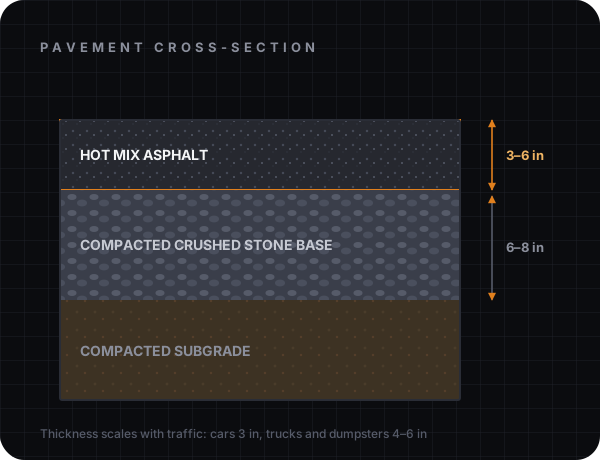
Residential driveways should have at least 2 to 3 inches of compacted HMA over a 6 to 8 inch gravel base. Parking lots need 3 to 4 inches. Roads and areas with truck traffic need 4 to 6 inches or more. Thicker asphalt lasts longer and handles heavier loads, but costs more in material.
Hot mix is produced at 275 to 325 degrees Fahrenheit, requires professional equipment to install, and lasts 15 to 20+ years. Cold mix is sold in bags at ambient temperature, can be applied by hand, and lasts months to a few years. Hot mix is for permanent paving. Cold mix is for temporary patches and pothole repairs. You cannot build a driveway or parking lot with cold mix.
Hot mix asphalt cools from laydown temperature (225°F to 275°F) to traffic-ready temperature (below 150°F) in about 30 to 90 minutes depending on air temperature, wind, layer thickness, and sun exposure. Thinner layers cool faster. On a hot, sunny day, a 2 inch lift may be ready for traffic in 30 to 45 minutes. On a cool, cloudy day, a 4 inch lift may take 90 minutes or more.
You can, but it is risky. Hot mix needs a ground temperature of at least 50°F for proper compaction. Below that, the material cools too fast for the rollers to compress the voids, resulting in a porous, weak surface that cracks early. If you must pave in cool weather, warm mix asphalt is the safer choice because it compacts at lower temperatures and has a longer working window.
One cubic yard of compacted hot mix asphalt weighs about 3,915 pounds, or approximately 1.96 tons. For ordering purposes, round up to 2 tons per cubic yard. Loose hot mix before compaction weighs about 25% less per cubic yard because it contains air voids that get compressed during rolling.
The number refers to the nominal maximum aggregate size. A 9.5mm mix uses smaller aggregate particles, producing a smoother, tighter surface ideal for top coats and driveways. A 12.5mm mix uses slightly larger aggregate, providing more structural strength and better drainage, making it the standard for parking lots and medium-traffic roads. Both weigh about the same (145 to 148 lb per cubic foot compacted). Your contractor or spec will typically call for one or the other based on the traffic load and layer position.
Yes. Asphalt is the most recycled material in the United States. According to the National Asphalt Pavement Association, about 99% of reclaimed asphalt pavement is reused. When an old road or lot is milled up, the material (called RAP or recycled asphalt millings) is crushed and mixed back into new hot mix at the plant, or used as aggregate in base layers. Using RAP reduces costs and the need for virgin aggregate.
PG 64-22 is a Performance Grade binder classification used in the Superpave mix design system. The first number (64) is the high temperature limit in Celsius, meaning the binder performs reliably up to 64°C (147°F) in summer pavement temperature. The second number (-22) is the low temperature limit, meaning the binder resists cracking down to -22°C (-8°F) in winter. PG 64-22 is the most common grade in moderate US climates. Hotter regions use higher first numbers (PG 76-22), and colder regions use lower second numbers (PG 64-28 or PG 58-34).
Enter your dimensions above and see how much hot mix asphalt you need, in tons, cubic yards, and cost. Free, instant, density-accurate.
Every number on this page follows the methodology documented on our About page: 145 lb/ft³ density per the Asphalt Institute MS-2 standard, facts cross-checked against the National Asphalt Pavement Association. Found an error? Email hello@getasphaltcalculator.com.
Last updated July 12, 2026.