One ton of hot mix asphalt covers approximately 83 square feet at 2 inches thick, 55 square feet at 3 inches, and 41 square feet at 4 inches. Coverage scales inversely with depth: double the thickness, and you cover half the area with the same ton.
One ton of hot mix asphalt covers about 83 square feet at 2 inches thick, 55 square feet at 3 inches, and 41 square feet at 4 inches. Coverage scales inversely with depth. Double the thickness and you cover half the area with the same ton, because you are spreading the same weight of material over a thinner or thicker layer.
Asphalt coverage per ton by depth
| Compacted depth | Coverage per ton (sq ft) | Coverage per ton (sq yd) | Tons per 1,000 sq ft |
|---|---|---|---|
| 1 inch | 166 sq ft | 18.4 sq yd | 6.0 tons |
| 1.5 inches | 110 sq ft | 12.2 sq yd | 9.1 tons |
| 2 inches | 83 sq ft | 9.2 sq yd | 12.1 tons |
| 3 inches | 55 sq ft | 6.1 sq yd | 18.1 tons |
| 4 inches | 41 sq ft | 4.6 sq yd | 24.2 tons |
| 6 inches | 28 sq ft | 3.1 sq yd | 36.3 tons |
If your site plan or a commercial spec sheet is in square yards rather than square feet, the middle column saves you the conversion step. For a deeper walkthrough of square yard math specifically, see the asphalt square yardage calculator.
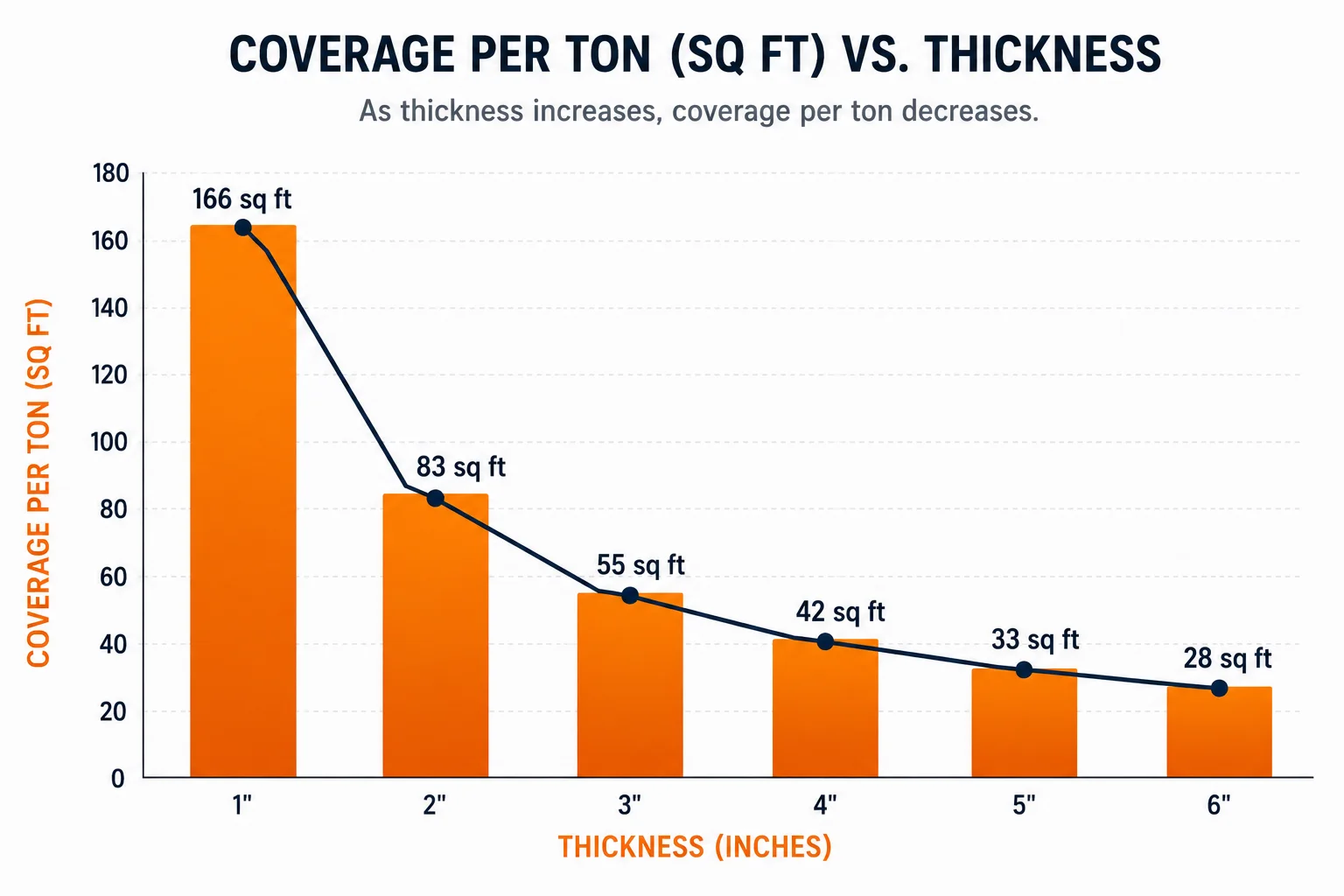
Where these numbers come from
Compacted hot mix asphalt weighs about 145 pounds per cubic foot. One ton, 2,000 pounds, is therefore 13.8 cubic feet of compacted mix. Spread 13.8 cubic feet at 2 inches (0.167 feet) deep and you cover 13.8 divided by 0.167, which comes out to about 83 square feet.
Crews often round down to about 80 square feet in the field to leave room for waste and hand work around edges, which is why you will sometimes see a slightly more conservative number quoted on a job site than what the pure math gives you. For the full explanation of the density this math is based on, including why different sources quote slightly different numbers, see our density and weight guide.
The quick formula
Coverage per ton (sq ft) is approximately 166 divided by depth in inches.
At 2.5 inches: 166 divided by 2.5 is about 66 square feet per ton. At 3.5 inches: 166 divided by 3.5 is about 47 square feet per ton. This one-line formula works for any thickness, not just the depths in the table above, so it is worth memorizing if you deal with odd or custom specs.
Flip the math around and enter your area and depth in the free asphalt calculator to get exact tonnage instead of doing it by hand.
Example: how many tons for a 20 by 30 foot pad?
A 20 by 30 foot pad is 600 square feet. At 3 inches deep, each ton covers about 55 square feet, so you need 600 divided by 55, which is about 10.9 tons. Add 5% to 10% for compaction and waste, and order 11.5 to 12 tons. To calculate your exact tonnage for a project of any shape or size, see the full formula walkthrough.
Example: how many tons for a single parking space?
A standard parking space, including its share of the drive aisle, runs about 325 square feet. At the typical 4 inch commercial thickness, each ton covers about 41 square feet, so one space needs roughly 325 divided by 41, or about 7.9 tons. For a full lot, our asphalt parking lot calculator handles the math by number of spaces instead of doing this one at a time.
What does 1 ton of asphalt actually look like?
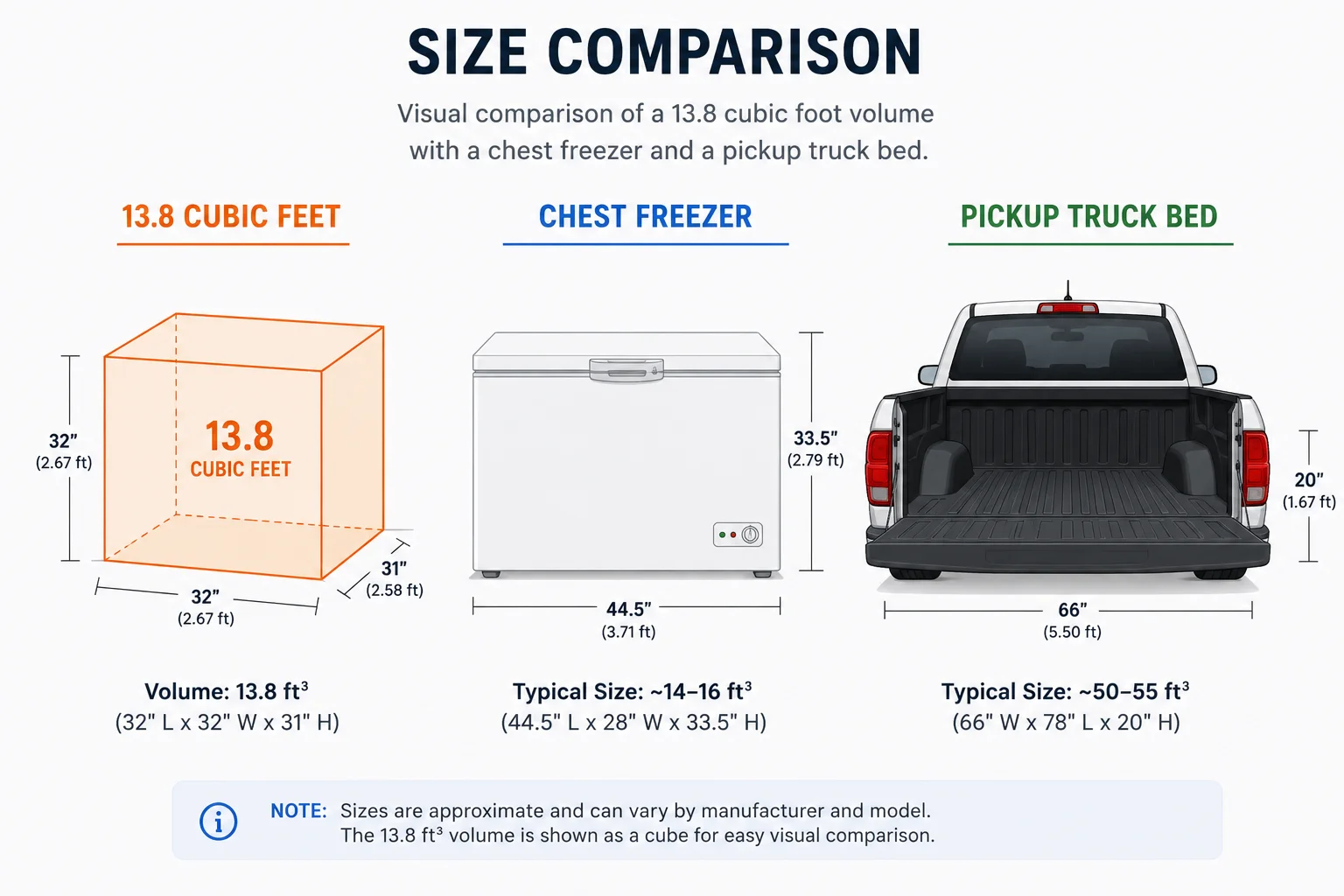
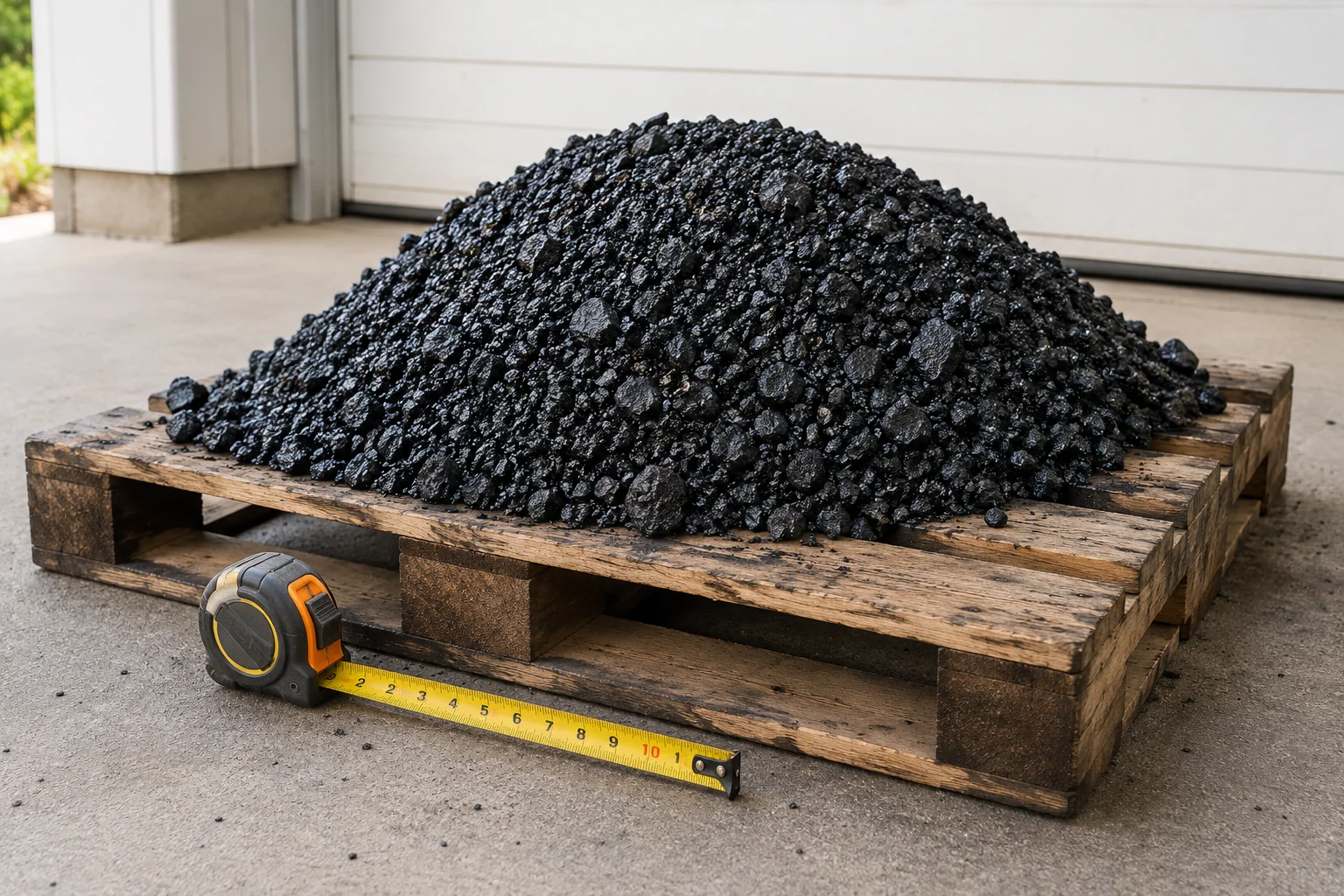
If you have never ordered asphalt before, a ton is harder to picture than it sounds. At the standard compacted density, one ton is about 13.8 cubic feet of material, roughly the volume of a large chest freezer, or a bit less than half of a standard 8 foot pickup truck bed loaded level with the rails.
Spread flat rather than piled, that same ton covers a driveway patch about the size of a one-car garage floor at 2 inches thick, or a smaller area closer to a large parking space at 4 inches. Seeing it this way helps explain why small jobs, like patching a pothole or resurfacing a short stretch, often only need a fraction of a ton, while a full driveway or lot needs a full truckload or more.
Coverage for recycled millings
Recycled asphalt millings are lighter than hot mix, at roughly 120 pounds per cubic foot compacted rather than 145. One ton of millings covers about 100 square feet at 2 inches, and since millings are usually laid 3 to 4 inches deep, real driveways typically see 50 to 65 square feet per ton.
The lighter density means a ton of millings actually stretches a little further per inch than a ton of hot mix would at the same thickness, one of the reasons millings run cheaper for a given project size on top of their lower per-ton price. More detail on pricing and installation is in our asphalt millings guide.
At a glance: coverage per ton in seven numbers
- 183 sq ft — coverage per ton at the standard 2 inch depth.
- 255 sq ft — coverage per ton at the standard 3 inch driveway depth.
- 3166 ÷ depth in inches — the one-line formula for any thickness, not just the table values.
- 413.8 cubic feet — the volume of one ton, roughly a large chest freezer or half a pickup truck bed.
- 57.9 tons — what a single 4 inch commercial parking space needs.
- 6120 lb/ft³ vs 145 lb/ft³ — recycled millings density versus hot mix, which is why a ton of millings stretches slightly further.
- 75% to 10% — the waste buffer to add on top of any coverage-table figure before ordering.
Sources and citations
- National Asphalt Pavement Association — asphaltpavement.org
- Asphalt Institute — asphaltinstitute.org
- Asphalt Calculator (internal tool)
- Asphalt Square Yardage Calculator (internal tool)
- Asphalt Parking Lot Calculator (internal tool)
- Asphalt Driveway Cost Calculator (internal tool)
- Asphalt Millings Cost (internal guide)
- How Much Does Asphalt Weigh (internal guide)
- How to Calculate Asphalt Tonnage (internal guide)
Frequently asked questions
About 83 square feet. Crews often plan on 80 square feet to allow for waste and hand work, and the free asphalt calculator adds a 5% waste allowance for you automatically.
At 2 inches, 1,000 square feet needs about 12.1 tons. At 3 inches, about 18.1 tons. At 4 inches, about 24.2 tons. Add 5% to 10% on top of any of these for waste and compaction before placing your order.
One ton of compacted hot mix asphalt is about 13.8 cubic feet, based on a standard density of 145 pounds per cubic foot. Divide 2,000 pounds (one ton) by 145 to get that figure directly.
One ton is roughly 13.8 cubic feet of material, close to the volume of a large chest freezer, or a bit under half a standard 8 foot pickup truck bed loaded level. Spread flat at 2 inches thick, that same ton covers an area close to the size of a one-car garage floor.
At 2 inches, 1 ton covers about 9.2 square yards. At 3 inches, about 6.1 square yards. At 4 inches, about 4.6 square yards. Since a square yard is 9 square feet, you can also get this by dividing the square-foot coverage figure by 9.
A standard parking space, including its share of the drive aisle, covers roughly 325 square feet. At the typical 4 inch commercial thickness, that works out to about 7.9 tons per space. Multiply by your total number of spaces for a rough lot-wide estimate, or use the asphalt parking lot calculator for an exact figure with drainage and striping included.
Yes. Millings compact to about 120 pounds per cubic foot, lighter than the 145 lb/ft³ standard for new hot mix, so a ton of millings covers slightly more area at the same thickness. One ton of millings covers about 100 square feet at 2 inches, compared to 83 square feet for hot mix at the same depth.