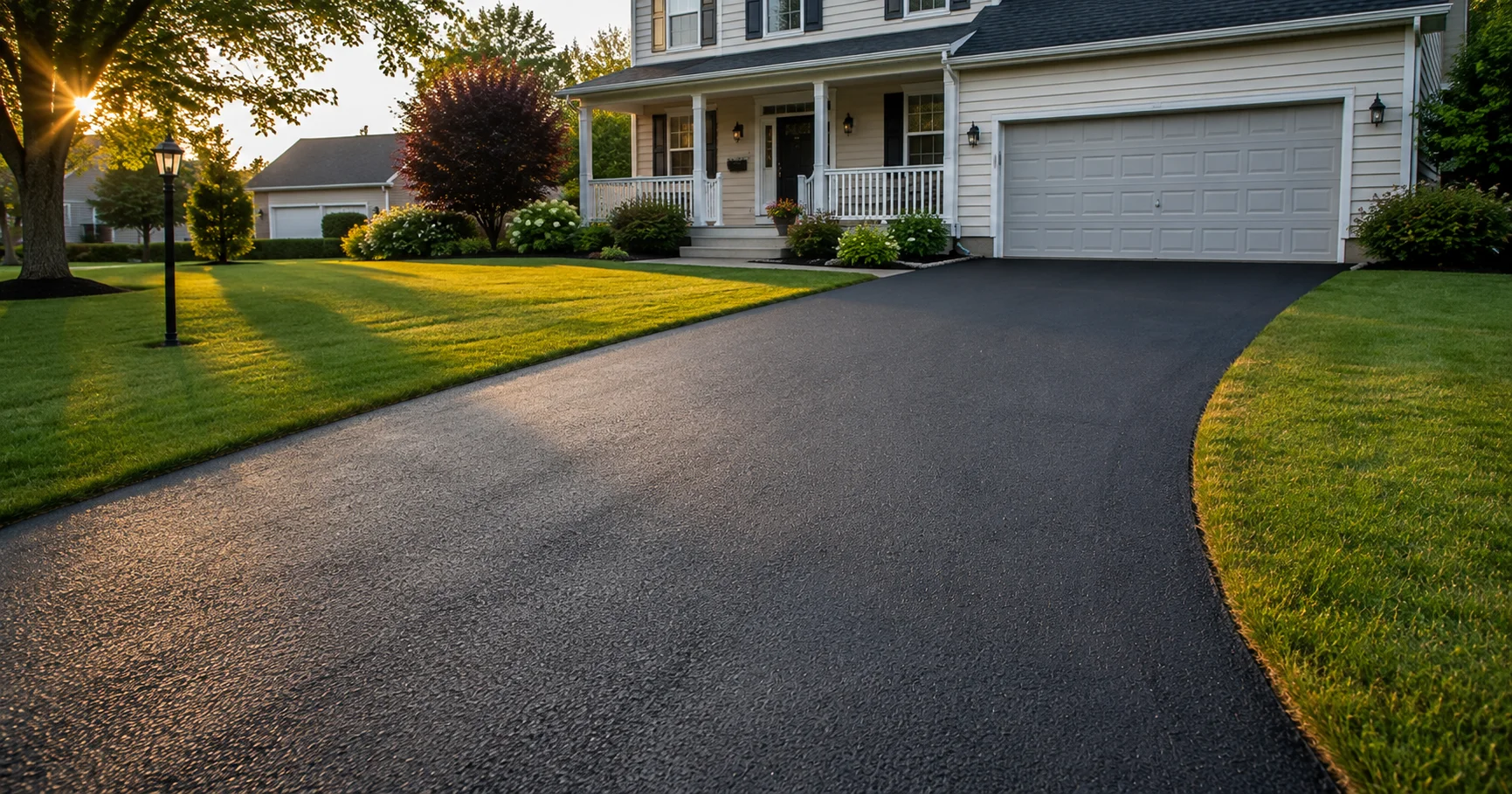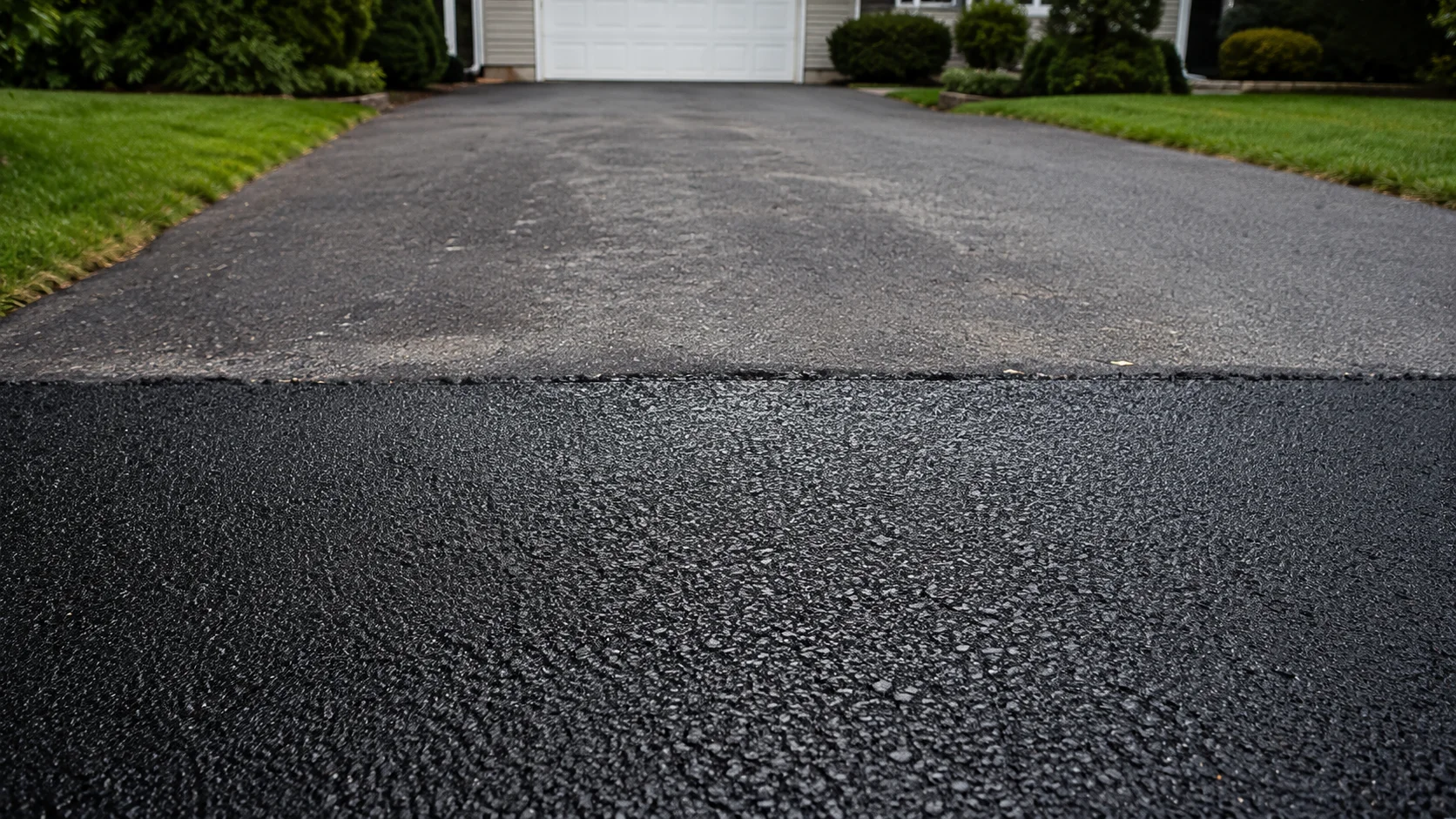
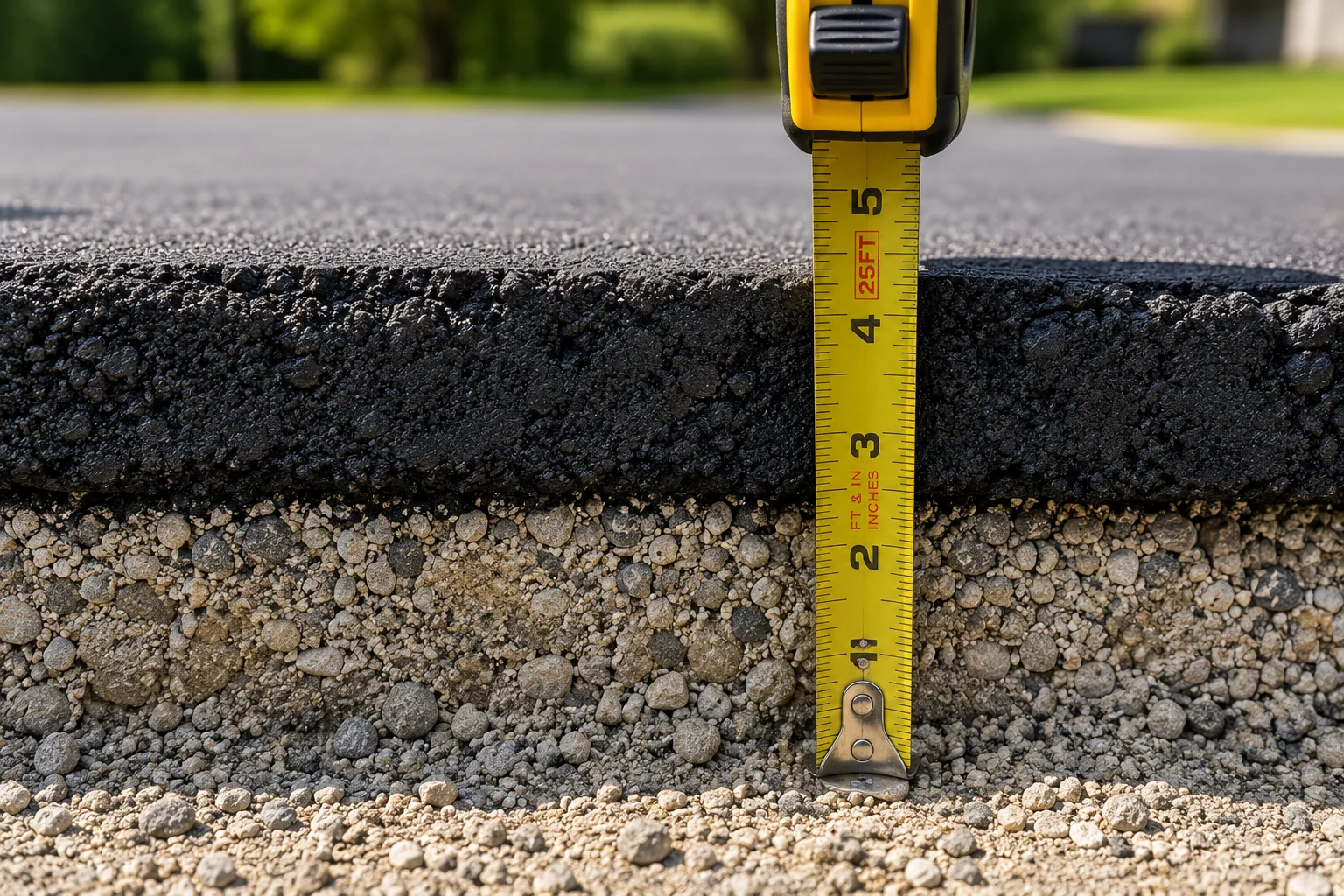
A residential asphalt driveway should be 2 to 3 inches of compacted hot mix over a 6 to 8 inch compacted gravel base. Surfaces that carry trucks or constant traffic need 4 inches or more. The base underneath matters more than the asphalt on top.
A residential asphalt driveway should be 2 to 3 inches of compacted hot mix asphalt over a 6 to 8 inch compacted gravel base. Surfaces that carry trucks or constant heavy traffic need 4 inches or more of asphalt on top of an equally deeper base.
Recommended asphalt thickness by use
| Surface | Asphalt thickness | Gravel base |
|---|---|---|
| Walkway / patio | 2 in | 4 to 6 in |
| Residential driveway (cars) | 2 to 3 in | 6 to 8 in |
| Driveway with trucks/RVs | 3 to 4 in | 8 in |
| Parking lot (cars) | 3 to 4 in | 6 to 8 in |
| Parking lot (trucks) | 4 to 6 in | 8 to 12 in |
| Local road | 4 to 6 in | 8 to 12 in |
| Highway / heavy traffic | 6 to 7 in+ | 12 in+ |
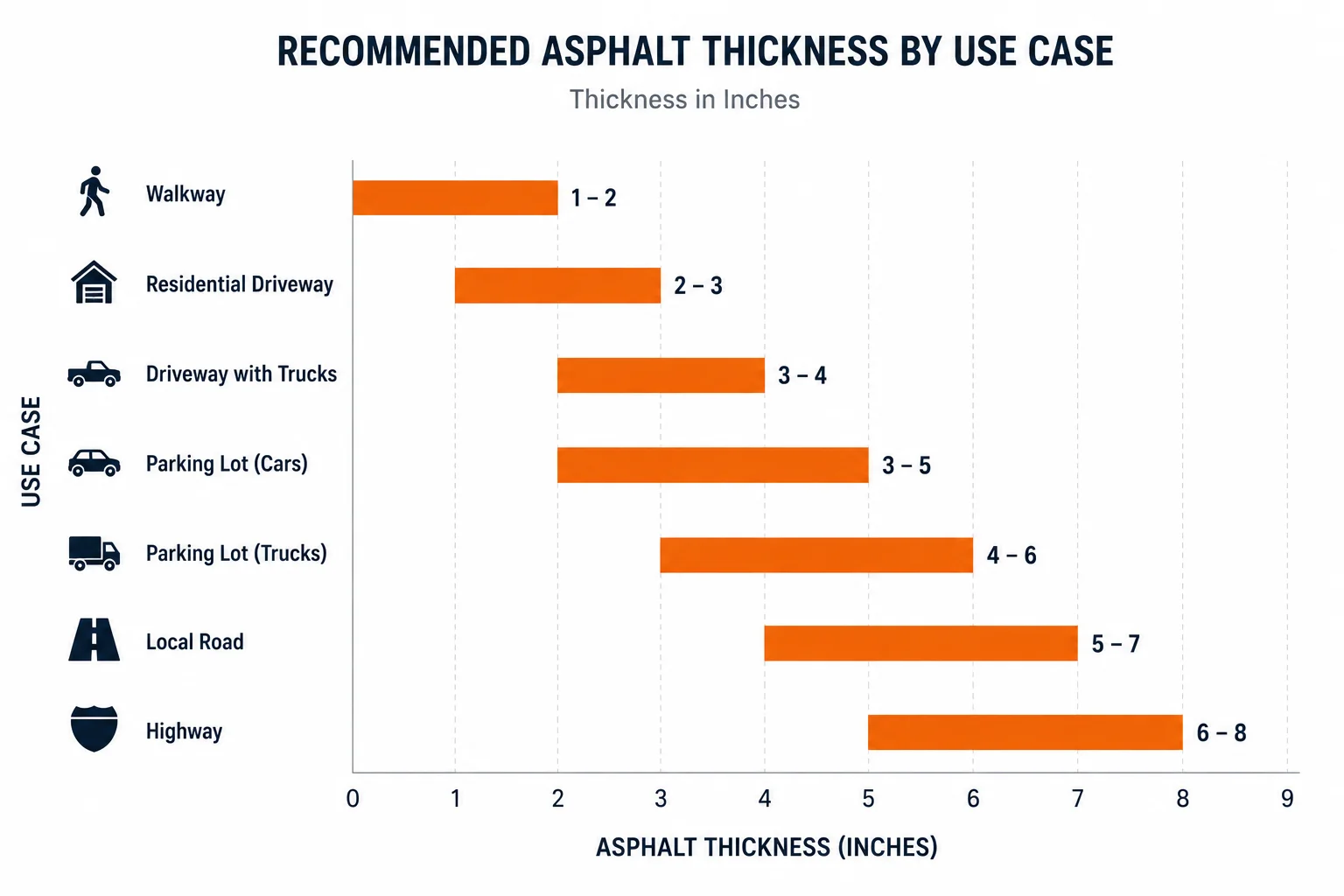
This table covers nearly every situation a homeowner or small commercial property owner will run into. If your project sits between two rows, like a driveway that occasionally sees a delivery truck but is mostly cars, lean toward the thicker option. The extra material is cheap insurance against the wheel ruts and cracking that show up first under repeated heavy loads. If you are sizing a commercial lot rather than a driveway, use the asphalt parking lot calculator directly, which sets the right thickness automatically based on your traffic type. Note that parking lots also need different cost planning than residential driveways, covered in depth in our parking lot cost guide.
Why the base matters more than the asphalt
Asphalt is a flexible pavement. It distributes load down into the base, and the base is what actually carries that weight. A 3 inch asphalt mat on a weak 3 inch base will fail years before a 2 inch mat sitting on a proper 8 inch compacted base.
If your budget forces a trade-off between paying for extra asphalt thickness or paying for a deeper, better-compacted base, put the money into the base. This is the single most common mistake in budget driveway jobs: a contractor cuts corners on base prep, which is invisible once the asphalt goes down, rather than on the asphalt itself, which is what the customer can see and measure.
Base course vs wearing course
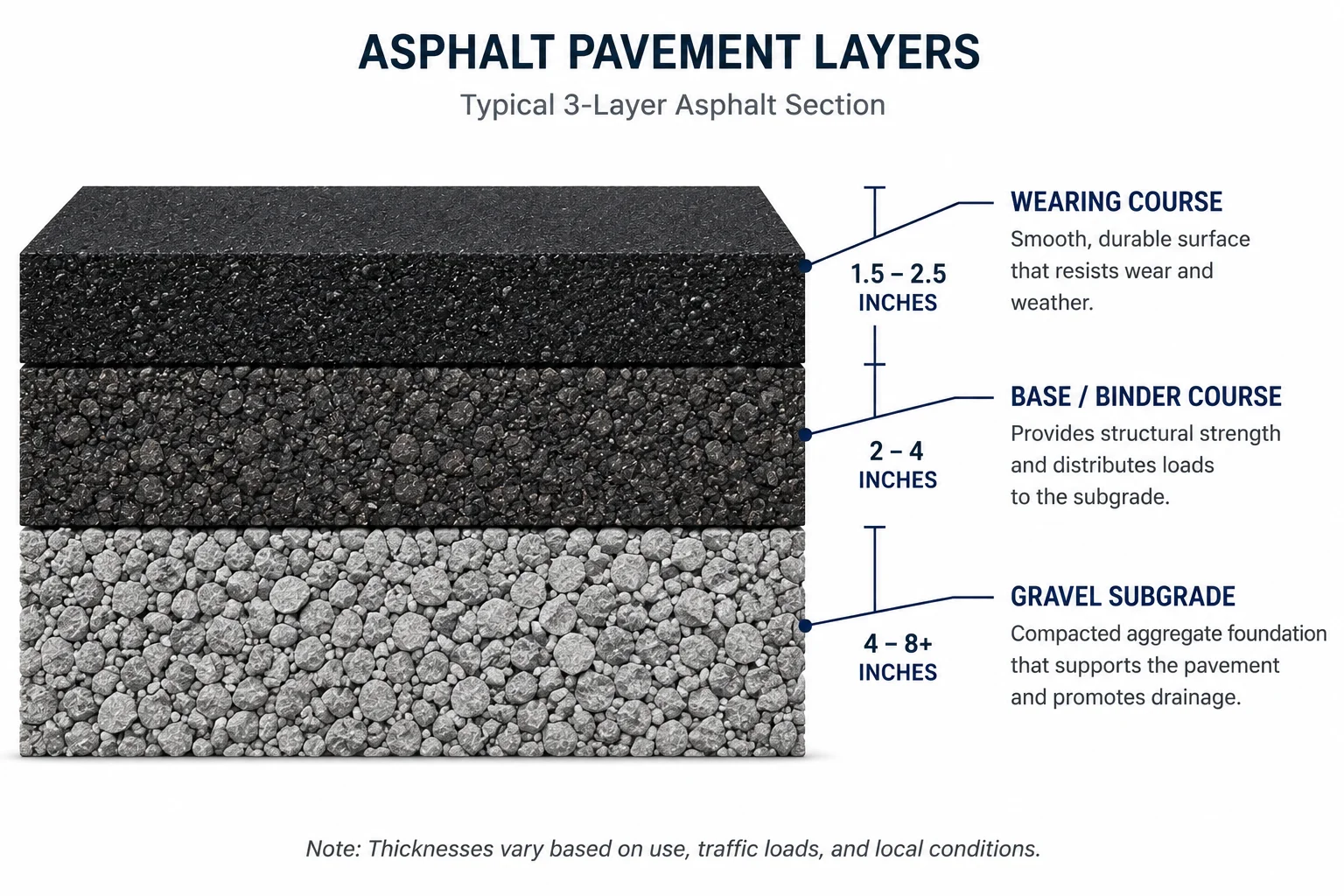
A properly built driveway is not just one slab of asphalt. It typically has two functional layers, even when poured as a single lift on a residential job.
The base course (sometimes called the binder course) sits closer to the gravel and uses a coarser aggregate mix. Its job is structural: spreading load evenly and resisting deformation under weight. The wearing course is the thin top layer that actually contacts tires, weather, and UV exposure. It uses a finer aggregate mix for a smoother, more weather-resistant surface.
On a standard 2 to 3 inch residential driveway, both functions are often combined into a single lift of a mid-grade mix. Thicker commercial and road applications separate them into distinct layers, sometimes poured on different days, because the structural and surface demands genuinely differ enough to benefit from different mix designs.
The mix type itself can shift the practical thickness slightly, too. A denser, heavier-duty mix like Stone Matrix Asphalt (SMA) carries more load per inch than a standard surface course mix, so a commercial job spec'd in SMA may hit the same structural target at a marginally lower thickness than the same job in standard hot mix. If your project spec calls out a specific mix type, the hot mix asphalt calculator lets you select it directly so your tonnage estimate matches that mix's actual density instead of the generic default.
Does climate affect driveway thickness?
Yes, mainly through the base, not the asphalt layer itself. In regions where the ground freezes deeply, water trapped in the base can freeze, expand, and heave the pavement above it, a problem called frost heave. Areas with a deep frost line need a thicker, better-draining base to keep water from sitting where it can freeze and push the surface upward.
| Region type | Approximate frost depth | Base depth recommendation |
|---|---|---|
| Deep South, Gulf Coast (minimal freeze) | 0 to 6 in | 6 in base is typically sufficient |
| Mid-Atlantic, transitional zones | 12 to 24 in | 8 in base recommended |
| Midwest, Northeast (regular hard freeze) | 30 to 48 in | 8 to 10 in base, good drainage critical |
| Northern tier, mountain regions (deep freeze) | 48 in+ | 10 in+ base, drainage and sometimes insulation board considered |
These are general regional patterns, not engineering specifications for your specific site. Local frost depth varies within a state depending on elevation, soil type, and microclimate. A local contractor or your state DOT frost depth chart will have the exact number for your area. The asphalt thickness recommendations in the table above generally hold regardless of climate. It is the base depth and drainage design that need to flex with your local frost conditions.
Compacted vs loose thickness
Asphalt compacts by roughly 25% under rolling. To end up with 3 compacted inches, crews lay about 4 loose inches before the roller passes over it.
When a contractor quotes a thickness, always ask whether it refers to compacted (finished) thickness or loose thickness before compaction. Reputable quotes always specify compacted thickness, since that is the number that actually determines how the driveway performs. A quote that only mentions loose thickness, without clarifying, is worth a follow-up question.
Rule of thumb: each compacted inch of asphalt needs about 110 pounds of hot mix per square yard. A 3 inch driveway needs roughly 330 pounds per square yard.
Pick your thickness, then let the free asphalt calculator convert it into exact tonnage and cost.
Does thicker asphalt last longer?
Up to a point, yes. Going from 2 to 3 inches on a driveway meaningfully extends life for a modest added cost. That extra inch adds about 50% more material but can add 5 to 10 years of usable life, which is a strong return for the money.
| Compacted thickness | Typical residential lifespan |
|---|---|
| 2 inches | 10 to 15 years |
| 3 inches | 15 to 20 years |
| 4 inches | 20 to 25 years |
Beyond what your actual traffic load requires, though, extra thickness buys diminishing returns. A 6 inch layer under a car-only driveway is not meaningfully more durable than a well-built 3 inch layer over a proper base, since the cars driving over it were never close to testing the structural limits of 3 inches in the first place. At that point, drainage and base quality drive longevity far more than adding still more asphalt on top.
Signs your existing driveway is too thin
- Alligator (interconnected) cracking within a few years of paving
- Wheel ruts forming where vehicles regularly park or turn
- Edges crumbling under occasional tire loads at the driveway's border
- Potholes recurring in the same spots after repeated repair attempts
If you are seeing two or more of these on a driveway under 10 years old, thickness (or base depth) is a likely root cause, not just normal wear. If your existing driveway shows these signs, the next question is whether resurfacing vs full replacement is the right fix.
Why do some contractors install thinner driveways?
The most common reason is cost, both theirs and the customer's. A thinner asphalt layer and a shallower base use less material and less compaction time, which lets a contractor quote a lower number and win the job on price. That is not automatically a red flag. Plenty of light-use driveways genuinely do fine at 2 inches over a solid base.
The actual red flag is a contractor who cuts base depth without saying so, or who cannot clearly state the compacted thickness they are quoting. Since the base is invisible once finished, that is exactly where corners get cut quietly. Ask directly, in writing, what compacted asphalt thickness and base depth you are being quoted, and be skeptical of a bid that comes in noticeably below others without a clear explanation of what is different about the spec.
At a glance: asphalt driveway thickness in seven numbers
- 12 to 3 inches — the standard compacted asphalt thickness for a car-only residential driveway.
- 26 to 8 inches — the gravel base depth that should sit beneath it. This matters more than the asphalt layer.
- 325% — how much asphalt compacts under rolling. 3 finished inches needs about 4 loose inches at laydown.
- 4110 lb — the weight of hot mix per square yard, per compacted inch of thickness.
- 550% more material, 5 to 10 more years — the real trade-off of going from 2 to 3 inches.
- 64+ inches — the floor for driveways carrying trucks, RVs, or constant heavy traffic.
- 74 signs of trouble — alligator cracking, wheel ruts, crumbling edges, and recurring potholes all point to a driveway built too thin for its load.
Sources and citations
- National Asphalt Pavement Association — asphaltpavement.org
- Asphalt Institute — asphaltinstitute.org
- Asphalt Calculator (internal tool)
- Asphalt Driveway Cost Calculator (internal tool)
- Asphalt Parking Lot Calculator (internal tool)
- Hot Mix Asphalt Calculator (internal tool)
Frequently asked questions
Two inches of compacted asphalt is the minimum for a car-only driveway, and it only works over a solid 6 to 8 inch base. Three inches is the safer standard and handles occasional heavy vehicles like a delivery truck or moving van without added risk.
Not recommended as a standalone driveway thickness. 1.5 inches falls below the accepted minimum for most residential applications and is more appropriate as a thin overlay layer on top of an existing sound surface, not as the full asphalt depth for a new driveway.
The standard is 2 to 3 inches of compacted hot mix asphalt for a residential, car-only driveway, installed over a 6 to 8 inch compacted gravel base. Three inches is the more common recommendation when the driveway will occasionally see heavier vehicles.
Car-only parking lots need 3 to 4 inches of compacted asphalt over a 6 to 8 inch base. Lots with delivery trucks, dumpster pickup, or other heavy traffic need 4 to 6 inches over an 8 to 12 inch base. Loading zones and drive-through lanes should use the higher end of that range.
Each additional inch adds roughly 50% more material on top of a 2 inch base thickness, since 110 pounds per square yard per inch scales linearly with depth. For a typical 600 sq ft driveway, going from 2 to 3 inches adds roughly $300 to $500 in material cost at 2026 pricing, a small increase relative to the years of added life it can provide.
Highway and heavy-traffic asphalt typically runs 6 to 7 inches or more, laid over a 12 inch or deeper compacted base. The exact figure varies by state DOT specification and expected traffic load, but full-depth highway construction is always substantially thicker than any residential application.
Practically, yes, in the sense of diminishing returns rather than actual harm. Once a driveway's thickness comfortably exceeds what its actual traffic load requires, additional inches add cost without adding meaningful extra lifespan, since the structural limit of the asphalt was never close to being tested by cars parking and pulling in and out. Base quality and drainage matter far more past that point.
A driveway built too thin for its traffic load typically shows alligator cracking, wheel ruts, and crumbling edges within just a few years, well short of the 15 to 20 year lifespan a properly built driveway should reach. Potholes also tend to recur in the same spots even after patching, since the underlying structural problem was never addressed by a surface repair.
Frost depth affects the base more than the asphalt layer itself. In regions with deep winter freezing, water trapped in the base can freeze and expand, heaving the pavement above it. Areas with a deep frost line typically need an 8 to 10 inch or deeper base with good drainage, compared to 6 inches in mild-climate regions. The asphalt thickness recommendation generally stays the same across climates. It is the base depth and drainage design that should adjust for local frost conditions.