Compacted hot mix asphalt weighs about 145 pounds per cubic foot, or roughly 3,915 pounds (1.96 tons) per cubic yard. Loose asphalt in the truck weighs 10% to 20% less per cubic foot until it is rolled. Every conversion on this page starts from that one number.
Compacted hot mix asphalt weighs about 145 pounds per cubic foot. That works out to roughly 3,915 pounds, or 1.96 tons, per cubic yard.
That single number is the seed for every other figure on this page. Tons per truckload, cost per ton, how far a load will stretch across your driveway. It all traces back to how much one cubic foot of asphalt weighs once it is laid down and rolled flat. If you would rather read the finished numbers off a table than derive them, the asphalt tonnage and coverage guide has them by area and depth.
Here is where people get tripped up. Type "asphalt density" into Google and you will land on pages about compaction testing, nuclear density gauges, and pavement engineering specs. That is a real topic, but it is not this one. If you are trying to figure out how many tons to order, you do not need a density gauge. You need the weight numbers below.
Asphalt weight reference table
| Quantity | Weight |
|---|---|
| 1 cubic foot (compacted) | 145 lbs |
| 1 cubic yard (compacted) | 3,915 lbs (about 1.96 tons) |
| 1 cubic meter (compacted) | 2,322 kg (about 2.32 tonnes) |
| 1 square yard at 1 inch deep | about 110 lbs |
| 1 ton of hot mix | about 13.8 cubic feet |
| 1 cubic yard, loose (in truck) | about 2,900 to 3,200 lbs |
Bookmark this table. It answers 80% of the questions people search for, and every calculator on this site runs on these same numbers.
Why does asphalt density vary? (140 to 150 lb/ft³)
Mix design changes the number, and that is normal, not a red flag. Dense-graded highway mixes with heavier aggregate run 148 to 150 lb/ft³. Finer driveway mixes sit closer to 142 to 145. Porous (open-graded) asphalt drops to 120 to 135 lb/ft³ because it is built with air voids on purpose, so water can pass through it. Recycled asphalt millings run lighter still, around 120 lb/ft³ compacted, because reclaimed material has more variability and slightly more air voids than fresh hot mix.
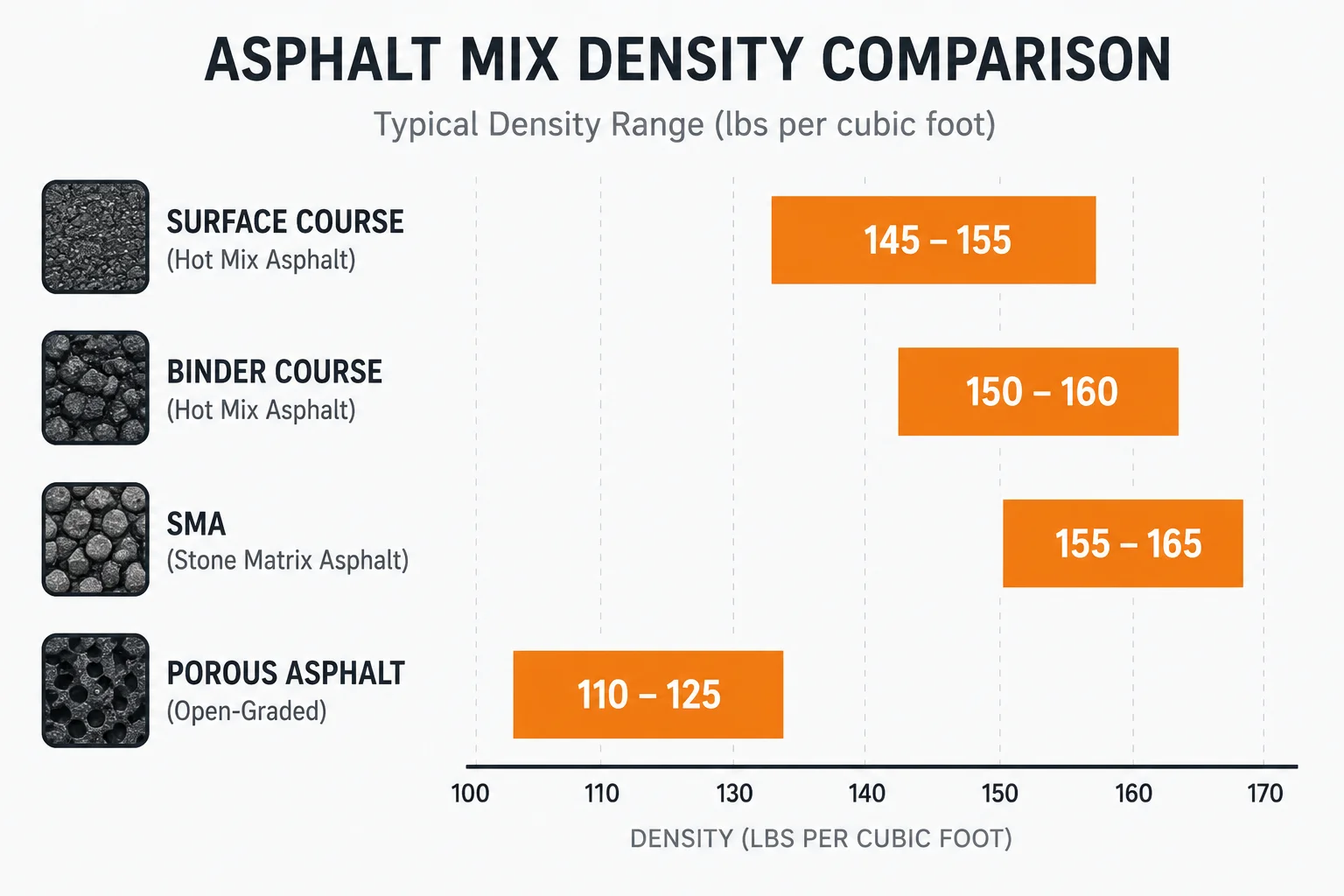
| Mix type | Density (lb/ft³) | Why it differs |
|---|---|---|
| Surface course (driveway grade) | 142 to 145 | Finer aggregate, smoother finish |
| Binder/base course | 140 to 147 | Coarser aggregate, structural layer |
| Stone Matrix Asphalt (SMA) | 148 to 155 | Denser stone skeleton, built for heavy traffic |
| Porous asphalt | 120 to 135 | Intentional air voids for drainage |
| Recycled asphalt millings (RAP) | about 120 | Reclaimed material, more variable aggregate and voids |
For planning purposes, 145 lb/ft³ is the accepted default across the industry. If your supplier gives you a mix-specific density off the job ticket, especially for DOT work or a large commercial pour, use that number instead. It will always beat a generic assumption.
If you know you are working with hot mix specifically and want tonnage tuned to your exact mix type, the hot mix asphalt calculator lets you select surface course, binder course, base course, SMA, or polymer-modified and auto-adjusts the density for you.
Why do different calculators quote different numbers?
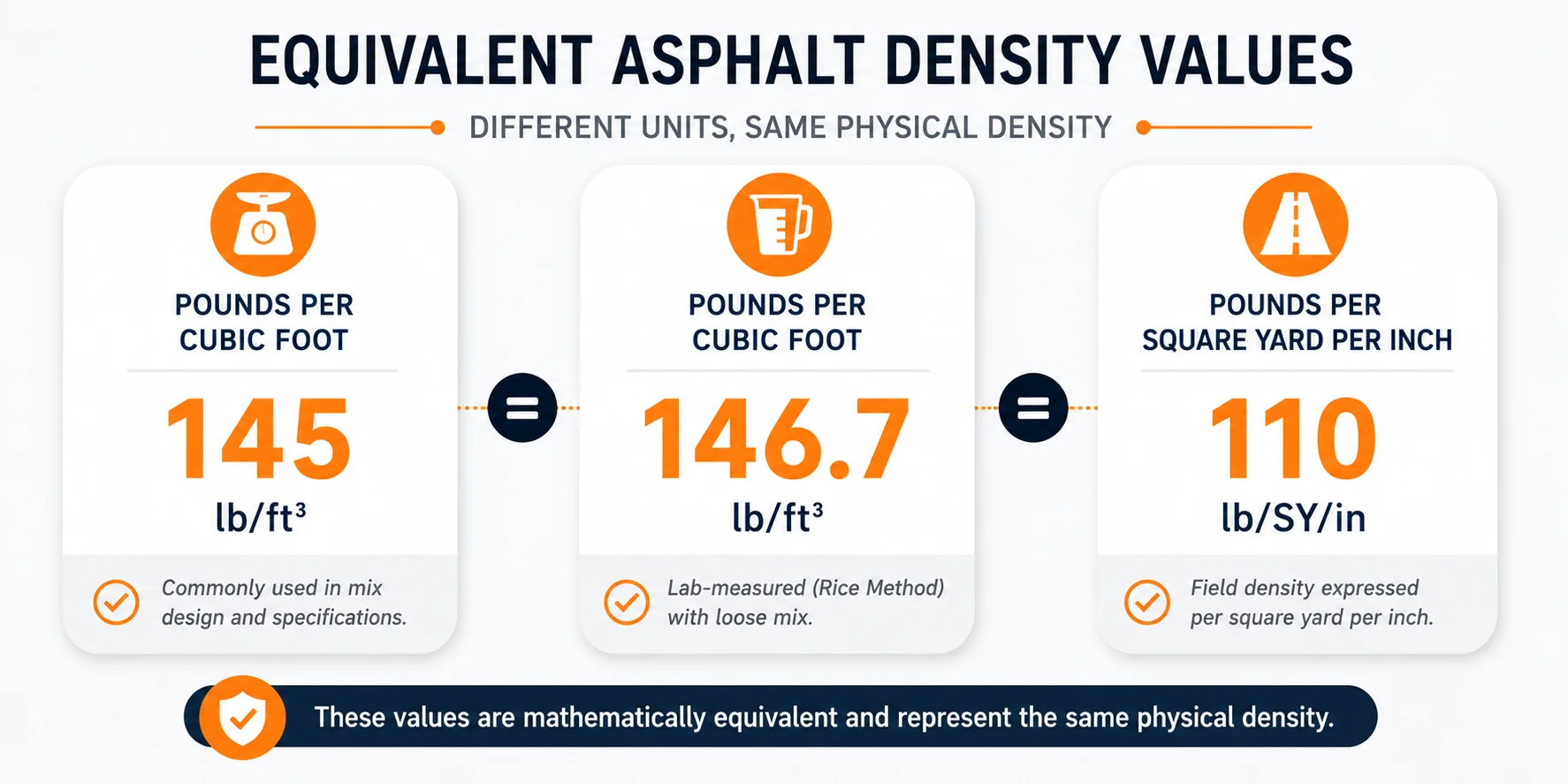
You will see 145, 146.7, and 110 lb per square yard per inch scattered across different sites and wonder which one is wrong. None of them are. They are the same physics expressed three different ways. The 110 figure is the one commercial plans use, converted step by step in square yards to tons of asphalt.
- 145 lb/ft³ is the density expressed per cubic foot.
- 146.7 lb/ft³ is a slightly denser mix assumption some calculators use as their default. It is inside the normal 140 to 150 range, just a touch higher than the 145 midpoint.
- 110 lb per square yard per inch is the same density expressed per square yard at one inch of thickness, which is how state DOTs and paving contractors often write it on a spec sheet.
Run the math and they land in the same place. A square yard is 9 square feet. At 1 inch thick (0.0833 feet), 9 square feet times 0.0833 feet is 0.75 cubic feet. Multiply 0.75 by 145 and you get about 109 pounds, which rounds to the 110 that shows up on formula sheets everywhere. It is one number wearing three outfits.
Loose vs compacted weight
Asphalt in the truck is loose, and it weighs roughly 10% to 20% less per cubic foot than it will once the roller passes over it. This trips up more first-time estimators than any other single fact on this page.
Here is the part that actually matters when you are ordering material. The plant weighs your load on a scale before it ever leaves the yard, so the tons on your ticket are real tons regardless of how loose or compacted the pile looks. What shrinks under the roller is volume, not weight. Always calculate your tonnage need from the compacted density (145 lb/ft³) and the finished, rolled thickness you want, never from how much space the loose pile takes up on the truck.
How much does asphalt weigh per square foot?
At the standard 145 lb/ft³ density, weight per square foot depends entirely on thickness.
| Thickness | Weight per sq ft | Tons per 100 sq ft |
|---|---|---|
| 1 inch | 12.1 lbs | 0.60 tons |
| 2 inches | 24.2 lbs | 1.21 tons |
| 3 inches | 36.3 lbs | 1.81 tons |
| 4 inches | 48.3 lbs | 2.42 tons |
| 6 inches | 72.5 lbs | 3.63 tons |
Multiply the per-square-foot weight by your total square footage, then divide by 2,000 to get tons. A 400 square foot driveway at 3 inches works out to about 14,520 pounds, or 7.3 tons.
For the inverse question, how much area a ton actually covers at each thickness, see how much a ton actually covers.
Common conversions
- Cubic yards to tons: multiply by 1.96 (10 yd³ is about 19.6 tons)
- Tons to cubic yards: multiply by 0.51
- Square yards to tons: square yards times depth in inches times 0.054
- Square feet to tons: square feet times depth in inches times 0.006
If your site plan or supplier quote is already in square yards, skip the manual math and use the asphalt square yardage calculator directly.
Convert any area and depth into tons instantly with the free asphalt calculator. It uses the 145 lb/ft³ standard and lets you override it with a mix-specific density if your supplier gives you one. For a full walkthrough with a worked example, see the full tonnage calculation.
How much does a truckload of asphalt weigh?
A standard tandem dump truck hauls 13 to 20 tons of hot mix. A tri-axle carries up to 22 to 25 tons where legal weight limits allow it.
That range matters for your wallet, not just your math. Plants price by the load as much as by the ton, because dispatching a truck costs roughly the same whether it hauls 8 tons or 20. Orders that land near a full-truck increment tend to price better per ton than small, partial loads, since you are covering the trip either way. If your project needs 17 tons, ordering exactly 17 might cost more per ton than rounding up to a full 20-ton tandem load. For current per-ton pricing by region and asphalt type, see the asphalt cost calculator.
Ton vs tonne: the 10% mistake
A ton (the US short ton) equals 2,000 pounds. A tonne (the metric ton, used almost everywhere outside the US) equals 2,205 pounds. That is a 10% gap, and it is an easy one to miss if you are cross-referencing a US supplier quote against a metric spec sheet or an international source.
If a number looks slightly off between two sources, check whether one of them is quietly using tonnes. It happens more often than you would expect, especially with imported equipment specs or international DOT references.
At a glance: asphalt weight in six numbers
- 1145 lb/ft³ — the compacted weight of standard hot mix asphalt, per cubic foot.
- 23,915 lb (1.96 tons) — the weight of one full cubic yard, compacted.
- 310% to 20% lighter — how much less loose asphalt weighs in the truck versus after rolling. Weight does not change; volume does.
- 4120 to 155 lb/ft³ — the full density range across mix types, from porous (lightest) to Stone Matrix Asphalt (heaviest).
- 513 to 25 tons — what a truckload carries, tandem to tri-axle.
- 62,000 lb vs 2,205 lb — a US ton versus a metric tonne. A 10% gap worth double-checking on any international spec.
Sources and citations
- National Asphalt Pavement Association — asphaltpavement.org
- Asphalt Institute — asphaltinstitute.org
- Federal Highway Administration, Pavement Density — fhwa.dot.gov
- Asphalt Calculator (internal tool)
- Asphalt Square Yardage Calculator (internal tool)
- Asphalt Driveway Cost Calculator (internal tool)
- Asphalt Cost Per Ton Calculator (internal tool)
- Hot Mix Asphalt Calculator (internal tool)
Frequently asked questions
Compacted hot mix asphalt weighs about 145 pounds per cubic foot. Real-world density ranges from 140 to 150 lb/ft³ depending on the specific mix design, with porous asphalt running lighter (120 to 135 lb/ft³) due to intentional air voids for drainage.
One cubic yard of compacted hot mix asphalt weighs about 3,915 pounds, approximately 1.96 US tons. Loose in the truck, before compaction, it weighs closer to 2,900 to 3,200 pounds per cubic yard.
Multiply your area in square feet by the thickness in feet, then multiply by 145 pounds per cubic foot, then divide by 2,000. A 400 square foot driveway at 3 inches (0.25 feet) needs about 3.6 tons before waste. Add 5% to 10% for compaction loss and spillage.
At the standard 145 lb/ft³ density, one square foot of asphalt weighs about 12.1 pounds per inch of thickness. At 2 inches, that is 24.2 pounds per square foot. At 3 inches, 36.3 pounds. Multiply by your total area and divide by 2,000 to convert to tons.
A standard tandem dump truck hauls 13 to 20 tons of hot mix asphalt. A tri-axle truck can legally carry up to 22 to 25 tons in most states. Orders near a full-truck increment typically price better per ton, since dispatch cost is roughly fixed per trip.
Compacted hot mix asphalt has a density of about 2,322 kg/m3, which is the metric equivalent of 145 lb/ft3. One cubic meter of compacted asphalt weighs approximately 2.32 metric tonnes.
Numbers like 145, 146.7, and 110 lb per square yard per inch all describe the same asphalt density, just expressed in different units or rounded slightly differently. Run a 110 lb per square yard per inch figure through the math (a square yard at 1 inch is 0.75 cubic feet) and you land at about 109 pounds per cubic foot, which rounds to the same 145 lb/ft3 standard. They are not contradictory numbers, they are the same physics written three ways.
Loose asphalt straight off the truck weighs about 10% to 20% less per cubic foot than the same material after it has been rolled and compacted. The plant weighs your load on a scale before it leaves, so the tonnage on your ticket is accurate regardless of how loose the pile looks. It is volume that shrinks under the roller, not weight.
A ton (the US short ton) equals 2,000 pounds. A tonne (the metric ton) equals 2,205 pounds, about 10% heavier. If you are comparing a US supplier quote to an international spec sheet or imported equipment documentation, always confirm which unit is being used before you order.
One ton of compacted hot mix asphalt is about 0.51 cubic yards. To convert tons to cubic yards, multiply the tonnage by 0.51. To go the other direction, multiply cubic yards by 1.96 to get tons.
Finer surface-course mixes (like 9.5mm or 12.5mm nominal aggregate) run 142 to 148 lb/ft3. Coarser binder and base course mixes with larger aggregate (19mm to 37.5mm) run 140 to 147 lb/ft3. Stone Matrix Asphalt, built with a denser stone skeleton for heavy traffic, runs heavier at 148 to 155 lb/ft3. Porous mixes are the lightest at 120 to 135 lb/ft3 due to their open, water-permeable structure.
Recycled asphalt millings (RAP) weigh about 120 pounds per cubic foot compacted, lighter than fresh hot mix asphalt's 145 lb/ft3. The lower density comes from the variability in reclaimed aggregate and slightly higher air void content. If you are ordering RAP for a base layer or budget driveway surface, use the lighter density when calculating tonnage, or ask your supplier for the specific density of the reclaimed material.