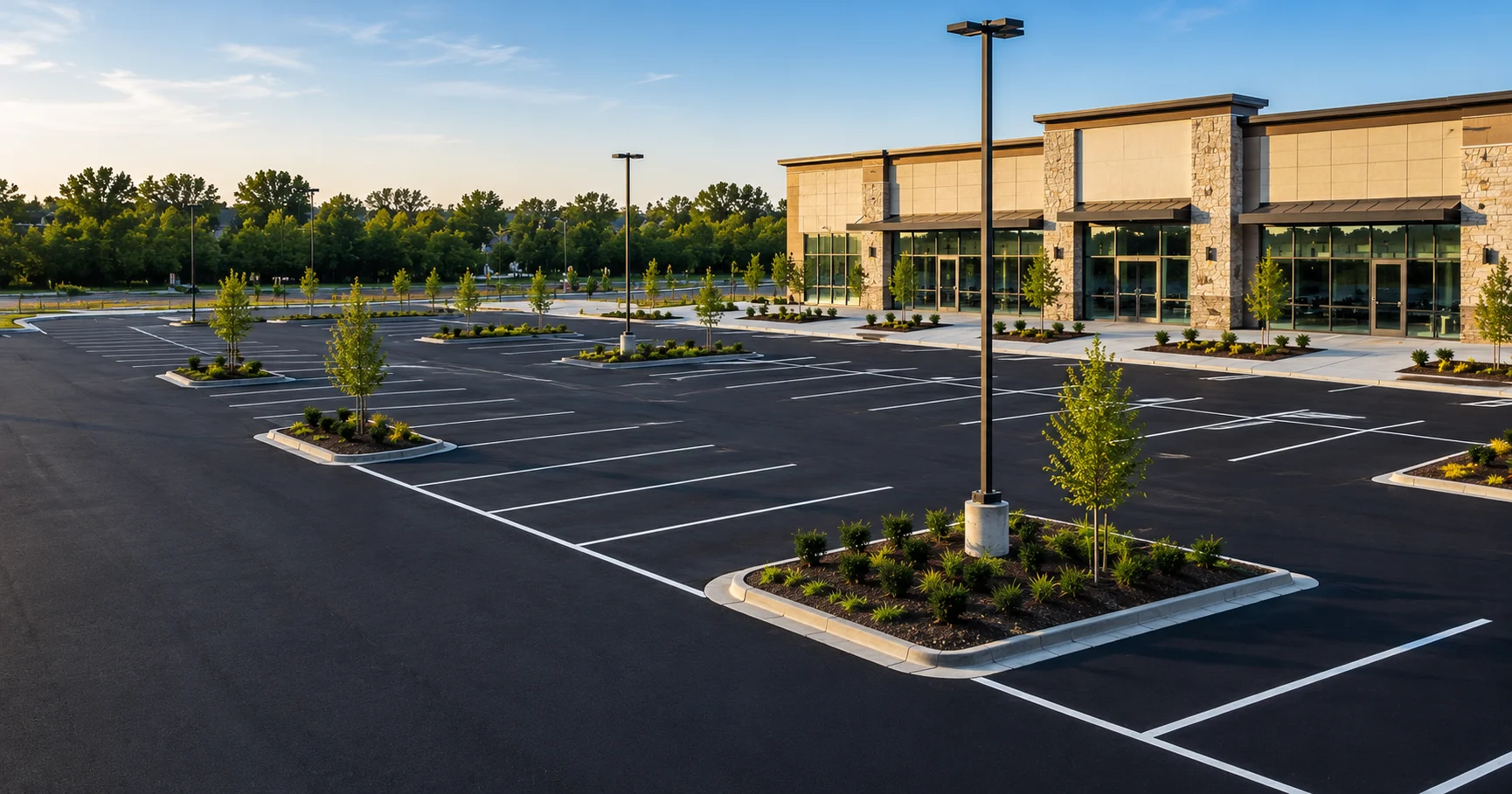
A new asphalt parking lot runs $3 to $7 per square foot in 2026, or roughly $1,000 to $2,500 per parking space. But paving is only 50% to 65% of what you will actually spend. Drainage, striping, lighting, and ADA compliance push most real projects to $4.50 to $12 per square foot.
A new asphalt parking lot costs $3 to $7 per square foot to pave in 2026, including base work, 3 to 4 inches of hot mix, and compaction. With each parking space consuming roughly 300 to 350 square feet once you count drive aisles, that works out to about $1,000 to $2,500 per space.
That is the number most articles give you, and it is where most articles stop.
Here is the part that costs property owners real money. Paving is only 50% to 65% of a finished parking lot project. The rest goes to drainage, striping, lighting, curbing, landscaping, and ADA compliance. So the owner who budgets $175,000 for paving and then gets handed a $300,000 total is not being cheated. They budgeted one line item and called it a project.
This guide breaks down every line, so you can read a quote instead of just reacting to it.
Parking lot cost by size
| Lot size | Approx. area | Typical paving cost |
|---|---|---|
| 10 spaces | 3,500 ft² | $10,500 to $24,500 |
| 25 spaces | 8,750 ft² | $26,000 to $61,000 |
| 50 spaces | 17,500 ft² | $52,500 to $122,500 |
| 100 spaces | 35,000 ft² | $105,000 to $245,000 |
| 300 spaces | 105,000 ft² | $315,000 to $735,000 |
New construction on unprepared ground lands at the top of these ranges. Overlays on an existing sound lot can drop below them.
Notice something about the big lots. A 300 space lot does not cost 30 times what a 10 space lot costs, even though it covers 30 times the area. Mobilization is why. Getting the paver, the rollers, the crew, and the trucks to your site costs roughly the same whether they pave 3,500 square feet or 105,000. On a small lot that fixed cost can add $1 to $2 per square foot. On a large lot it disappears into rounding.
If you are close to a size threshold, ask your contractor what happens to the per-foot price if you expand. Sometimes a bigger lot is cheaper per space.
Cost breakdown per square foot
| Line item | Cost per ft² |
|---|---|
| Grading and base (6 to 8 in gravel) | $1.00 to $2.50 |
| Asphalt material (3 to 4 in) | $1.20 to $2.20 |
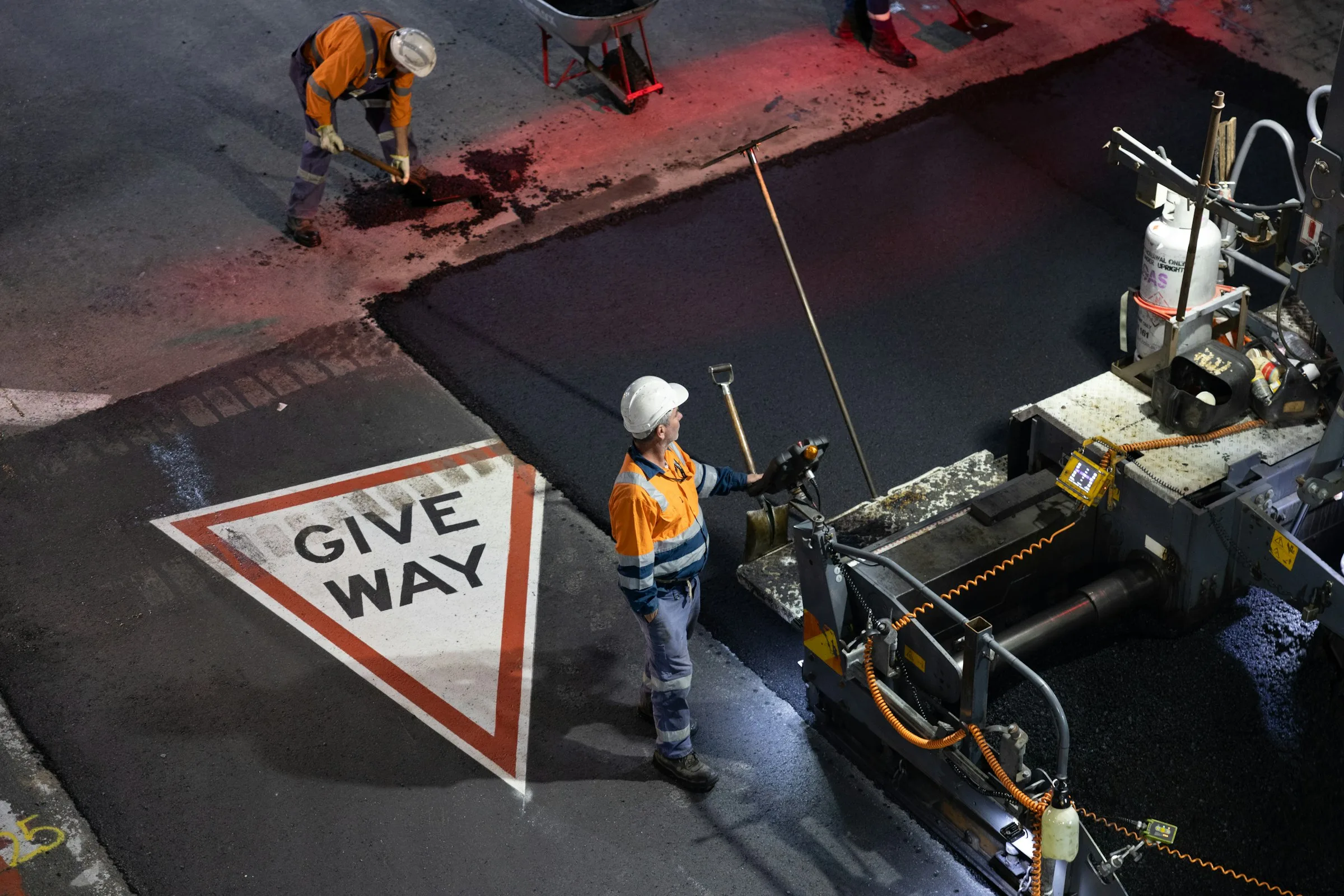
| Paving labor and equipment | $0.80 to $2.00 |
| Striping and signage | $0.10 to $0.30 |
| Sealcoating (optional, year 2+) | $0.15 to $0.40 |
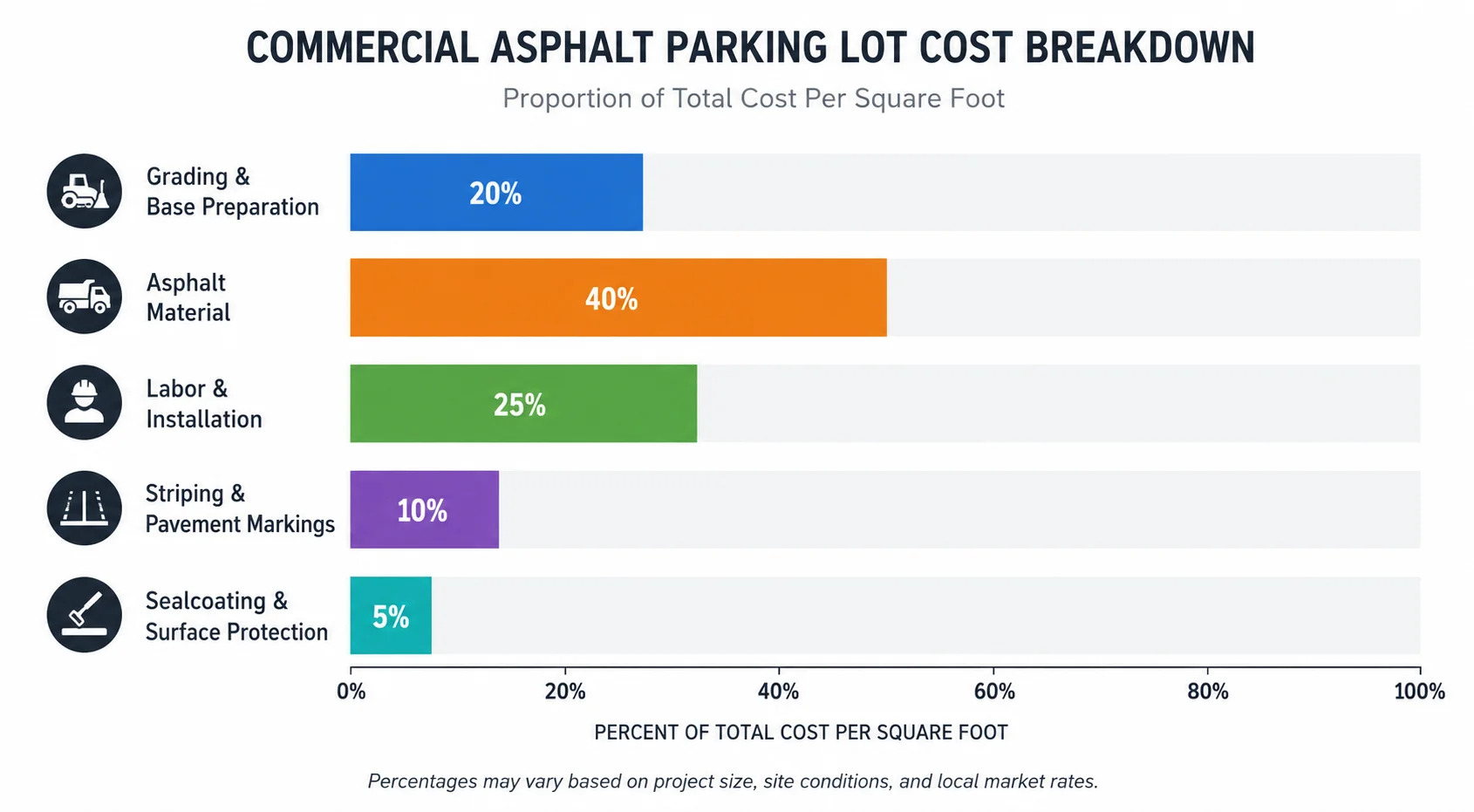
Add those up and a basic lot lands in the $3 to $7 range. Now add the items that basic pricing leaves out.
The add-ons that turn a $3 lot into a $10 lot
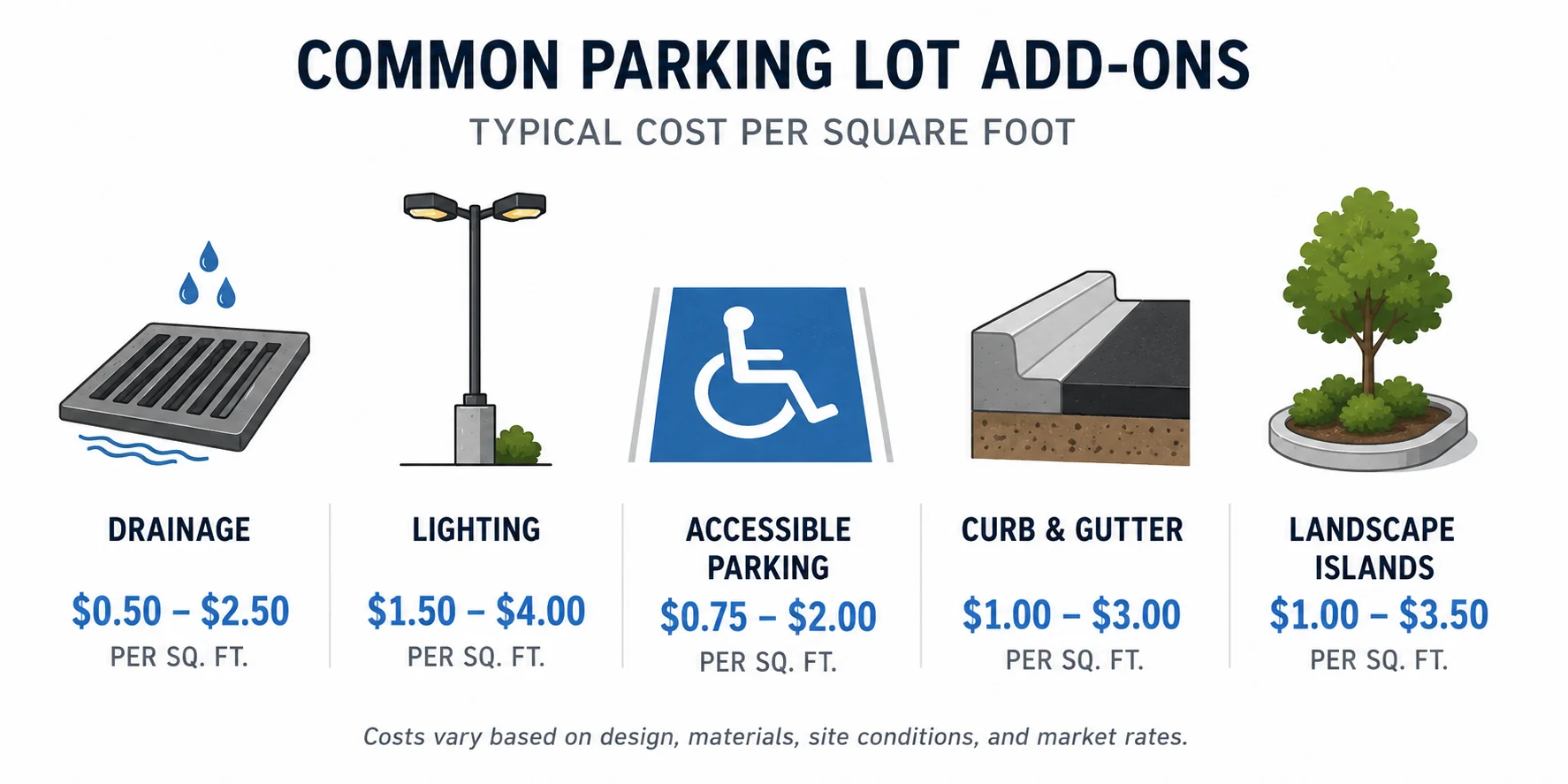
Most cost guides quote you the paving number and go quiet. These are the line items that actually blow up budgets.
Drainage: $0.75 to $5.00 per ft²
Basic catch basins and pipe sit at the low end. A full system with detention runs to the top. Most jurisdictions require engineered drainage on lots over an acre. And this is not a place to cut. Standing water attacks the base from below, and a lot with bad drainage loses 40% to 50% of its service life.
Lighting: $0.50 to $1.50 per ft²
A 100 space lot typically needs 8 to 12 poles at $3,000 to $6,000 each installed. LED cuts energy cost by half or more against metal halide, and it makes your security cameras usable at night, which the old orange sodium fixtures never really did.
ADA compliance: $0.15 to $0.40 per ft²
Accessible stalls, van accessible stalls, signage, curb ramps, detectable warnings, and a compliant accessible route. Federal minimums require one accessible space for every 25 spaces. Retrofitting compliance later costs far more than building it in, so do not treat this as optional.
Curbing and barriers: $0.25 to $0.50 per ft²
Concrete curb runs $12 to $25 per linear foot. Wheel stops are $50 to $100 each. Bollards run $300 to $800 each.
Landscaping and islands: $0.25 to $0.50 per ft²
Many municipalities require 5% to 10% of lot area as landscaped island. Budget $2,000 to $5,000 a year to maintain it.
Stack the required ones onto your paving cost and you land at $4.50 to $12 per square foot for a real commercial build. That gap between $3 and $12 is not contractors gouging you. It is scope.
How much asphalt does a parking lot need?
Car only lots are paved 3 to 4 inches thick. Areas that carry delivery trucks, dumpsters, or fire lanes need 4 to 6 inches, sometimes more.
At 3 inches, every 1,000 ft² of lot consumes about 18 tons of hot mix. So a 50 space lot at 17,500 ft² eats roughly 320 tons.
| Traffic type | Asphalt thickness | Base thickness | Typical use |
|---|---|---|---|
| Light, cars only | 3 inches | 6 to 8 inches | Small office, church, low traffic retail |
| Standard mixed | 4 inches | 8 inches | Most retail, restaurant, medical office |
| Heavy or delivery | 5 to 6 inches | 8 to 12 inches | Loading zones, dumpster pads, drive-through |
| Truck traffic | 6 inches or more | 10 to 12 inches | Warehouse, distribution, heavy equipment |
Thickness is where a suspiciously cheap bid usually hides. Cutting the asphalt from 4 inches to 3, or the base from 8 inches to 4, drops the quote noticeably and shortens the lot's life by years. If one bid comes in far under the others, do not assume you found a bargain. Compare the spec sheets, not the totals. For the same base-matters-more logic applied to residential driveways, see our asphalt driveway thickness guide.
If your job spec calls for a specific commercial mix, the hot mix asphalt calculator lets you select the mix type directly so your tonnage estimate reflects that mix's actual density instead of the generic default.
Enter your lot dimensions in the free asphalt parking lot calculator to get exact tonnage and cost before you call a single contractor.
Asphalt parking lot cost by region
Where you build changes the price more than most owners expect. Labor rates, refinery distance, and local regulation all move the number.
| Region | Paving only (per ft²) | With required add-ons | 100 space lot |
|---|---|---|---|
| Gulf Coast (TX, LA, MS) | $2.50 to $5.50 | $3.75 to $8.50 | $131K to $298K |
| Southeast (FL, GA, NC, SC, TN) | $3.00 to $6.00 | $4.00 to $9.00 | $140K to $315K |
| South Central (OK, AR) | $2.50 to $5.50 | $3.75 to $8.50 | $131K to $298K |
| Midwest (OH, MI, IL, IN, WI) | $3.00 to $6.50 | $4.50 to $9.50 | $158K to $333K |
| Mountain West (CO, AZ, NV, UT) | $3.00 to $7.00 | $5.00 to $10.00 | $175K to $350K |
| Mid-Atlantic (PA, VA, MD, NJ) | $3.50 to $7.50 | $5.50 to $11.00 | $193K to $385K |
| Northeast (NY, MA, CT, RI) | $4.00 to $8.00 | $6.25 to $12.00 | $219K to $420K |
| West Coast (CA, WA, OR) | $4.50 to $9.00 | $6.50 to $12.50 | $228K to $438K |
Gulf Coast states sit next to the refineries that produce asphalt binder, so their material lands cheaper before a single laborer swings a tool. A Northeast owner can pay 25% more than a Southeast owner for a functionally identical lot.
Material pricing shifts too. Hot mix runs $100 to $150 per ton nationally in 2026, and you can check current rates in our asphalt price index, which tracks per-ton pricing by state and region.
Asphalt or concrete: which is actually cheaper?
| Factor | Asphalt | Concrete |
|---|---|---|
| Installed cost per ft² | $3 to $8 | $6 to $12 |
| 100 space lot | $105K to $280K | $210K to $420K |
| Lifespan | 15 to 25 years | 25 to 40 years |
| Maintenance | Sealcoat every 2 to 3 years | Minimal, joint sealing |
| Repair | Simple, fast, cheap, blends in | Hard, slow, patches stay visible |
| Freeze and thaw | Flexes with ground movement | Cracks, heaves |
| Extreme heat | Can soften | Excellent |
Asphalt costs 40% to 60% less upfront. Concrete lasts longer and needs less attention.
Run it over 30 years and the gap narrows more than people expect. Concrete lands around $0.30 to $0.40 per square foot per year. Asphalt, including one mid life resurfacing, lands around $0.35 to $0.50. Close enough that the decision usually comes down to climate and cash flow, not lifetime math.
In freeze and thaw country, asphalt is generally the smarter build because it moves with the ground instead of fighting it. In hot climates with heavy truck traffic, concrete earns its premium.
Overlay vs full reconstruction
If the existing lot drains well and shows only surface cracking, a 1.5 to 2 inch overlay at $1.50 to $3.50 per square foot buys 10 to 15 more years for about a third of reconstruction cost.
Widespread alligator cracking, standing water, or base pumping means reconstruction. An overlay laid over a failed base is money burned. You are putting a fresh surface on a foundation that is already moving, and it will telegraph those same cracks back through the new asphalt within a couple of seasons.
The test is simple. Is the problem on the surface, or underneath it? Surface problems take an overlay. Base problems take a rebuild.
Permits and zoning for parking lots
New parking lot construction and lot expansions almost always require permits. This is one of the most commonly forgotten line items in a first-time property owner's budget, and it is not optional the way some add-ons are.
When a permit is required: new construction on vacant land, expansion of an existing lot, and major grading changes all trigger permit review. Simple resurfacing or a like-for-like overlay with no grade changes typically does not require one, but confirm with your local building department before assuming.
Typical cost and timeline: a commercial site plan review and grading permit runs $500 to $5,000 depending on the municipality and lot size, with larger cities toward the top of that range. Approval typically takes 4 to 12 weeks, longer if a planning board hearing or environmental review is triggered.
Stormwater management: many municipalities require a formal stormwater management plan for new impervious surface, which can mean retention ponds, permeable pavers on a portion of the lot, or bioswales. Budget $1 to $4 per square foot for this when it applies, and treat it as a line item to ask about explicitly, since it rarely shows up in a paving-only quote.
ADA compliance is federal, not local. Every commercial parking lot must meet ADA requirements regardless of whether a local permit is pulled. Non-compliance exposes an owner to federal fines and private lawsuits, which is why the ADA line item in the add-ons section above is never optional.
Fold expected permit costs and timeline into your project schedule from day one. A lot that is otherwise ready to bid can sit for two to three months waiting on approvals, and that delay costs money even before the first truck shows up.
Maintenance budget owners forget
- Crack sealing, every year: $0.10 to $0.20 per ft² of affected area
- Sealcoating, every 2 to 3 years: $0.15 to $0.40 per ft²
- Restriping, every 2 to 4 years: $4 to $6 per stall
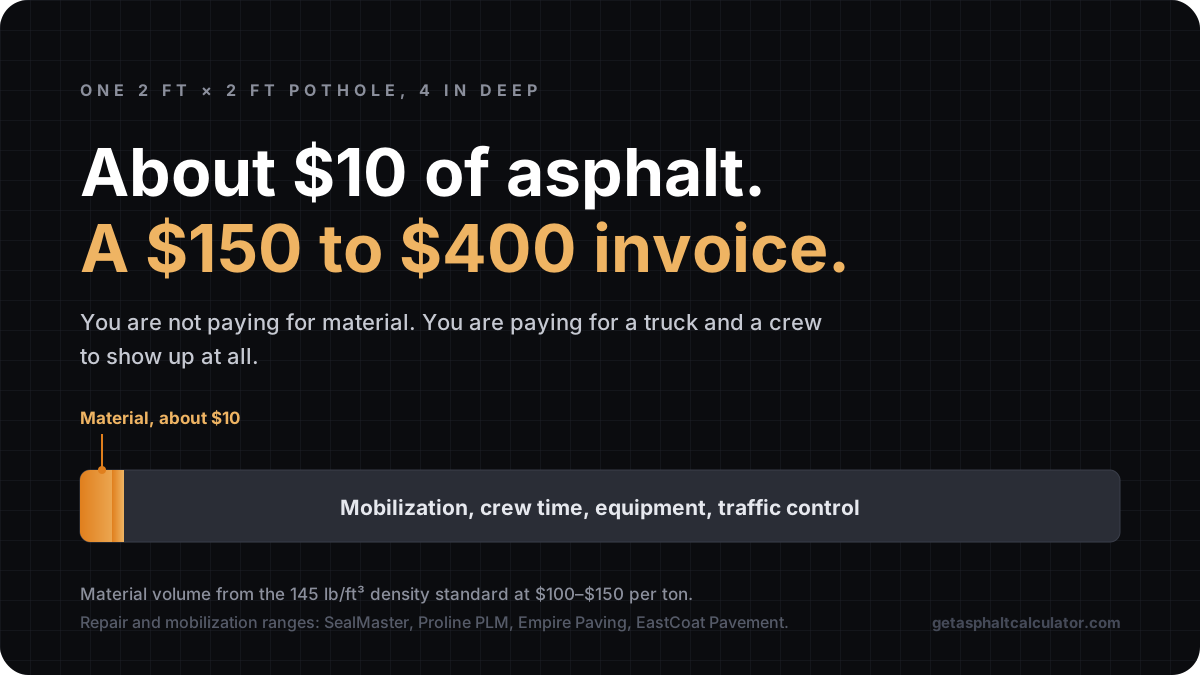
- Pothole patching, as needed: $50 to $300 per patch
Budget roughly 3% to 5% of the original paving cost per year and the lot will reach its full 20 to 30 year design life.
Skip it and you will not get 20 years. You will get 8 to 12, and then you will pay for the whole thing again. Water is the enemy. Every crack you leave open is a channel straight to the base, and once the base goes soft, the surface above it has nothing left to stand on.
How to read a parking lot bid
Four things separate a fair quote from a bad one.
Make them itemize. Material, base, labor, striping, drainage, removal, and each add-on should be its own line. A single lump sum makes comparison impossible, which is sometimes the point.
Compare specs, not totals. Two bids at different prices might be quoting different lots. Check asphalt thickness and base depth on both before you decide one is expensive.
Get three bids. Real world spread between contractors on identical scope runs 30% to 50%. Two bids tell you nothing. Three tell you where the market actually is.
Ask what is excluded. Permits, soil stabilization, utility relocation, and stormwater compliance are the four costs that most commonly appear after signing. Poor soil alone can add $1.50 to $4.00 per square foot. A soil test up front runs $1,000 to $3,000 and is the cheapest insurance in the whole project.
And build in a contingency of 15% to 20%. Not because your contractor is unreliable, but because nobody can see what is under the ground until they open it up.
One more lever worth asking about: if the base layer needs work, ask whether recycled asphalt millings are an option for the sub-base. Millings run a fraction of the cost of virgin aggregate and are a legitimate way to bring a bid down without touching asphalt thickness or drainage, the two places you never want to cut.
At a glance: asphalt parking lot cost in eight numbers
- 1$3 to $7 per sq ft — basic new paving cost in 2026, before add-ons.
- 2$4.50 to $12 per sq ft — the realistic full-build number once drainage, lighting, ADA, curbing, and landscaping are added.
- 350% to 65% — the share of a real project budget that paving actually represents. The rest is scope most guides skip.
- 4$1,000 to $2,500 — cost per parking space, at 300 to 350 sq ft per space including drive aisle.
- 518 tons per 1,000 sq ft — hot mix needed at the standard 3 inch thickness.
- 625% — how much more a Northeast owner pays than a Gulf Coast owner for a functionally identical lot.
- 730% to 50% — the normal spread between contractor bids on the exact same scope. Get three quotes, not two.
- 83% to 5% annually — the maintenance budget that gets a lot to its full 20 to 30 year design life instead of failing at year 10.
Sources and citations
- National Asphalt Pavement Association — asphaltpavement.org
- Asphalt Institute — asphaltinstitute.org
- HomeAdvisor, Asphalt Parking Lot Cost — homeadvisor.com
- Angi, Cost to Pave a Parking Lot Price Guide 2026 — angi.com
- HomeGuide, Cost to Build a Parking Lot 2026 — homeguide.com
- Asphalt Price Index (internal)
- Asphalt Parking Lot Calculator (internal tool)
- Asphalt Millings Cost (internal guide)
Frequently asked questions
Between $3 and $7 per square foot in 2026 for standard new paving, covering base, 3 to 4 inches of asphalt, and compaction. Overlays on a sound existing lot run $1.50 to $3.50 per square foot. Full commercial builds with drainage, lighting, and ADA compliance reach $4.50 to $12 per square foot.
A single asphalt parking space costs $1,000 to $2,500 in 2026. That covers the stall itself plus its share of the drive aisle, at roughly 300 to 350 square feet per space. ADA accessible spaces cost 20% to 40% more because they are wider and require access aisles and signage.
At 3 inches thick, one standard parking space of about 325 square feet needs roughly 5.9 tons of hot mix. A 50 space lot at 17,500 square feet consumes about 320 tons. Add 5% to 10% for waste and compaction before ordering.
Most commercial parking lots need 4 inches of compacted asphalt over an 8 inch crushed stone base. Light traffic lots can use 3 inches. Loading zones, dumpster pads, and truck lanes need 5 to 6 inches or more. Thin asphalt is the most common reason parking lots fail early.
An asphalt parking lot lasts 20 to 30 years with proper maintenance, or 15 to 25 years under heavy traffic. Sealcoating every 2 to 3 years and prompt crack sealing push it toward the upper end. Without maintenance, expect 8 to 12 years before major failure.
Asphalt costs 40% to 60% less upfront, at $3 to $8 per square foot against $6 to $12 for concrete. Concrete lasts 25 to 40 years versus 15 to 25 for asphalt and needs less maintenance. Over a 30 year lifecycle the two land close together, so climate and cash flow usually decide it.
Paint striping costs $0.10 to $0.30 per square foot and lasts 1 to 2 years. Thermoplastic costs $0.50 to $1.00 per square foot and lasts 4 to 6 years. Restriping runs $4 to $6 per stall. A 100 space lot costs roughly $4,500 to $12,000 to stripe with paint.
Quotes vary 30% to 50% on identical scope. The usual drivers are asphalt thickness, base depth, drainage requirements, poor soil needing stabilization, and add-ons like lighting and ADA work. Ask for an itemized breakdown and compare the specs, not the totals. A cheap bid often means a thinner base.
Use recycled asphalt millings for the base layer, book in the shoulder season (late spring or early fall), skip decorative add-ons, and keep the layout a simple rectangle. Complex shapes need hand raking at the corners and drive labor cost up. Never cut base depth or asphalt thickness to save money.
Grading and a 6 to 8 inch gravel base cost $1.00 to $2.50 per square foot. Poor soil requiring stabilization adds $1.50 to $4.00 per square foot on top. The base carries the entire load of the lot, so cutting it is the fastest way to lose 10 years of service life.
Resurfacing an asphalt parking lot with a 1.5 to 2 inch overlay costs $1.50 to $3.50 per square foot, roughly a third of full reconstruction cost. This only works when the existing base is sound and drains properly. For a 50 space lot at 17,500 square feet, that is $26,250 to $61,250. If there is widespread alligator cracking, standing water, or base pumping, a full reconstruction at $3 to $7 per square foot is the better long-term investment, since an overlay over a failed base will crack again within a couple of seasons.
Pothole patching costs $50 to $300 per patch depending on size and depth. Crack sealing runs $0.10 to $0.20 per square foot of affected area and should be done annually to keep water out of the base. Larger structural repairs, like fixing a section with base failure, cost closer to a partial resurfacing rate of $1.50 to $3.50 per square foot for the affected area. Routine annual maintenance in the 3% to 5% of build cost range prevents most repairs from becoming that expensive in the first place.