Illustration: getasphaltcalculator.com
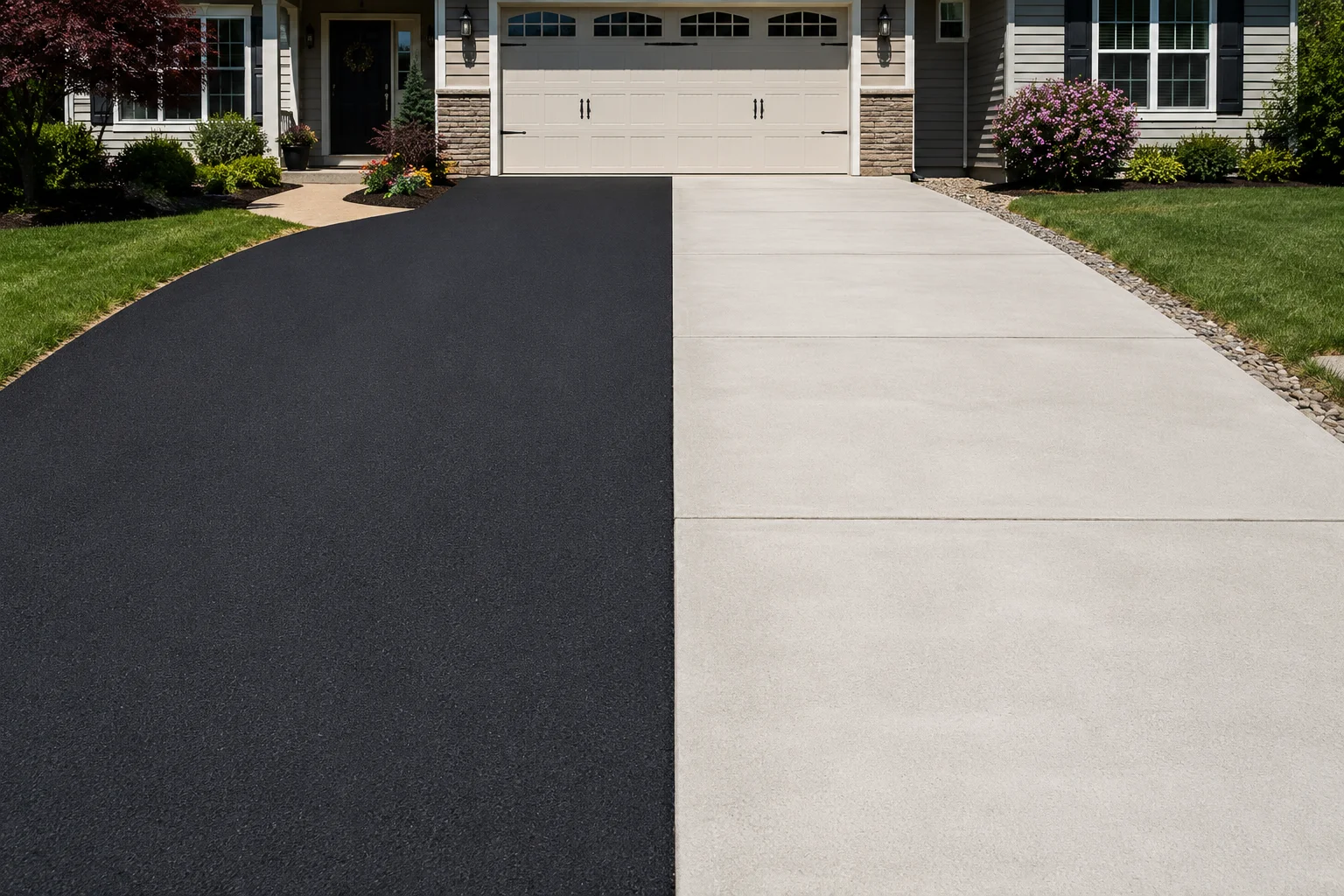
An asphalt driveway costs about $3 to $15 per square foot installed, while concrete runs $6 to $15, according to published cost guides. Asphalt wins on upfront price, installation speed, and cold-weather performance. Concrete wins on lifespan, summer heat, and low maintenance.
Concrete costs more upfront: $6 to $15 per square foot installed (HomeGuide) against about $3 to $15 for asphalt (HomeGuide lists $3 to $7; Bob Vila lists $7 to $15, updated May 2024). Behind that gap sit two different sets of trade-offs. Asphalt goes down faster and handles freeze-thaw cycles well; concrete lasts longer and does not soften in summer heat.
Most of what ranks for this comparison is written by a contractor who pours one of these two surfaces for a living, and the recommendation tends to land wherever their crew's expertise does. Nobody here pours concrete or lays asphalt. This page runs a free calculator, not a bid, so there is nothing nudging you toward either answer.
Asphalt vs concrete at a glance
| Factor | Asphalt | Concrete |
|---|---|---|
| Installed cost | $3 to $15 per ft² | $6 to $15 per ft² |
| Lifespan | 15 to 20 years, up to 30 with care | 30 to 40 years |
| Cure time before driving | 2 to 3 days | 7 days |
| Maintenance | Sealcoat about every 2 to 5 years as wear shows | Occasional cleaning/sealing |
| Repair cost | Low, patches blend in | High, patches show |
| Cold climates | Excellent, flexes with freeze-thaw | Prone to salt/spalling damage |
| Hot climates | Can soften in extreme heat | Excellent |
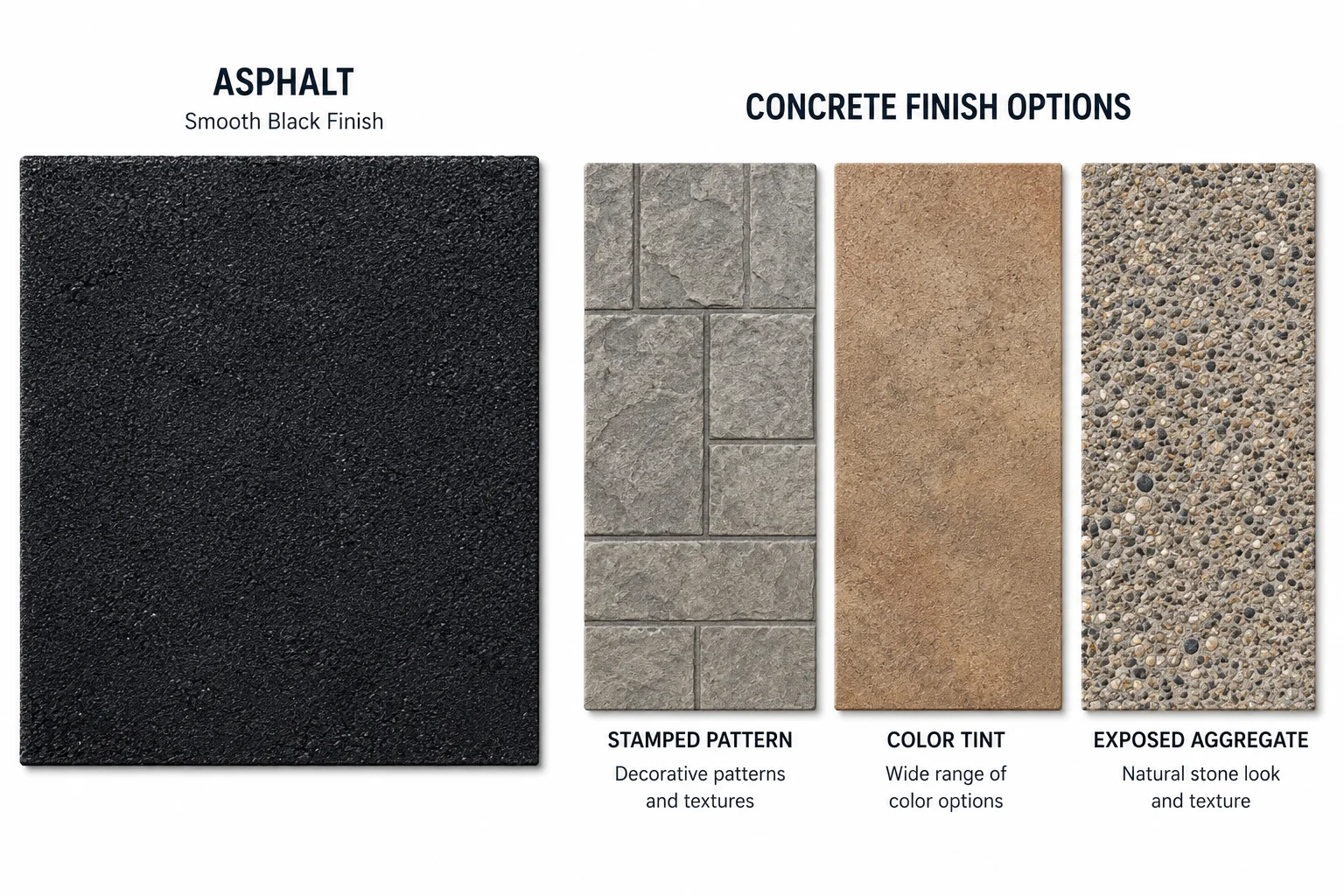
| Resale look | Uniform black | Finishes, colors, stamping |
Cost by driveway size
Here is the same comparison broken into real dollar figures for common driveway sizes, so you are not doing the per-square-foot math yourself.
| Driveway size | Area | Asphalt (installed) | Concrete (installed) |
|---|---|---|---|
| Single car (10 × 20) | 200 sq ft | $600 to $3,000 | $1,200 to $3,000 |
| Standard 2-car (20 × 20) | 400 sq ft | $1,200 to $6,000 | $2,400 to $6,000 |
| Wide 2-car (20 × 30) | 600 sq ft | $1,800 to $9,000 | $3,600 to $9,000 |
| Long/large (20 × 40) | 800 sq ft | $2,400 to $12,000 | $4,800 to $12,000 |
| Extra large | 1,000 sq ft | $3,000 to $15,000 | $6,000 to $15,000 |
A 20 by 20 foot driveway, one of the most commonly searched sizes, runs about $1,200 to $6,000 in asphalt versus $2,400 to $6,000 in concrete. The two ranges overlap: concrete starts higher, and the published tops are the same.
When asphalt is the right choice
- You live with freeze-thaw winters. Flexible pavement tolerates ground movement and road salt far better than a rigid slab.
- Budget matters. A 600 sq ft driveway costs roughly $1,200 to $1,800 less in asphalt, comparing the low end with the low end and the high end with the high end of each published range.
- You want to use it fast. Asphalt takes traffic in 2 to 3 days, not a full week.
- You have a long rural driveway. The per-foot savings multiply quickly over distance. Once you have decided on asphalt, how thick your new driveway should be depends on how it will be used.
When concrete is the right choice
- You are in a hot southern climate where asphalt can soften and track in summer heat.
- You want the longer-lived surface with minimal upkeep. Concrete simply asks less of you over the decades.
- Curb appeal drives the decision. Stamping, exposed aggregate, and color are concrete-only options.
- An HOA or neighborhood standard requires it.
Does the choice affect resale value?
Neither surface reliably adds resale value on its own. What matters more to most buyers and appraisers is condition, not material. A well-maintained asphalt driveway with no major cracking reads just as clean to a buyer as a plain gray concrete slab.
Where concrete does have a real edge is customization. Stamped, colored, or exposed-aggregate concrete can meaningfully lift curb appeal in a way flat black asphalt cannot match, since asphalt's only real design lever is uniform black. If the home is in a higher-end market where curb appeal carries real weight, that aesthetic flexibility is worth factoring in beyond the raw cost comparison.
Total 10-year cost of ownership
For a 600 sq ft driveway at the midpoint of each published range, asphalt costs about $4,800 installed and concrete about $6,300. Add two sealcoat applications in ten years at HomeGuide's $1 to $2 per square foot, $1,200 to $2,400 in total, and asphalt lands at about $6,000 to $7,200. Concrete has little scheduled maintenance, so it stays near $6,300. On those figures the two surfaces cost about the same over the first decade. Work out your own sealing bill with the sealcoat calculator, check what a sealcoat quote contains, and see how long an asphalt driveway lasts for what that maintenance buys.
Asphalt costs less on day one. Concrete catches up within about a decade on these figures and pulls ahead later, because an asphalt driveway is often due for resurfacing somewhere in the 15 to 20 year window. For what goes into the asphalt figure, see how much an asphalt driveway costs.
Can you pave asphalt over concrete?
Yes. A 2 inch asphalt overlay on sound concrete is a common budget upgrade when the underlying slab is structurally solid but showing its age cosmetically. The concrete must be genuinely stable, though. Any slab movement telegraphs cracks straight through the new asphalt layer above it.
Expansion joints in the old concrete will usually reflect through the new surface within a few seasons, appearing as faint lines in the same pattern as the joints below. Plan on routine crack sealing along those lines rather than treating it as a failure of the overlay itself.
If you already have an asphalt driveway and are deciding between fixing it and starting over, see our guide on resurfacing vs replacing your existing driveway.
Sources and citations
- HomeGuide: concrete driveway cost ($6 to $15 per sq ft installed), checked October 2026, homeguide.com
- HomeGuide: asphalt prices ($3 to $7 per sq ft installed), homeguide.com
- Bob Vila: How Much Does an Asphalt Driveway Cost? ($7 to $15 per sq ft, including minimal grading; updated May 29, 2024)
- HomeGuide: driveway sealing cost ($1 to $2 per sq ft), homeguide.com
- Bob Vila: concrete vs asphalt driveways (concrete lifespan of 30 to 40 years)
- Asphalt Driveway Cost Calculator (internal tool)
- Asphalt Calculator (internal tool)
- Asphalt Millings Cost (internal guide)
- Asphalt Parking Lot Cost Guide (internal)
- Asphalt Driveway Thickness Guide (internal)
- Asphalt Resurfacing vs Replacement (internal)
Frequently asked questions
Asphalt, usually. Published guides put asphalt at about $3 to $15 per square foot installed and concrete at $6 to $15 (HomeGuide). For a typical 600 sq ft driveway that is $1,800 to $9,000 in asphalt against $3,600 to $9,000 in concrete.
Concrete lasts longer, typically 30 to 40 years against asphalt's 15 to 20 years, or up to 30 with care. Concrete's rigid slab construction resists wear better over the long term, though it can be more prone to cracking if the ground shifts or freezes unevenly beneath it.
Asphalt generally performs better in cold, freeze-thaw climates. Its flexible surface moves with the ground as it freezes and thaws, rather than cracking under that stress the way a rigid concrete slab can. Asphalt is also more resistant to road salt damage, which matters if you live somewhere winter de-icing is routine.
Asphalt needs sealcoating about every 2 to 5 years as wear shows, can soften and rut under heavy weight in extreme summer heat, and offers only one real aesthetic option: uniform black. It also has a shorter lifespan than concrete, typically 15 to 20 years before resurfacing, or up to 30 with care.
Concrete costs more upfront, takes about a week to cure before it can handle vehicle traffic, and is harder to repair invisibly since patches and repairs tend to show against the original surface. It can also crack under freeze-thaw stress or from tree root movement if it was not reinforced properly at installation.
That comes down to preference and budget. Asphalt offers a clean, uniform black look with no design variation. Concrete can be stamped, colored, exposed-aggregate finished, or polished, giving it far more design flexibility if curb appeal and customization matter to you.
A 20 by 20 foot driveway (400 sq ft) costs about $1,200 to $6,000 installed in asphalt, or $2,400 to $6,000 in concrete, at the published per-square-foot ranges. The ranges overlap: concrete starts higher, and the published tops are the same.
You can typically drive on a new asphalt driveway in 2 to 3 days. Concrete needs about 7 days before it can safely handle regular vehicle traffic, since it needs more time to cure to sufficient strength.
Not reliably on its own. Condition matters more to buyers than the specific material. Concrete does offer more aesthetic customization through stamping and coloring, which can support curb appeal in higher-end markets, but a well-maintained driveway of either material reads as a positive to most buyers.
Gravel is usually the cheapest to install, at about $4 to $10 per square foot (HomeGuide), though its published range overlaps asphalt's and it needs periodic regrading. See asphalt vs gravel driveway for the full cost and lifespan breakdown. Recycled asphalt millings cost $10 to $20 per ton for the material, cheaper than new asphalt but not as smooth or long-lasting. New asphalt is usually the cheapest true paved surface, with concrete as the most expensive common option.