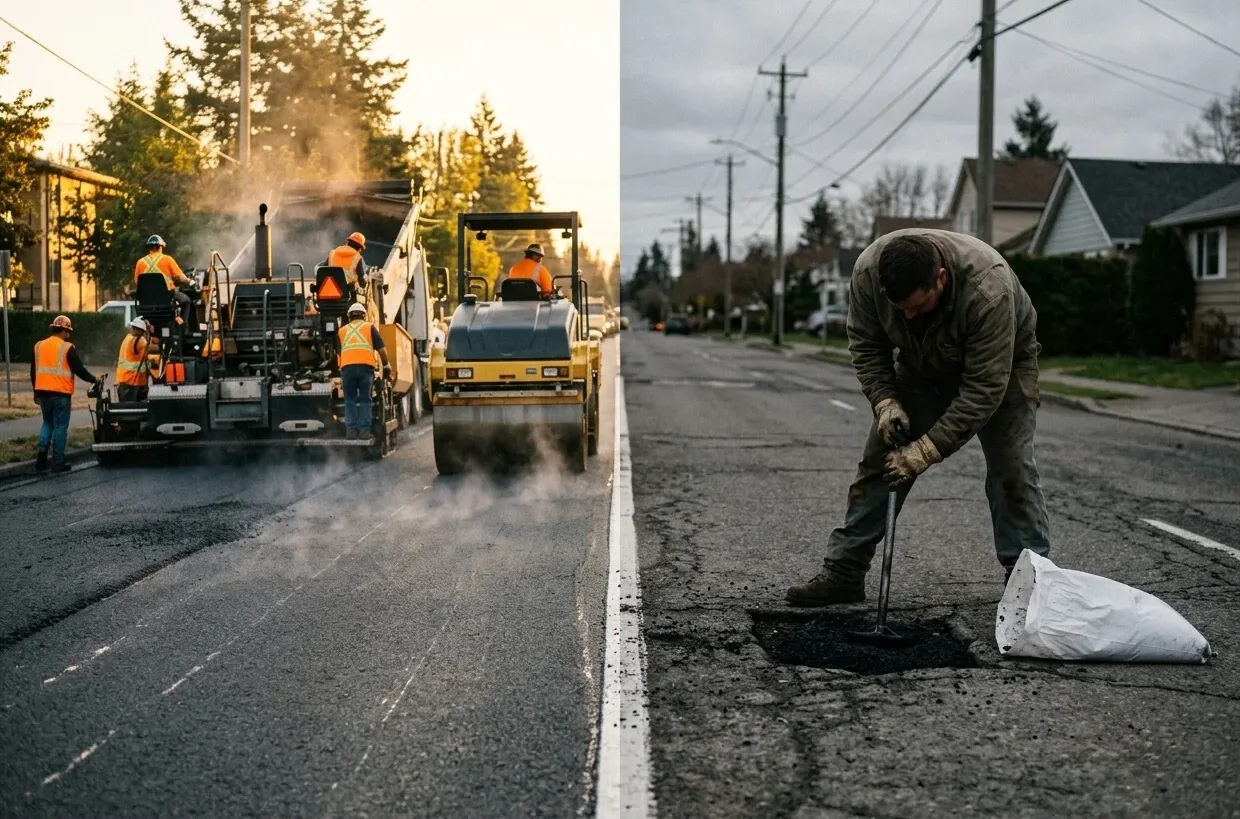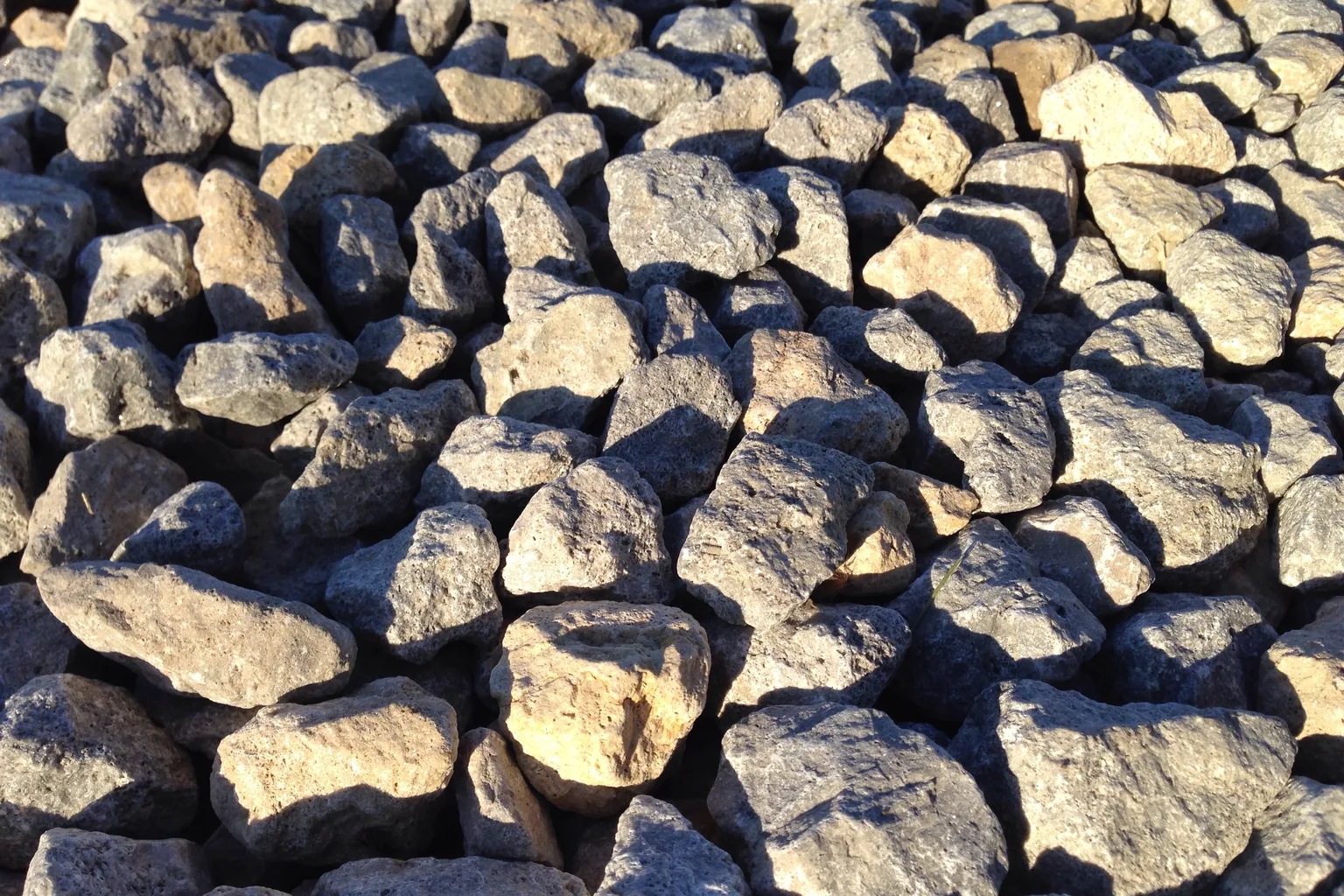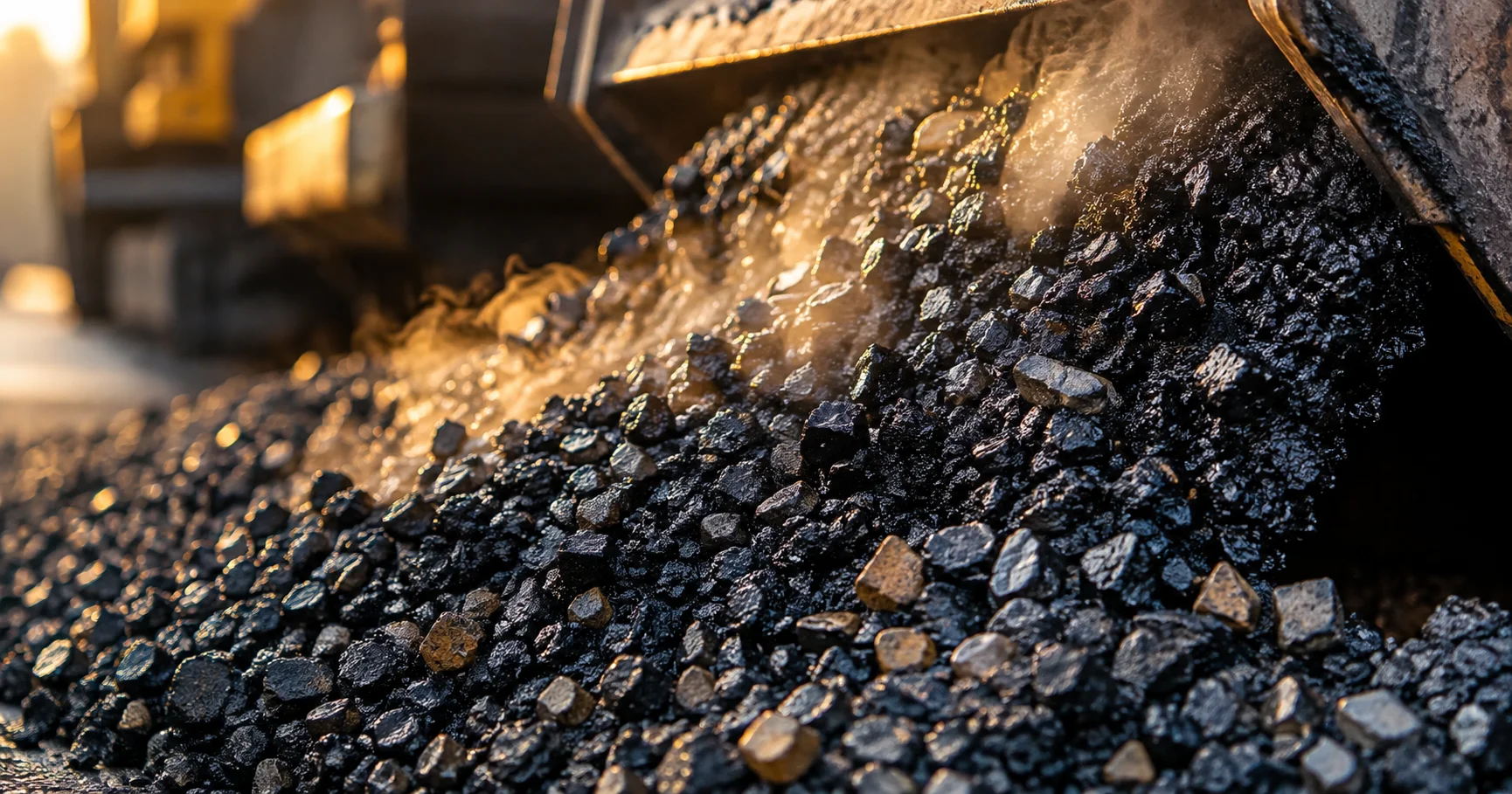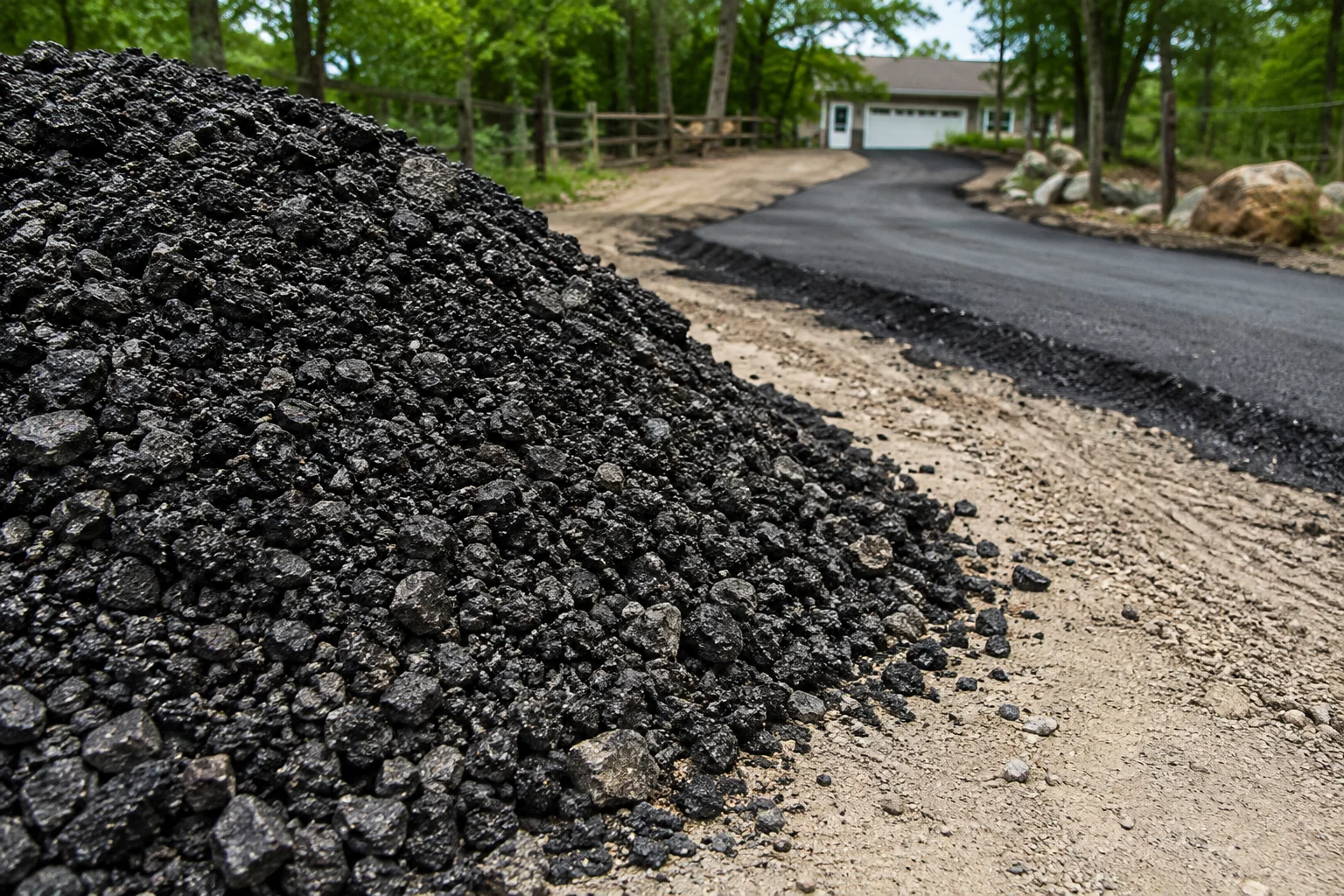
Asphalt millings cost $10 to $55 per ton in 2026 depending on whether you pick them up, buy from a quarry, or have them delivered, versus $100 to $150 per ton for new hot mix. One ton covers about 67 square feet at 3 inches, based on a compacted density of roughly 120 lb/ft³.
What are asphalt millings?
Asphalt millings, also called recycled asphalt pavement, RAP, or crushed asphalt, are ground-up chunks of old asphalt reclaimed when a road or lot gets milled and repaved. The leftover bitumen coating each chunk is what lets millings re-bind into a semi-solid surface once they are compacted, which is the whole reason they work as a driveway material instead of just being waste.
How much do asphalt millings cost?
Asphalt millings cost $10 to $55 per ton in 2026, and where that number lands inside the range depends almost entirely on how you source them, not on the millings themselves.
| Source | Cost per ton | Why |
|---|---|---|
| Picked up yourself from a contractor | $10 to $25 | You haul it. Contractors often want it gone anyway |
| From a quarry or aggregate supplier | $15 to $35 | Screened, more consistent, still self-haul |
| Delivered to your site | $25 to $55 | Adds trucking, distance, and fuel cost |
Millings pricing is unusually local and load-dependent compared to new hot mix, since it often trades on whatever a nearby contractor happens to be tearing up that month rather than a standard plant price sheet. Treat the ranges above as planning-level figures, and confirm current rates with 2 to 3 local suppliers before you commit to an order.
Compare that to $100 to $150 per ton for new hot mix asphalt, and millings come in at roughly a third to a half of the cost. That gap is the entire reason millings exist as a driveway option for rural properties, farm lanes, and parking areas where a full asphalt job is not worth the spend.
Prices sometimes drop far below this range near an active milling project. Contractors tearing up a road or lot often want the material gone and will price it accordingly, or give it away outright if you can arrange your own pickup on short notice.
How much do asphalt millings cover?
One ton of compacted asphalt millings covers about 67 square feet at 3 inches deep, based on a compacted density of roughly 120 lb per cubic foot. That density number is worth holding onto. It is lower than the 145 lb/ft³ standard for new hot mix, because millings are irregular chunks that never pack as tightly as fresh asphalt straight from a plant. For the equivalent figures on new hot mix, see how much a ton of asphalt covers.
Millings are typically laid 3 to 4 inches thick and compact by about 25% under rolling, the same general shrinkage you would see with new asphalt.
| Compacted depth | Coverage per ton | Tons per 1,000 sq ft |
|---|---|---|
| 2 inches | 100 sq ft | 10 tons |
| 3 inches | 67 sq ft | 15 tons |
| 4 inches | 50 sq ft | 20 tons |
For a concrete example, a 1,000 square foot driveway at the standard 3 inch depth needs about 15 tons of millings, plus the waste allowance below.
How to calculate millings tonnage
- Measure the area in square feet (length times width).
- Multiply by depth in feet to get cubic feet. Three inches converts to 0.25 feet.
- Multiply by 120 lb/ft³, the compacted millings density.
- Divide by 2,000 to get tons.
- Add 10% to 15%. Millings arrive in irregular chunks and settle unevenly, so this project needs a bigger buffer than new hot mix typically does.
Curious why hot mix and millings weigh differently? It comes down to how tightly irregular chunks compact versus fresh plant-mixed material.
Millings vs gravel vs hot mix
| Surface | Cost per ton | Finish | Best for |
|---|---|---|---|
| Gravel | $15 to $40 | Loose stone, needs regrading over time | Budget lanes, temporary access |
| Asphalt millings | $10 to $55 | Semi-solid, packs hard in summer heat | Rural driveways, lots, farm roads |
| Hot mix asphalt | $100 to $150 | Solid paved surface | Driveways, streets, parking lots |
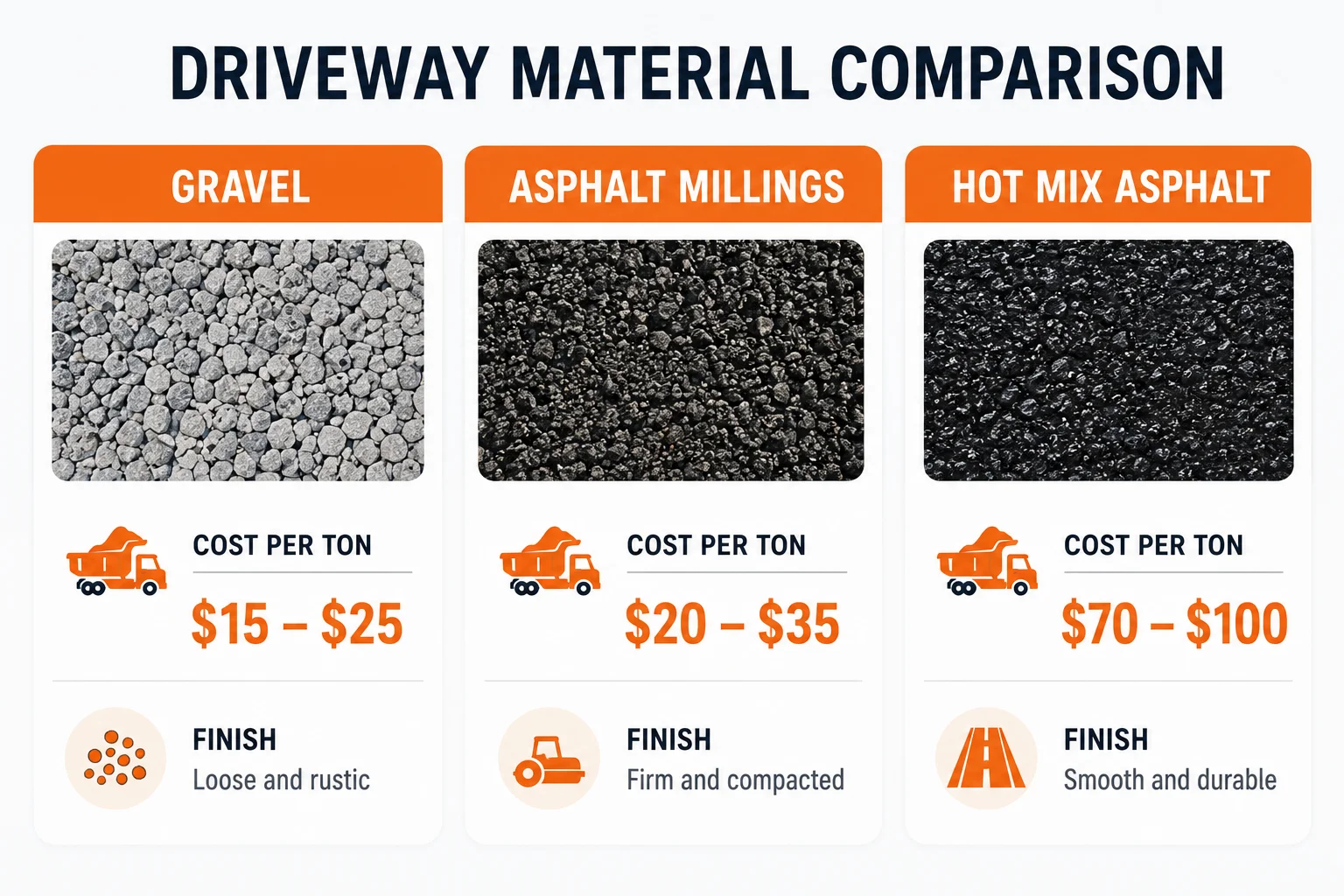
Millings sit in the middle on purpose. They cost more than gravel because they eventually bind into something closer to a solid surface, and they cost far less than hot mix because they are a byproduct, not a freshly manufactured product. If loose stone is the alternative you are weighing, asphalt vs gravel driveways sets the two against each other on cost and upkeep.
Are asphalt millings sustainable?
Yes, and this is one of the strongest practical cases for millings beyond the price difference. Every ton of millings used is a ton of old pavement diverted from a landfill and a ton of new aggregate and bitumen that never had to be mined or manufactured. Asphalt is already the most recycled material in the United States by volume, and driveway-scale millings reuse is a direct extension of that same system, just applied at the scale of a single property instead of a highway repaving project.
There is a practical upside that follows from the environmental one. Because millings are a byproduct rather than a manufactured product, their price does not track crude oil the way new hot mix does. When oil prices spike and push new asphalt higher, millings pricing tends to stay comparatively stable, since it is driven mainly by local hauling distance and contractor supply rather than petroleum markets.
Pros and cons of asphalt millings
Pro: 50% to 80% cheaper than new asphalt, and it is 100% recycled material, so there is no manufacturing cost baked into the price.
Pro: self-binding. Summer heat and traffic slowly fuse the surface together, so a millings driveway actually improves in the first season or two rather than just sitting static.
Pro: almost no dust or mud compared with a straight gravel driveway, since the bitumen coating holds the aggregate together instead of letting it shift loose underfoot.
Con: never as smooth or durable as hot mix. Expect some raveling at the edges over time, especially where a tire regularly turns sharply.
Con: quality varies load to load. Ask your supplier for screened millings rather than raw grindings straight off the milling machine, since screened material compacts far more predictably.
Con: needs real compaction. A vibratory roller, not just truck tires driving back and forth, is what actually binds the surface. Skipping this step is the single most common reason a millings driveway fails to harden properly.
Installation tips
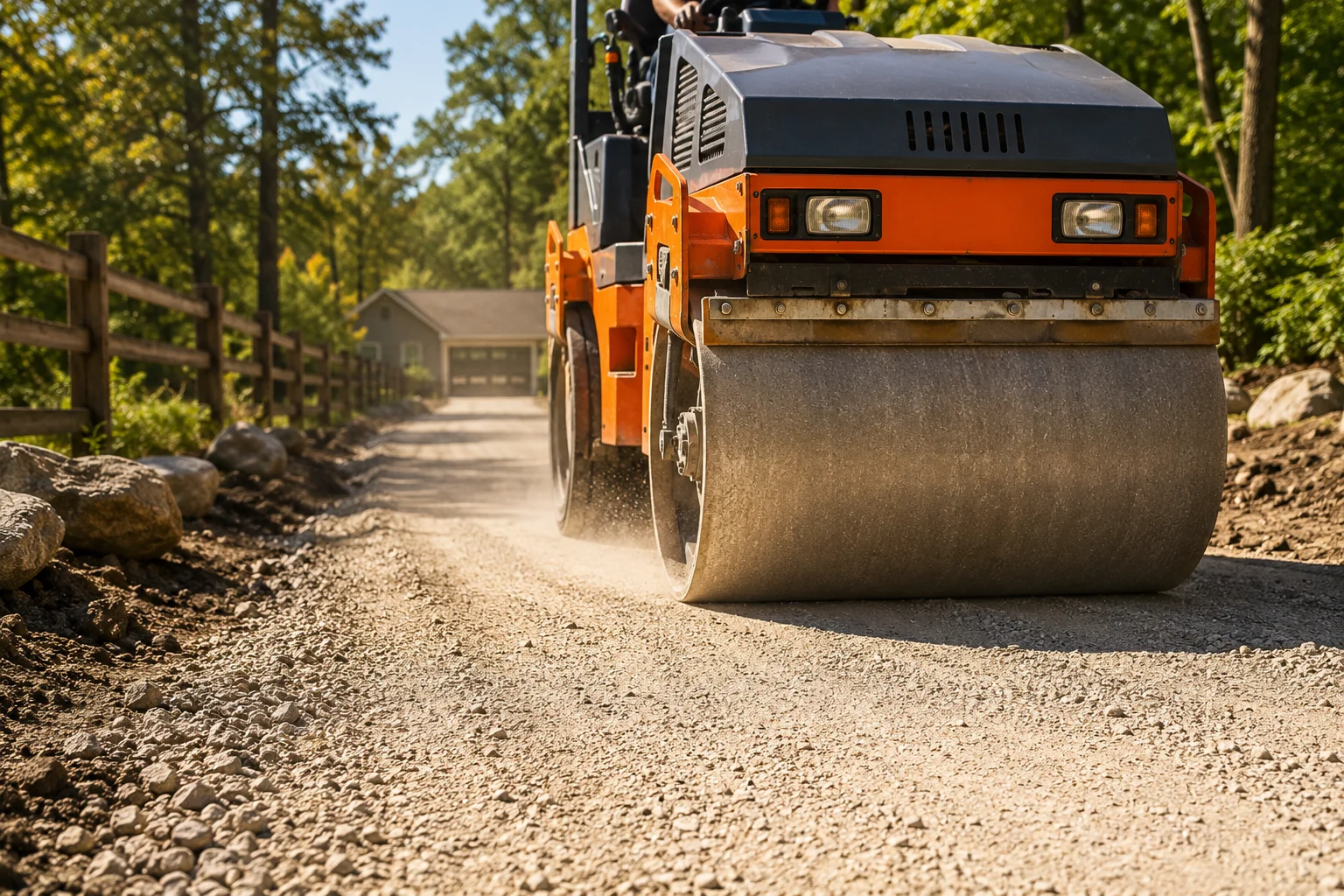
Grade the base with a slight crown for drainage before you spread a single ton. Spread millings 4 to 5 inches loose to land at a 3 to 4 inch compacted result, wet the surface lightly, and roll it with a vibratory roller on a hot day, since heat is what helps the bitumen re-soften and re-bind.
Some owners top-seal with an asphalt emulsion a season later to lock the surface down further. Ask your supplier about spray rates, typically around 0.2 to 0.3 gallons per square yard, if you want to go that route.
Do asphalt millings work as a parking lot surface?
For light residential and farm use, yes. For a commercial parking lot with regular customer traffic, millings are a harder sell. They lack the smooth, consistently graded surface that ADA compliance and heavy daily traffic really want, and they hold up worse under sustained turning from delivery trucks.
Millings make the most sense for overflow parking, employee lots, or storage yard surfaces where appearance and smoothness matter less than cost. For a customer-facing commercial lot, hot mix is almost always the better long-term investment. Our asphalt parking lot calculator covers full hot mix pricing for that scenario.
At a glance: asphalt millings in seven numbers
- 1$10 to $55 per ton — the full 2026 pricing range, driven mainly by how you source the material, not the material itself.
- 2$100 to $150 per ton — the price of new hot mix for comparison. Millings run roughly a third to a half of that cost.
- 3120 lb/ft³ — the compacted millings density, lighter than the 145 lb/ft³ hot mix standard because irregular chunks never pack as tightly.
- 467 sq ft per ton — coverage at the standard 3 inch compacted depth.
- 510% to 15% — the recommended waste buffer, higher than new hot mix because millings settle unevenly.
- 610 to 15 years — typical driveway lifespan with proper compaction and occasional top-ups.
- 7100% recycled — no new aggregate mined, no new bitumen manufactured, and pricing that stays comparatively stable when crude oil spikes.
Sources and citations
- National Asphalt Pavement Association (RAP and recycled asphalt use) — asphaltpavement.org
- Asphalt Institute — asphaltinstitute.org
- Asphalt Calculator (internal tool)
- Asphalt Cost Calculator (internal tool)
- Asphalt Parking Lot Calculator (internal tool)
Frequently asked questions
A 12 by 100 foot driveway (1,200 sq ft) at 3 compacted inches needs about 18 tons of millings, plus 10% to 15% extra for settling, so order roughly 20 tons. For a 1,000 sq ft driveway at the same depth, plan on about 15 tons before the waste buffer.
Asphalt millings and gravel land in a similar cost range ($10 to $55 per ton for millings versus $15 to $40 for gravel), but millings usually win on long-term value. Gravel needs periodic regrading as stone shifts and scatters, while millings self-bind into a semi-solid surface that holds its shape better over time.
Yes, though not to the same finished quality as new hot mix. The leftover bitumen coating on each chunk of milled material softens slightly in summer heat and re-bonds under traffic and compaction, gradually forming a semi-solid surface. It will never match the smoothness of freshly paved hot mix, but a properly compacted millings driveway firms up noticeably over its first one to two seasons.
One ton of compacted millings covers about 100 square feet at 2 inches deep, 67 square feet at 3 inches, or 50 square feet at 4 inches. Coverage drops as depth increases, the same relationship you see with new hot mix asphalt.
Millings never reach the smoothness or durability of new hot mix asphalt, and edges can ravel over time, especially where vehicles turn sharply. Quality also varies by load, since millings come from whatever pavement was ground up that day, so screened material is worth requesting over raw grindings. They also require real compaction with a vibratory roller to bind properly, not just driving over them.
A properly installed and compacted millings driveway typically lasts 10 to 15 years with occasional top-ups, though it will never match the 15 to 20 year lifespan of new hot mix. Heat exposure and consistent traffic actually help the surface bind tighter in the early years, but expect some annual maintenance like adding fresh material to worn tracks.
Three to four inches compacted is the standard for a residential driveway. Two inches works for light foot traffic or a temporary surface but will not hold up as well under regular vehicle weight. Four inches suits heavier vehicles or a longer-term installation. Spread loose material about 25% deeper than your target compacted depth to account for settling under the roller.
The leftover asphalt binder, called bitumen, that coats each chunk of milled material is what allows millings to bind. Bitumen is a petroleum-based substance that softens with heat. When millings are compacted and then warmed by summer sun and tire friction, that binder re-softens slightly and helps neighboring chunks fuse together, gradually forming a semi-solid surface instead of staying as loose gravel-like chunks.
For large areas, millings often end up cost-competitive with gravel once you factor in gravel's need for periodic top-ups and regrading. Millings typically cost $10 to $55 per ton against $15 to $40 for gravel, but the self-binding surface millings create needs less ongoing maintenance than loose stone, which can offset the higher upfront cost on a large driveway or lot.
In most areas, yes, but not universally. Millings are widely accepted for rural and residential driveways, but some municipalities and homeowners associations restrict or prohibit them, unlike gravel or hot mix, which are almost always permitted. Check your local zoning code and any HOA covenant before ordering material, since removing and replacing an unpermitted surface adds real cost on top of the original install.