
Pothole repair costs $50 to $150 per pothole for a cold-mix patch, $150 to $400 for hot mix, and $300 to $800 or more for a saw-cut full-depth repair, based on 2026 contractor pricing. Almost none of that is material. The asphalt inside a typical 2 ft by 2 ft pothole is worth about $10 to $15, and filling the same hole yourself with bagged cold patch costs roughly $70. What you are paying for is a truck and a crew arriving at all.
How much does pothole repair cost?
Professional pothole repair runs $50 to $800 per pothole in 2026 for the three common methods, and the method matters far more than the size of the hole. Infrared patching sits outside that range and is dealt with separately below. The table below gives the ranges published by paving contractors quoting current work. These are contractor and manufacturer figures rather than government data, so treat them as planning-level numbers and get local quotes before you budget.
| Method | Cost per pothole | What it involves |
|---|---|---|
| Cold-mix patch | $50 to $150 | Bagged or bulk cold patch shoveled in and compacted |
| Hot-mix patch | $150 to $400 | Hot asphalt from a plant, compacted with a roller or plate |
| Infrared patch | $400 to $1,000+ | Existing asphalt reheated and re-worked into a seamless repair |
| Saw-cut full-depth repair | $300 to $800+ | Square-cut through the full asphalt thickness, failed base removed |
Measured by area instead, the same work lands between $2 and $12 per square foot depending on method. Colorado's Department of Transportation puts its own average pothole repair cost at $60 per square yard, which works out to about $6.67 per square foot, sitting almost exactly in the middle of the contractor ranges below.
Asphalt patch cost per square foot by method (2026)
Infrared pricing is the least reliable figure on this page. Published rates run from $4 per square foot at one contractor to $400 or more per pothole at another, a spread far wider than any other method. If you are quoted infrared work, compare at least three bids rather than assuming any single published range applies.
Why one pothole costs more per square foot than a whole driveway
A pothole repair is priced by the visit, not by the volume. This is the single most useful thing to understand before you call anyone, and it explains why the per-square-foot numbers people search for are so misleading at pothole scale.
What the material actually costs
Work the material out for a typical pothole. A hole 2 ft by 2 ft and 4 inches deep is 4 square feet of surface and 1.33 cubic feet of volume. At the 145 lb/ft³ density standard that is 193 pounds of asphalt, or 0.10 tons. At the $100 to $150 per ton that hot mix costs in 2026, the material in that pothole is worth $10 to $15.
Now compare that with the invoice. A $250 repair on those 4 square feet is $63 per square foot. A new asphalt driveway costs $7 to $15 per square foot fully installed, and an overlay runs $3 to $7. The same material, laid in a small enough quantity, costs four to nine times more per square foot than paving an entire driveway, and up to twenty times more than an overlay.
| Job | Cost per sq ft | Why the gap |
|---|---|---|
| One 4 sq ft pothole at $250 | $63 | One visit, one crew, almost no material |
| One 9 sq ft pothole at $250 | $28 | Same visit cost spread over more area |
| New driveway, installed | $7 to $15 | Crew and equipment spread across the whole job |
| Overlay / resurfacing | $3 to $7 | Largest area, lowest setup cost per foot |
What the visit costs
Contractors are explicit about where the money goes. Published mobilization fees, the charge simply for bringing trucks and crew to your site, run $100 to $150 at SealMaster and $150 to $500 at Proline Parking Lot Maintenance. Minimum job charges run $300 to $600 at Empire Paving, rising to $600 to $1,600 at EastCoat Pavement Services once hot mix is involved and a plant order has to clear a minimum load. Proline notes plainly that if you have a single small pothole, the mobilization fee alone might double the cost of the repair itself.
That Columbus figure comes from an American Public Works Association fact sheet, and the per-pothole arithmetic is ours rather than theirs. It is material only, at 2012 prices, and a city buying by the truckload pays far less per ton than you do by the bag. But the order of magnitude is the point: the stuff that goes in the hole is close to a rounding error against the cost of getting it there.
What is the cheapest way to fill a pothole?
Bagged cold patch is the cheapest way to fill a pothole, because it is the only method that skips mobilization entirely. A 50 lb bag runs $8 to $20 at hardware-store prices, with commercial-grade products at the top of that band or a little above. The tables below use $22.09, a commercial-grade bag price verified at Outpost Construction Supply in August 2026, so the figures sit at the cautious end. You are the crew.
Coverage is where people miscalculate. UNIQUE Paving Materials, a cold-mix manufacturer, states that one 50 lb bag yields 0.42 to 0.48 cubic feet compacted. That is 8.7 to 9.9 pounds per square foot per inch of depth. The tables below round it to 10 pounds per square foot per inch, or about 5 square feet at 1 inch deep, which builds in a small waste allowance rather than leaving you a bag short.
| Pothole size | Cold patch needed | Bags (50 lb) | Material cost |
|---|---|---|---|
| 1 ft × 1 ft, 3 in deep | 30 lb | 0.6 | About $13 |
| 2 ft × 2 ft, 4 in deep | 160 lb | 3.2 | About $70 |
| 3 ft × 3 ft, 6 in deep | 540 lb | 10.8 | About $239 |
| 4 ft × 4 ft, 6 in deep | 960 lb | 19.2 | About $424 |
There is a catch worth knowing before you buy a pallet of it. At $22 for 50 pounds, bagged cold patch works out to roughly $880 per ton, against $80 to $130 per ton for the same cold mix bought in bulk and $100 to $150 for hot mix. You are paying a very large premium for the convenience of a bag. Cold patch is only cheap because you buy a few dollars' worth at a time and supply the labor yourself. Bought by weight, it is the most expensive asphalt on this page.
Two application details decide whether the patch holds. Fill deep holes in separate 2-inch layers rather than one deep pour, and heap the final layer about 25% above the surrounding surface so it compacts down flush. Cold patch that is dumped in loose and driven over once, without real compaction, is the version that fails by spring.
DIY or contractor: where the line actually falls
Do it yourself below about seven bags of cold patch, and get quotes above that. Seven bags is 350 pounds and about $155 of material. That is the point where your material cost alone meets the bottom of a professional hot-mix quote, and you are still supplying all the labor for free.
| Hole | Bags | Your material cost | Sensible call |
|---|---|---|---|
| 2 ft × 2 ft, 2 in deep | 1.6 | $35 | DIY, clearly |
| 2 ft × 2 ft, 4 in deep | 3.2 | $70 | DIY, clearly |
| 2 ft × 2 ft, 6 in deep | 4.8 | $106 | Still DIY, but 240 lb to move |
| 3 ft × 3 ft, 4 in deep | 7.2 | $159 | Get quotes |
| 3 ft × 3 ft, 6 in deep | 10.8 | $239 | Get quotes |
Two things override the arithmetic. If the pothole keeps reopening in the same spot, the base beneath it has failed and no amount of surface material will fix it. And if you have several potholes, the calculation inverts completely. Proline publishes volume discounts of 15% to 25% for bundling five or more repairs into one visit. The expensive part of the job is getting there, and it only happens once. Never call anyone out for a single hole if a second one is going to open in three months.
Is there a permanent fix for potholes?
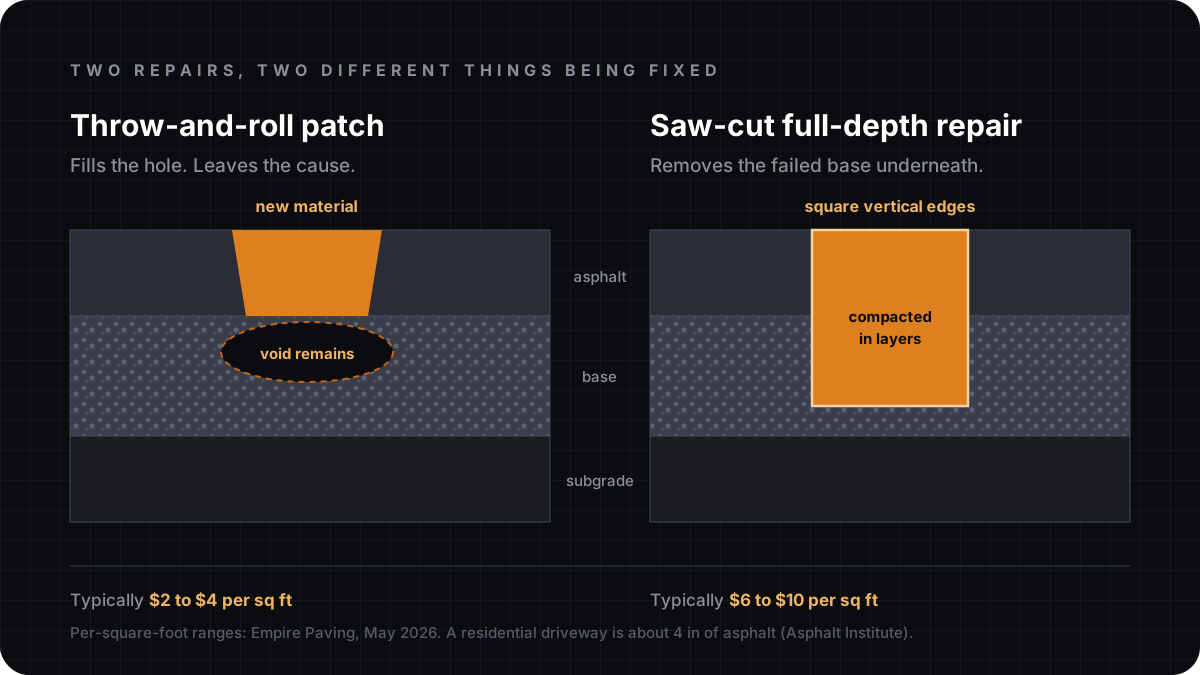
Yes — a saw-cut full-depth repair is the permanent fix, because it is the only method that removes the failed base rather than covering it. Everything else treats the symptom.
Why potholes come back
Water gets through a crack and saturates the material under the pavement. It freezes, expands, and lifts the surface; when it thaws it leaves a void behind. Traffic then pounds the unsupported surface until it collapses into that void. Fill only the visible hole and the void underneath is still there, still collecting water.
A full-depth repair cuts square vertical edges through the entire asphalt thickness, removes the compromised base, and rebuilds in compacted layers. On a residential driveway the Asphalt Institute puts full-depth construction at about 4 inches of compacted asphalt, or 3 inches of asphalt over a crushed stone base. A driveway patch is therefore a 4 to 6 inch job. State highway specifications call for far more: both Indiana and Missouri set a 10 inch minimum for full-depth patching. That is why the DOT patch depths quoted online rarely apply to a driveway.
That said, the case for cheap patching is stronger than most contractors will tell you. The SHRP H-106 study, reported by the Federal Highway Administration, placed more than 1,250 cold-mix patches across eight test sites in the US and Canada. 56% survived to the final round of monitoring in 1995. The study also found that simple throw-and-roll patching performed as well as the expensive semi-permanent method in most situations, and was more cost-effective. The study dates from the 1990s, and we found no later work of comparable scale.
The reconciliation between that finding and the durability complaints is compaction. The SHRP H-106 test patches were properly compacted; the throw-and-go work that fails over one winter is material dropped into a wet hole and left. If you patch a hole yourself and skip the tamping, you are not doing the thing the research validated.
How deep does a pothole have to be to be repaired?
Depth is the wrong test. What matters is whether the base under the hole is still intact. A shallow 1 inch divot in a driveway that has never had drainage trouble is cosmetic, and a well-compacted cold patch will hold in it. A 2 inch depression that reopens every spring in the same place is a base failure, and it needs full-depth work regardless of how shallow it looks.
Three signs push a hole from patch to full-depth repair: it has reopened after a previous patch, the edges crumble when you sweep them, or water stands in or beside it after rain. Any one of those means material is being washed out from underneath. Our guide to asphalt resurfacing versus replacement covers where the line sits once the problem stops being a single hole.
What makes pothole quotes vary so much?
Timing, batching, and whether hot mix is available. Quotes for what looks like identical work vary more than for almost any other paving job, and the reasons are largely outside the hole itself.
Season and plant availability
Asphalt plants shut down over winter in cold climates and typically reopen around April, which is why winter road repairs use cold patch as a stopgap and permanent work waits for spring. That creates a demand spike exactly when everyone else has noticed their potholes too. San Diego's own repair backlog shows the shape of it clearly.
Open pothole requests in San Diego's backlog, by month
The backlog runs from 150 open requests in July to 1,367 the following March, a nine-fold swing driven by rain and freeze-thaw cycling. No source states outright that spring repairs cost more, and we are not going to claim one does. What the data does show is that spring is when demand peaks and you have the least negotiating leverage. Booking in late summer, when contractors are chasing work, is the more sensible play.
How much of the crew's day your job takes
The other driver is how much of the crew's day your job actually consumes. A San Diego audit found its crews got about 6 hours of productive repair time out of a 10-hour shift. The rest went on yard time and driving to the asphalt plant. The same audit found that one in five pothole calls resulted in no repair at all: the crew arrived, found nothing to fix, and left. Those trips cost full mobilization and zero material, and that overhead is priced into every quote you receive.
When patching stops making sense
Once potholes are appearing faster than you can patch them, you are maintaining a surface that has already failed. At that point repeated patching costs more over a few years than resurfacing would have, and it looks worse the whole time.
The economics of acting early are well established in pavement management. The American Public Works Association, citing AASHTO figures, puts it at $6 to $14 avoided in later rebuilding cost for every $1 spent keeping a road in good condition. On a driveway that translates directly into sealing cracks before water reaches the base, which is the whole mechanism by which potholes form. Our asphalt driveway maintenance guide covers the crack-filling timing, and how long an asphalt driveway lasts sets out what the surface should be doing at each age.
For a commercial lot the same crossover applies at larger scale, and the per-square-foot economics shift much faster because the areas involved are bigger. Our asphalt parking lot cost breakdown covers resurfacing pricing for lots.
Work out what your repair actually needs in material. Enter the patch area and depth to get tonnage and cost, and see how much of any quote is asphalt and how much is the visit.
Open the asphalt calculatorAt a glance: pothole repair cost in seven numbers
- 1$50 to $800 per pothole — the common professional range in 2026, from a cold-mix patch to a saw-cut full-depth repair. Infrared patching runs higher.
- 2$10 to $15 — the value of the hot mix inside a typical 2 ft by 2 ft, 4 inch pothole, at 145 lb/ft³ and $100 to $150 per ton.
- 3$100 to $500 — published mobilization fees — what you pay simply to get a truck and crew to the site.
- 4$8 to $20 — the hardware-store price of a 50 lb bag of cold patch, covering roughly 5 square feet at 1 inch deep. Commercial-grade bags run a little above that, and the tables here use $22.09.
- 57 bags — roughly where DIY material cost meets the bottom of a professional quote, and the point to start getting bids.
- 615% to 25% — typical contractor volume discount for bundling five or more repairs into a single visit.
- 756% — the share of cold-mix patches still surviving at final monitoring in the FHWA-reported SHRP H-106 study, when properly compacted.
Sources and citations
- FHWA Focus, January 2000 — SHRP H-106 pothole patching study — fhwa.dot.gov
- City of San Diego Office of the City Auditor, performance audit OCA-24-11, April 2024 — sandiego.gov
- American Public Works Association, Pothole Fact Sheet, 2015 — mtc.ca.gov
- Colorado Department of Transportation, pothole repairs — codot.gov
- Asphalt Institute, Asphalt magazine — commercial and residential paving thicknesses — asphaltmagazine.com
- UNIQUE Paving Materials — cold patch coverage and application rates — uniquepavingmaterials.com
- Indiana DOT design manual, chapter 603 — full-depth patch minimums — in.gov
- Missouri DOT engineering policy guide, category 613 — pavement repair depths — epg.modot.org
- Outpost Construction Supply — verified 50 lb cold patch retail price, August 2026 — outpostcs.com
- Empire Paving — asphalt patching cost per square foot, May 2026 (contractor) — empirepaving.biz
- Proline Parking Lot Maintenance — pothole budgeting and mobilization, February 2026 (contractor) — prolineplm.com
- SealMaster — pothole repair cost and mobilization (manufacturer) — sealmaster.net
- EastCoat Pavement Services — minimum charges and hot mix plant minimums (contractor) — eastcoatpavement.com
- Asphalt Calculator (internal tool)
- Asphalt Cost Calculator (internal tool)
Frequently asked questions
Professional pothole repair costs $50 to $150 per pothole for a cold-mix patch, $150 to $400 for a hot-mix patch, and $300 to $800 or more for a saw-cut full-depth repair, based on 2026 contractor pricing. Measured by area that is roughly $2 to $12 per square foot. Colorado's Department of Transportation reports its own average at $60 per square yard, about $6.67 per square foot. Most contractors also apply a minimum charge or mobilization fee of $100 to $500 regardless of how small the repair is.
Bagged cold patch applied yourself is the cheapest method, because it avoids the mobilization fee that dominates small repair bills. A 50 lb bag costs $8 to $20 at hardware-store prices, or about $22 for commercial-grade. One bag covers roughly 5 square feet at 1 inch deep. A typical 2 ft by 2 ft pothole 4 inches deep therefore needs just over 3 bags, about $70 in material. Fill in 2 inch layers, heap the last layer about 25% proud of the surface, and compact it properly — uncompacted cold patch is the version that fails over one winter.
Not on its own, but it holds up better than its reputation suggests when it is compacted properly. The SHRP H-106 study reported by the Federal Highway Administration placed more than 1,250 cold-mix patches across eight test sites. 56% were still surviving at the final round of monitoring in 1995. The study also found that simple throw-and-roll patching performed as well as the expensive semi-permanent method in most situations. The usual failure mode is not the material but skipping compaction: cold patch tamped in 2 inch layers behaves very differently from material dumped in and driven over once. Where the base underneath has failed, though, no surface material is a permanent fix.
Clear the water and any loose debris out first, because cold patch tamped into a drained hole behaves very differently from material dropped into a wet one. Standing water is also a warning sign in itself. If water collects in or beside the hole after rain, material is being washed out from underneath and the base is failing, which points to a full-depth repair rather than a patch. Some agencies do use cold patch deliberately in wet conditions, partly for environmental reasons, but they treat it as an interim repair rather than a finished one.
Roughly $2 to $4 per square foot for throw-and-roll patching, $4 to $6 for infrared, $6 to $10 for saw-cut patching, and $8 to $12 or more for full-depth reclamation. Be careful with these figures on a single small pothole. Because contractors price by the visit, a $250 repair on a 4 square foot hole works out at $63 per square foot. Installing an entire new driveway costs $7 to $15 per square foot. Per-square-foot rates only behave sensibly once the repair area is reasonably large.
Figure about 10 pounds of cold patch per square foot per inch of depth, which is roughly one 50 lb bag for every 5 square feet at 1 inch. A 1 ft by 1 ft hole 3 inches deep needs under one bag. A 2 ft by 2 ft hole 4 inches deep needs about 3 bags. A 3 ft by 3 ft hole 6 inches deep needs about 11 bags. Add a little extra, since the final layer should sit about 25% above the surrounding surface before compaction.
Do it yourself below about seven bags of cold patch. Seven bags is 350 pounds and about $155 of material, at which point your material cost alone meets the bottom of a professional hot-mix quote and you are still supplying the labor. Two things override the arithmetic. If the pothole keeps reopening in the same place, the base has failed and needs professional full-depth work. And if you have several potholes, bundling them into one contractor visit earns volume discounts of 15% to 25% (Proline Parking Lot Maintenance).
Because the cost of a small repair is almost entirely the visit, not the material. Published mobilization fees run $100 to $500 (SealMaster, Proline Parking Lot Maintenance), and minimum job charges run $300 to $600 (Empire Paving). That rises to $600 to $1,600 when hot mix is required and a plant order has to clear a minimum load (EastCoat Pavement Services). For scale, the City of Columbus, Ohio spent $175,578 on patch material to fill 130,397 potholes in 2012 — about $1.35 of material per pothole. The truck, the crew, the drive, and the traffic control are what you are actually buying.
Yes, and winter is what it exists for. Asphalt plants shut down in cold climates and typically reopen around April, so hot mix is simply unavailable for months and highway agencies use cold patch as the interim repair. Some agencies also prefer cold patch in wet conditions for environmental reasons. Treat a winter cold patch as a holding measure and plan a permanent repair once plants reopen, particularly if the hole was deep or has reopened before.
Patching is cheaper per repair until potholes start appearing faster than you can fix them, at which point repeated patching costs more over a few years than resurfacing would have. Resurfacing runs $3 to $7 per square foot against $8 to $18 for full replacement. Acting earlier pays. The American Public Works Association puts the ratio at $6 to $14 of later rebuilding cost avoided for every $1 spent keeping a surface in good condition. That is the argument for sealing cracks before water ever reaches the base.