New asphalt is dry enough to walk on within 24 hours and to drive on in 48 to 72 hours, but that is not the same as being cured. Full curing, when the binder finishes oxidizing and hardening, takes 6 to 12 months. Cold weather can stretch the traffic-ready window to about a week, rain in the first 24 to 72 hours can damage a surface that has not set yet, and it is normal for a driveway to still feel slightly soft after 2 weeks.
A new asphalt driveway is technically ready for foot traffic within a day and vehicle traffic within 2 to 3 days. But if a kickstand, a lawn chair, or a car parked in one spot for an afternoon a month later leaves a mark, that is not a bad installation. It just means the asphalt is still curing, a process that keeps running for 6 to 12 months after the surface is already hard enough to drive on.
Most of what shows up when you search this question is written either by a paving contractor with a driveway to sell or a commercial guide aimed at a parking-lot manager. Neither is written for a homeowner deciding when it is safe to park the family car. This page runs a calculator, not a paving crew, so here is the drying-versus-curing distinction in plain terms, with the specific windows for walking, driving, parking, cold weather, and rain.
Asphalt drying time vs. curing time: what's the difference?
Drying is how long new asphalt takes to cool and set enough to hold weight without rutting, roughly 24 to 72 hours. Curing is the much slower process where the asphalt binder oxidizes and hardens, which takes 6 to 12 months regardless of how solid the surface already feels (EastCoat Pavement Services).
Drying (traffic-ready)
The first 24 to 72 hours after paving, when the asphalt cools below the temperature where it deforms under weight. Once dry, the driveway can handle foot and vehicle traffic, but the surface is still relatively soft underneath.
Curing (full cure)
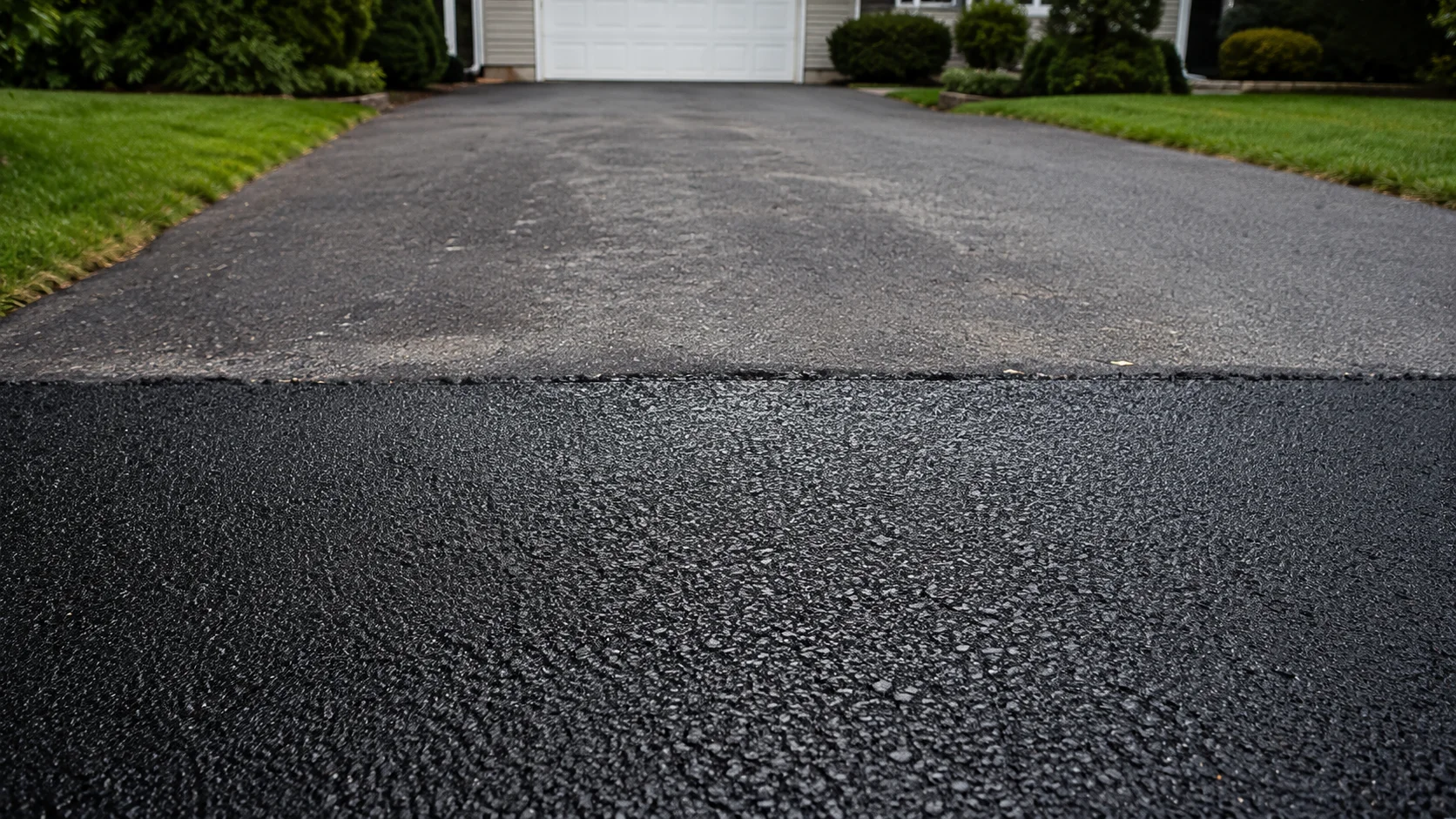
The 6 to 12 months after paving during which the asphalt binder oxidizes and hardens. Cured asphalt is noticeably firmer, has lost its jet-black sheen, and resists dents from stationary weight far better than a merely "dry" surface.
How long before you can walk on new asphalt?
Light foot traffic is generally safe within 24 hours of paving, once the surface has cooled and firmed up (Angi). Be careful with anything that puts weight on a small, concentrated point during that first day: narrow heels, kickstands, and ladder feet can all leave dents in asphalt that has not fully set, even after it looks solid.
How long before you can drive on new asphalt?
Plan on 48 to 72 hours before regular vehicle traffic, and lean toward the longer end for a residential driveway specifically (Angi; EastCoat Pavement Services). Driving on it at the 48-hour mark in hot weather carries a real risk of leaving tire ruts or scuff marks that waiting the full 72 hours mostly avoids.
How soon you can use new asphalt
How long before you can park on new asphalt?
Driving across new asphalt and parking on it put very different stress on the surface. A rolling tire spreads its weight over a fraction of a second; a parked car concentrates the same weight on four small contact points for hours. Wait at least 14 days before leaving a heavy vehicle, dumpster, or trailer parked in one spot, and rotate where you park for a few weeks after that (Angi).
- Rotate parking spots for the first month, especially in hot weather, so no single area takes repeated concentrated weight while it is still soft.
- Avoid kickstands, bike stands, and folding chairs with narrow feet; they dent asphalt that a rolling tire would not.
- Keep dumpsters, RVs, and trailers off the surface for at least 14 days, longer in hot climates.
- Skip sharp turns and full-lock steering while parking for the first couple of weeks; twisting the tires in place can scuff or tear the surface.
How long does asphalt take to cure in cold weather?
Cold weather slows curing; it does not speed it up. Most state DOT specifications require asphalt to be placed at an air temperature of at least 50°F, since colder conditions let the mix cool below its workable range before it compacts properly (Maricopa Association of Governments paving spec).
So no, asphalt does not cure faster in cold weather. In cold or humid conditions, the traffic-ready window that normally takes 48 to 72 hours can stretch to roughly a week, and the months-long curing process behind it slows down the same way (EastCoat Pavement Services; McConnell Associates).
Traffic-ready time by weather conditions
Does rain help or hurt new asphalt curing?
Rain does not speed up curing. Curing is an oxidation process in the asphalt binder, not something moisture drives, and asphalt itself is close to waterproof once it has set. What rain can do is hurt a driveway that has not dried yet: heavy rain within the first 24 hours can displace surface oils and leave ruts or soft spots, since the mix has not fully compacted into its final shape (Angi).
A light shower after the first day or so is unlikely to cause real damage. The safest rule tracks the same window that governs driving on it: give a new driveway 24 to 72 hours of dry weather before treating it as rain-proof, and push the paving date back entirely if a downpour is forecast within that window.
How to tell if your asphalt driveway is fully cured
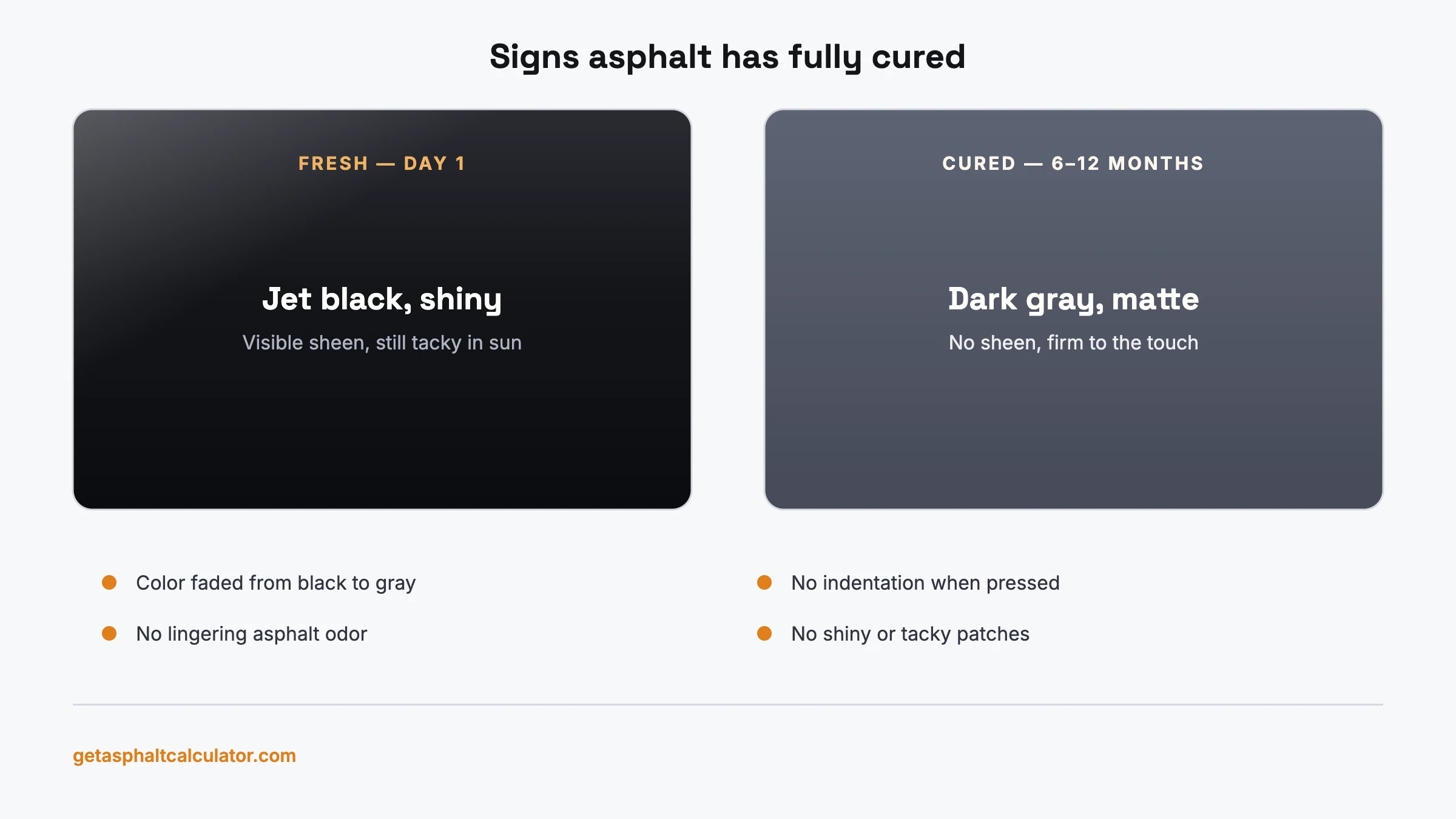
There is no single test, but a handful of visual and physical cues line up with the 6 to 12 month curing window:
- Color has faded from jet black to dark gray. That shift is the binder's oils oxidizing at the surface, a reliable sign curing is well along.
- No more asphalt smell. Fresh asphalt has a distinct petroleum odor that fades as volatile compounds finish evaporating; cured asphalt is odorless.
- Pressing on it leaves no indentation. A heel or a finger pressed firmly into fresh asphalt on a hot day can leave a mark; cured asphalt does not give.
- No shiny or tacky patches, especially in direct sun. A visible sheen means oil is still migrating to the surface.
Is asphalt still soft after 2 weeks?
Yes, and that is normal. The surface hardens enough to drive on within days, but the binder underneath keeps oxidizing for months, so the driveway stays somewhat soft and pliable well past the two-week mark. A south-facing driveway in full summer sun can still show tire marks or kickstand dents a month or more after paving, simply because dark asphalt absorbs heat and softens further in direct sunlight.
This is not a sign of a bad job. It is why most paving contractors ask for a full season, sometimes a full year, before judging the surface as "finished."
Full cure timeline: what happens over the next 6 to 12 months
The oxidation that hardens asphalt is a long-term process driven by the pavement's ongoing exposure to oxygen, moisture, and UV radiation over its service life, distinct from the short-term aging that happens during mixing and initial cooling (National Center for Biotechnology Information). In practice, that means a new driveway keeps getting slightly harder and lighter in color for the better part of a year, well after it has been safe to drive on for months.
Sealcoating timing splits along the same line. Some commercial specs allow sealing a higher-traffic lot 30 to 90 days after paving (EastCoat Pavement Services). General residential guidance leans toward waiting closer to the full cure, often about a year, so the sealer does not trap uncured volatiles under the surface. See our asphalt driveway lifespan guide for the full sealcoating schedule once the driveway is past this initial cure.
At a glance: asphalt curing time in seven numbers
- 124 hours — when light foot traffic is generally safe on new asphalt.
- 248 to 72 hours — when regular vehicle traffic is safe; lean toward 72 for a driveway.
- 314 days — minimum wait before parking a heavy vehicle or dumpster in one fixed spot.
- 4~1 week — typical traffic-ready wait in cold or humid weather, versus 48 to 72 hours in warm conditions.
- 524 to 72 hours — how long a new driveway needs to stay dry before rain is unlikely to damage it.
- 66 to 12 months — full cure time for the asphalt binder to oxidize and harden.
- 730 to 90 days vs. ~1 year — sealcoating window contractors use, commercial lots versus typical residential guidance.
Sources and citations
- Angi — How Long Until You Can Drive on New Asphalt?
- Angi — How Long Before New Driveway Can Get Wet?
- EastCoat Pavement Services — Asphalt Drying Time vs. Curing Time
- McConnell Associates — How Long Does It Take for Asphalt to Cure and Dry?
- Maricopa Association of Governments — Minimum Paving Temperature Specification
- National Center for Biotechnology Information — Effect of Thermal and Oxidative Aging on Asphalt Binders
- National Asphalt Pavement Association — asphaltpavement.org
- Asphalt Institute — asphaltinstitute.org
- Asphalt Driveway Cost Calculator (internal tool)
- Asphalt Calculator (internal tool)
- Asphalt vs. Concrete Driveway (internal guide)
- How Long Does an Asphalt Driveway Last? (internal guide)
Frequently asked questions
Asphalt is dry enough to drive on in 48 to 72 hours, but full curing, when the binder finishes oxidizing and hardening, takes 6 to 12 months. Cold or humid weather stretches both windows.
New asphalt is dry enough for foot traffic in about 24 hours and for regular vehicle traffic in 48 to 72 hours. Drying refers to the surface cooling and setting, not the months-long curing process underneath it.
Drying is the 24 to 72 hour window in which the surface cools and sets enough to hold foot and vehicle traffic. Curing is the 6 to 12 month process in which the asphalt binder oxidizes and hardens fully, regardless of how solid the surface already feels.
Plan on 48 to 72 hours before regular vehicle traffic, leaning toward the longer end for a residential driveway. Driving on it too early, especially in hot weather, risks leaving tire ruts or scuff marks.
Wait at least 14 days before leaving a heavy vehicle, dumpster, or trailer parked in one fixed spot, and rotate where you park for a few weeks after that. Parking concentrates weight far longer than driving across the same surface does.
Avoid it for the first 24 hours. Light foot traffic is generally safe after that, but narrow heels, kickstands, and other concentrated-weight points can still leave dents in asphalt that has not fully set.
No. Cold weather slows both drying and curing. Asphalt should be placed at air temperatures of at least 50°F, and in cold or humid conditions the normal 48 to 72 hour traffic-ready window can stretch to about a week.
Rain doesn't affect curing speed either way, since curing is an oxidation process, not a moisture-driven one. What rain can do is damage asphalt that hasn't dried yet: heavy rain within the first 24 hours can displace surface oils and leave ruts or soft spots.
Look for color that has faded from jet black to dark gray, no lingering asphalt odor, no indentation when you press on the surface, and no shiny or tacky patches. These line up with the typical 6 to 12 month cure window.
Yes, and that's normal. The surface is hard enough to drive on within days, but the binder keeps oxidizing and hardening for months, so a driveway can still show tire marks or kickstand dents well past the two-week mark, especially in direct summer sun.
Some commercial specs allow sealcoating 30 to 90 days after paving on higher-traffic lots, but typical residential guidance leans toward waiting closer to a full cure, often about a year, so the sealer doesn't trap uncured volatiles under the surface.