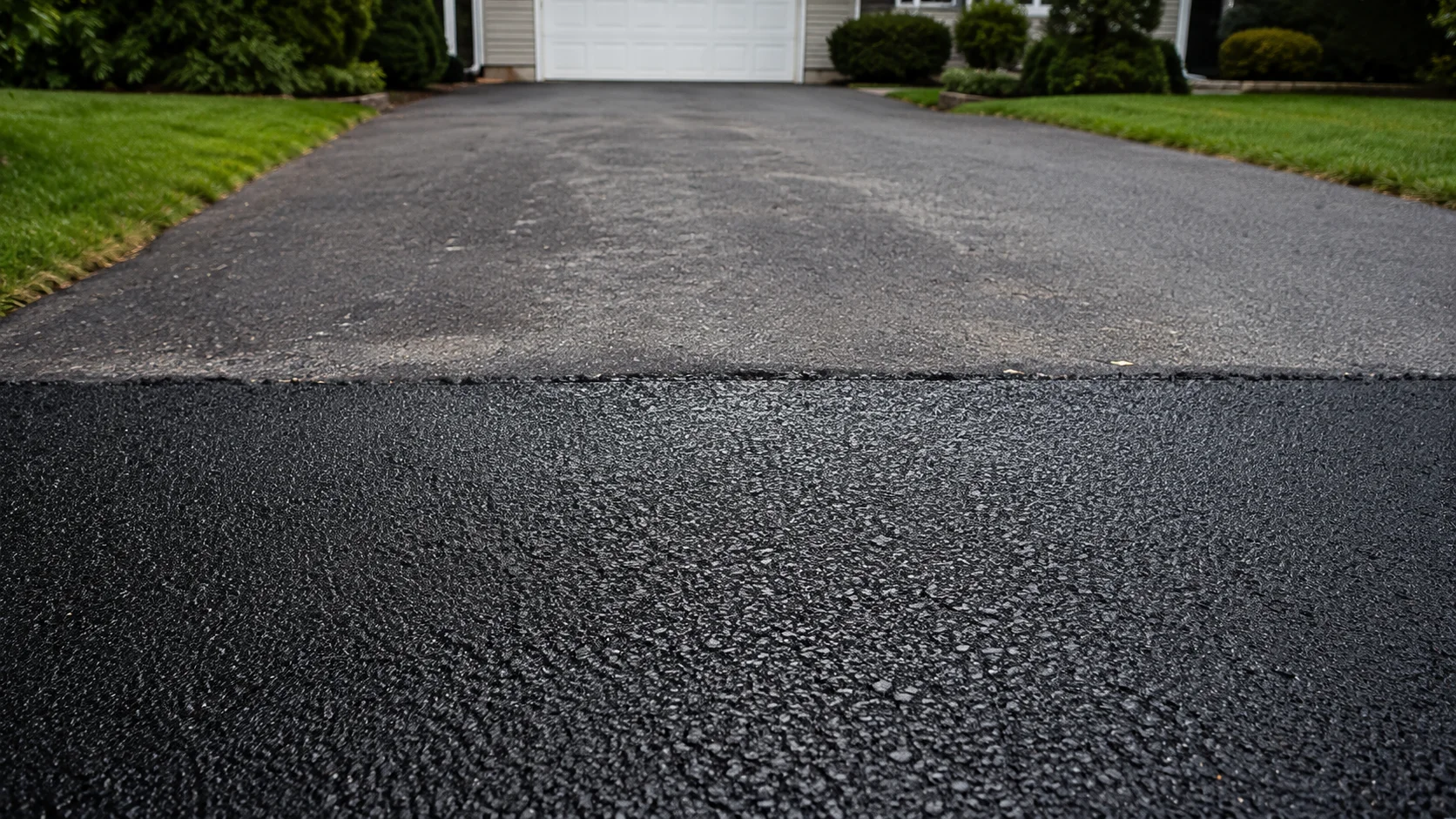
Asphalt driveway maintenance is four jobs: keep water out from under the surface, keep petroleum off the top of it, slow oxidation, and fix small failures before they spread. Timing matters more than effort. Pavement loses about 40% of its quality across the first 75% of its life, then another 40% in the next 12%, which is why $1 spent before that cliff replaces $6 to $10 spent after it. Seal cracks from 1/4 inch to 1 inch, leave hairline cracks alone, and sealcoat on condition rather than on a calendar.
Most driveway maintenance advice is a list of chores with no sense of priority, which is how homeowners end up sealcoating every year while ignoring the puddle quietly destroying the base. The guidance below is ordered by what actually extends service life, and every threshold comes from pavement engineering sources rather than contractor rules of thumb: the Asphalt Institute, Caltrans, the FHWA and the Transportation Research Board.
What does asphalt driveway maintenance actually involve?
Asphalt driveway maintenance is four jobs, not a long chore list: keep water out from under the surface, keep petroleum products off the top of it, slow the oxidation that turns flexible asphalt brittle, and repair small failures before they spread. Nearly every tip below is one of those four wearing a different hat. That framing also tells you what to skip. Sweeping matters not for appearance but because grit traps moisture against the surface and hides cracks you would otherwise catch early.
At a glance: the numbers that drive driveway maintenance
- 140%, then 40% — a pavement loses roughly 40% of its quality across the first 75% of its life, then another 40% in just the next 12%.
- 2$6 to $10 — what timely preservation avoids in later rehabilitation, per $1 spent at the right point in that curve.
- 350% of service life — what a pavement loses if its structure sits saturated only 10% of the time, about one month a year.
- 40.12 to 1.00 inch — the crack width band crack sealing is designed for. Narrower cracks are left alone, wider ones need repair instead.
- 52 to 5 years — how long the Asphalt Institute says a well-built, low-traffic driveway should go before it needs sealing at all.
- 650°F and rising — minimum air and pavement temperature for seal coat, with no freeze for 24 hours and no rain within 8 hours after.
Why timing matters more than effort
The same work costs wildly different amounts depending on when you do it. In the pavement option curve published in TR News, a pavement drops about 40% in quality during the first 75% of its life, then loses another 40% in the next 12% (Transportation Research Board, TR News 228, September–October 2003). Deterioration is not a straight line. It is a long, slow slide followed by a cliff.
How pavement condition falls off a cliff near the end of its life
The money follows the same shape. That figure states that spending $1 on preservation before the cliff *eliminates or delays spending $6 to $10 on rehabilitation or reconstruction* after it. Caltrans published its own version in the same issue: every $1 spent on preventive maintenance saved $3 on capital preventive maintenance, $6 on rehabilitation, and $20 on reconstruction, provided the treatment went down at the right time (TR News 228, p. 11). For a driveway, the translation is blunt. Work done while the surface still looks fine is the work that pays.
Dollars saved later per $1 spent on preventive maintenance at the right time
The year-round asphalt driveway maintenance checklist
Here is the full routine. The frequency column matters most: three of these run on a calendar, and the rest run on condition, meaning you do them when you see the trigger and not before.
| Task | How often | Right conditions | Why it matters |
|---|---|---|---|
| Sweep debris and clear leaves | Monthly | Any dry day | Debris holds moisture against the surface and hides cracks |
| Walk the driveway and inspect | Twice a year | Early spring and early fall | Spring finds winter damage, fall catches cracks before freeze-thaw |
| Check for standing water | After heavy rain | Within an hour of rainfall | Puddles mark low spots and drainage failures that attack the base |
| Clean oil, fuel and fluid spills | Immediately | As soon as noticed | Petroleum dissolves the binder holding the aggregate together |
| Seal cracks 1/4 in to 1 in | As found | Pavement 45°F and rising, fully dry | Open cracks route water straight into the base |
| Trim vegetation and support edges | Twice a year | Spring and fall | Unsupported edges crumble first, and roots lift the surface |
| Patch potholes and full-depth failures | As found | Warm and dry, 30 to 90 days before any sealing | These are base problems, not surface problems |
| Apply seal coat | On condition, not on a calendar | 50°F and rising, no freeze 24 hrs, no rain 8 hrs | Slows oxidation and closes surface voids once distress appears |
Sealcoating sits at the bottom and carries no interval. That is deliberate, and it is where most driveway advice goes wrong.
Keep water off and out of the driveway
Water is the primary destroyer of asphalt, and the mechanism is structural rather than cosmetic. The Federal Highway Administration's reference manual on the geotechnical aspects of pavements states that if a pavement system is saturated only 10% of its life, roughly one month a year, a section with a moderate stability factor will be serviceable only about 50% of its fully drained performance period (FHWA NHI-05-037, Chapter 7). Losing half a driveway's service life to about a month of saturation a year makes drainage the highest-return item on this page.
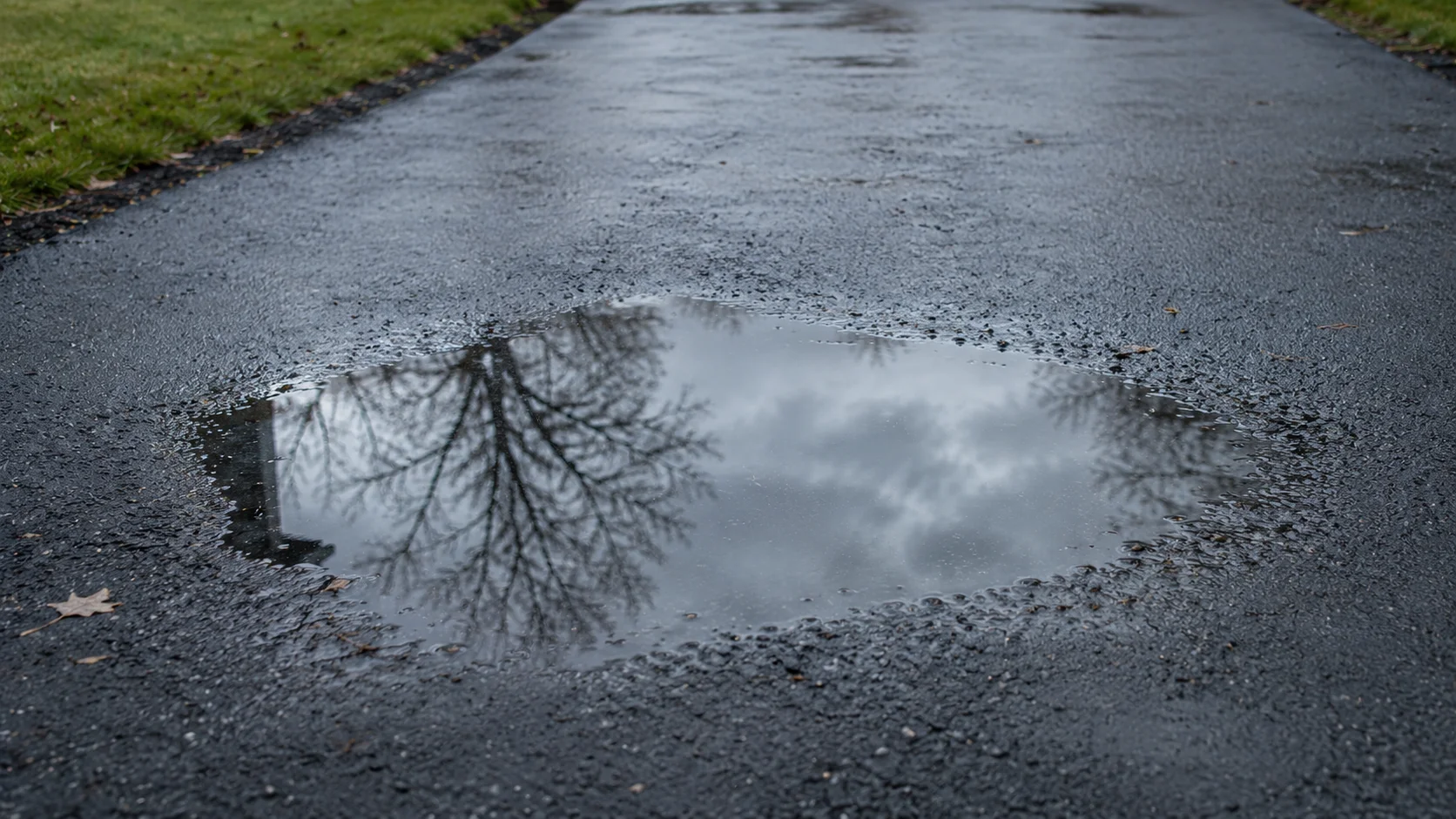
The damage also compounds. Once moisture reaches the base and the base softens, the surface above it flexes under vehicle weight, which opens more cracks, which admits more water. In freeze-thaw climates the trapped water expands as it freezes and pries those cracks wider every cycle. That loop is how a hairline crack becomes a pothole in two winters.
- Walk the driveway within an hour of heavy rain. Any puddle still standing marks a low spot or grading failure. Puddles are the diagnostic, and checking costs nothing.
- Redirect downspouts away from the pavement. A downspout discharging onto or alongside a driveway concentrates far more water on one spot than rainfall ever does.
- Keep the edges clear and draining. Soil, sod and mulch built up along the edge dam water onto the surface instead of letting it run off.
- Clear snow promptly, but skip the metal blade. Plow and shovel edges gouge the surface and create the exact entry points you are trying to close.
Which cracks to fill, and which to ignore
Crack sealing has a defined working range, and both narrower and wider cracks fall outside it. Caltrans specifies a crack width of 0.12 to 1.00 inch as the criteria for both crack sealing and crack filling (Caltrans Maintenance Technical Advisory Guide, Chapter 4). The Colorado Asphalt Pavement Association says the same thing in homeowner terms: seal cracks 1/4 inch to 1 inch the full length, ignore hairline cracks under 1/4 inch, and treat anything over 1 inch as a repair rather than a sealing job (Colorado APA).
| Crack width | What it usually is | Correct action |
|---|---|---|
| Under 1/4 inch (hairline) | Surface shrinkage and oxidation | Leave it. A seal coat closes these |
| 1/4 inch to 1 inch | Working thermal, longitudinal or transverse cracks | Crack seal the full length, to a depth of about twice the crack width |
| 1 inch to 1 1/2 inches | A widened crack, often with edge deterioration | Repair with a hot-applied mastic, not standard crack sealant |
| Over 1 1/2 inches | Structural movement or base loss | Remove and patch to the full depth of the damage |
| Interconnected “alligator” pattern | Base failure showing through the surface | Full-depth repair. Sealing this is wasted money |
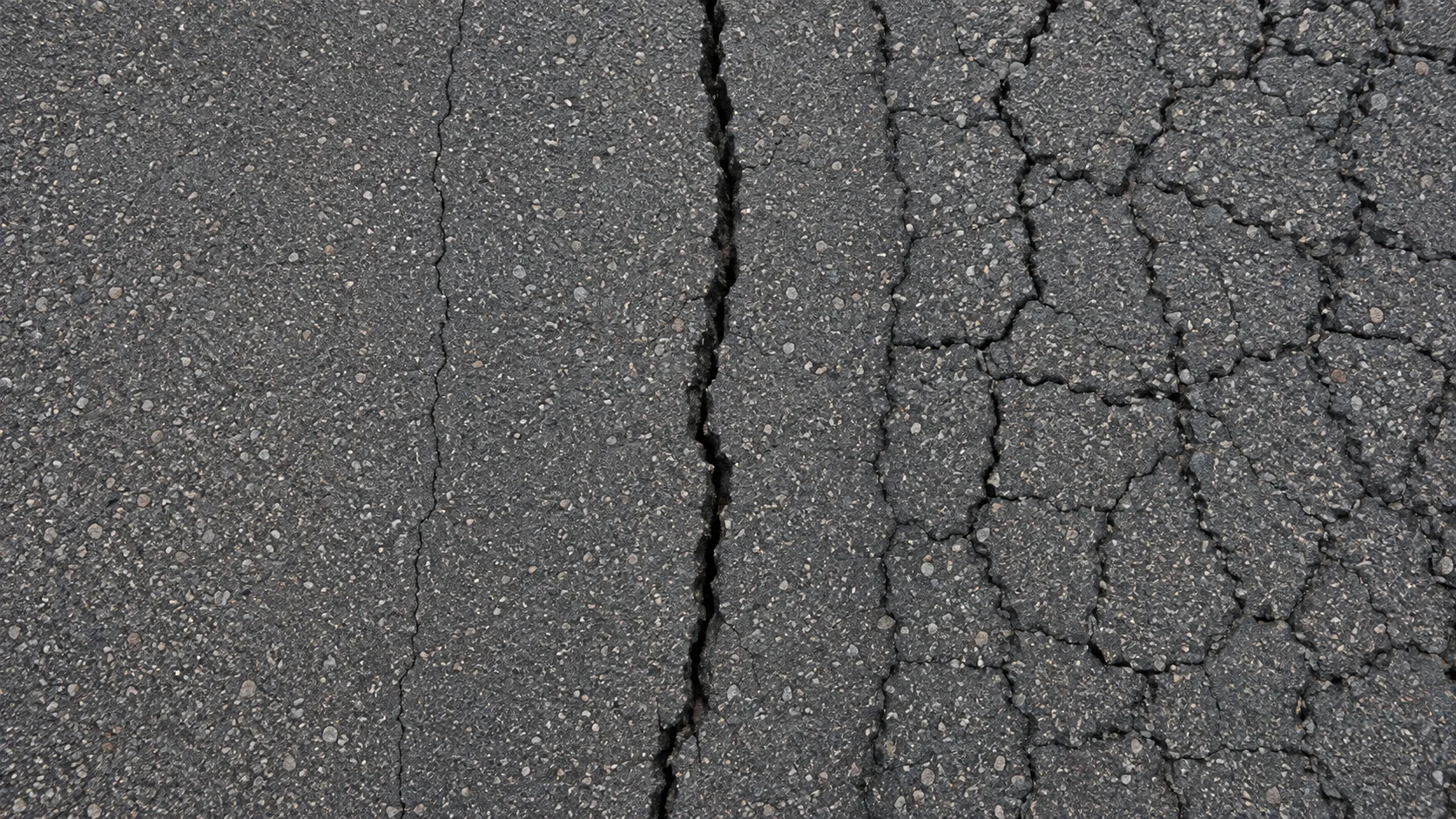
The alligator row saves the most money. Caltrans lists alligator, fatigue, reflective, edge and slippage cracking as distresses where crack sealing is not efficient, because the problem sits underneath the pavement rather than in it. Pouring sealant into an interconnected web treats a symptom of a failed base and buys almost nothing.
Material choice sets how long the repair lasts. Caltrans reports that asphalt emulsion placed flush in unrouted cracks lasts 2 to 4 years, while hot-applied rubber and fiber-modified asphalt lasts 6 to 8 years. For a driveway you intend to keep, the hot-applied material is usually worth the difference.
How often should you sealcoat an asphalt driveway?
The common answer is every two to three years. The Asphalt Institute, the technical authority for the material, gives no interval at all. Its guidance is condition-based: sealing “is effective to renew old asphalt surfaces that have become dry and brittle with age, to seal small surface cracks and surface voids, and to inhibit raveling,” so “sealing should be done as soon as any of these distresses are noted” (Asphalt Institute). It adds that a well-designed and constructed low-traffic pavement such as a driveway “should not require sealing for approximately 2 to 5 years,” depending on climate severity and the quality of the original work.
This cuts both ways. Sealing on a calendar means paying repeatedly for little structural return, and repeated over-application leaves a thick coat that cracks and peels on its own. It also means a driveway that starts raveling early waits out the rest of its interval while oxidation keeps working on it.
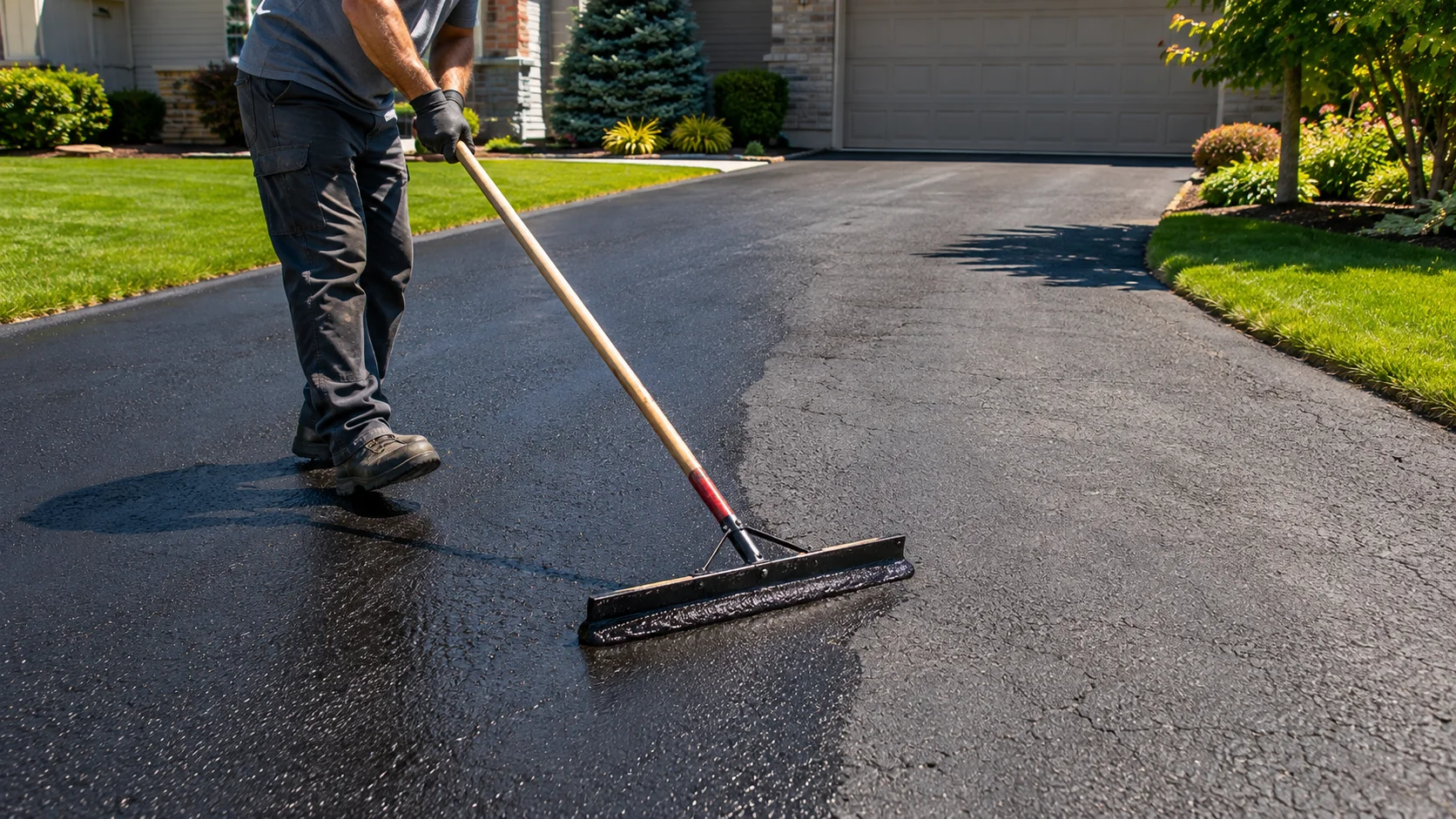
When you do seal, the conditions are not negotiable. Colorado APA specifies that sealer should not be applied unless the pavement temperature is at least 50°F and the air temperature is 50°F and rising, with no freezing temperatures expected for at least 24 hours, and never during wet weather or when rain is anticipated within eight hours after application (Colorado APA). Any patching should be finished 30 to 90 days before sealing so the new asphalt can cure, and two coats is the standard specification, with a third only in high-traffic areas.
Clean oil and fuel spills immediately
Asphalt is aggregate held together by bitumen, a petroleum binder, and gasoline, diesel, motor oil and transmission fluid are all solvents for it. Water attacks the structure from below; a fuel spill dissolves the surface from above, softening the patch and letting aggregate ravel out. So the rule is speed: blot a fresh spill rather than hosing it across a wider area, then clean the spot with a degreaser rated for asphalt, never a solvent-based cleaner. A cosmetic stain can wait for the next seal coat, but a patch that feels soft underfoot has already lost binder. Colorado APA's specification calls for pavement softened by petroleum derivatives to be cut out to the full depth of the damage and replaced.
Edges, potholes, and the jobs people skip
- Support the edges. Driveway edges have no lateral confinement, so they crumble first. Backfill with soil or gravel level to the surface and keep vehicles from riding over the lip.
- Keep roots and vegetation out. Grass growing through a crack means the crack has reached soil. Vegetation must be cleared to a depth of at least half an inch before sealant goes in, or the repair will not bond.
- Do not park heavy loads in one spot. Static weight from an RV, trailer jack or motorcycle kickstand indents asphalt, especially in summer heat. A plywood or steel plate spreads the load.
- Treat potholes as base problems. A pothole means water has already washed out material below the surface. Cold patch is a reasonable stopgap, but a pothole that returns in the same spot means the base needs full-depth repair.
How do you care for a freshly paved driveway?
A new driveway needs a different routine, because the mix is still hardening. In the first season the priorities are keeping concentrated loads off the surface, avoiding sharp turns from stationary wheels, and resisting the urge to seal it early.
- Do not seal it yet. The Asphalt Institute puts the first seal coat roughly 2 to 5 years out for a well-built low-traffic driveway. Sealing too early traps volatiles that need to escape while the mix hardens.
- Avoid point loads. Kickstands, trailer jacks and jack stands sink into a new surface in warm weather. Put a board under anything with a small footprint.
- Turn while rolling, not while stopped. Power-steering a parked car scuffs and tears a fresh surface.
- Start crack inspection in year one. Cracks in the first two seasons often point to a base or drainage fault worth catching under warranty rather than in year five.
When maintenance stops being the answer
Maintenance protects a sound structure. It cannot rebuild one. Once distress is widespread rather than isolated, once alligator cracking covers a meaningful share of the surface, or once potholes keep reopening in the same spots, the driveway has moved past preservation into resurfacing or replacement. The curve at the top of this page is the reason: after the second 40% drop, preservation treatments stop returning what they cost.
Planning repairs or a new surface? Estimate materials and cost for your exact driveway dimensions in one step.
Open the asphalt calculatorSources and citations
- Transportation Research Board — Principles of Pavement Preservation, TR News 228 (September–October 2003)
- Federal Highway Administration — Geotechnical Aspects of Pavements Reference Manual, NHI-05-037, Chapter 7
- Caltrans — Maintenance Technical Advisory Guide, Chapter 4: Crack Sealing, Crack Filling, and Joint Sealing
- Colorado Asphalt Pavement Association — Best Practices for Crack Sealing
- Colorado Asphalt Pavement Association — Best Practices for Seal Coats
- Asphalt Institute — Engineering FAQs: Asphalt Maintenance and Rehabilitation
Frequently asked questions
Keep water from reaching the base, clean petroleum spills immediately, seal cracks between 1/4 inch and 1 inch as soon as they appear, and seal coat when the surface shows distress rather than on a schedule. Timing matters more than frequency: a pavement loses about 40% of its quality over the first 75% of its life and another 40% in the next 12%, so work done while the surface still looks fine is what pays.
Sweep monthly, inspect twice a year in early spring and early fall, check for standing water after heavy rain, and clean spills immediately. Crack sealing, patching and seal coating are condition-based, done when you find the trigger. Crack sealing needs dry pavement at 45°F and rising; seal coat needs 50°F and rising, no freeze for 24 hours and no rain for 8 hours after.
The Asphalt Institute gives no fixed interval. It advises sealing as soon as the surface shows specific distress: dry and brittle asphalt, small surface cracks, surface voids, or raveling. It also notes a well-built low-traffic driveway should not require sealing for approximately 2 to 5 years. Sealing a driveway showing none of those signs buys appearance rather than service life.
No. Crack sealing is designed for cracks roughly 0.12 to 1.00 inch wide (Caltrans MTAG, Chapter 4). The Colorado Asphalt Pavement Association advises ignoring hairline cracks under 1/4 inch, since a seal coat closes them. Cracks over 1 inch need a hot-applied mastic, and alligator cracking indicates base failure, where sealing the surface accomplishes almost nothing.
Because saturation attacks the structure, not just the surface. The FHWA's Geotechnical Aspects of Pavements manual states that a pavement saturated only 10% of its life, about one month a year, will be serviceable only about 50% of its fully drained performance period. Water reaching the base softens it, the surface then flexes and cracks under load, and in freeze-thaw climates trapped water widens those cracks every cycle.
Keep concentrated loads off it, put a board under kickstands and trailer jacks, avoid turning the wheels of a parked car, and do not seal it yet. The Asphalt Institute puts the first seal coat around 2 to 5 years out for a well-built low-traffic driveway. Inspect for cracks in year one, since early cracking often points to a base or drainage fault worth catching under warranty.
Spend on preservation before the condition curve turns down. TR News 228 reports that $1 spent on preservation at the right point eliminates or delays $6 to $10 of rehabilitation or reconstruction. In practice: control drainage from day one, seal qualifying cracks promptly, and seal coat on condition rather than on a schedule.
No. Caltrans lists alligator, fatigue, reflective, edge and slippage cracking as distresses where crack sealing is not efficient, because the cause sits below the pavement. Potholes and alligator patterns both mean water has weakened the base, which requires full-depth repair. Sealant poured into either treats a symptom and typically fails within a season.