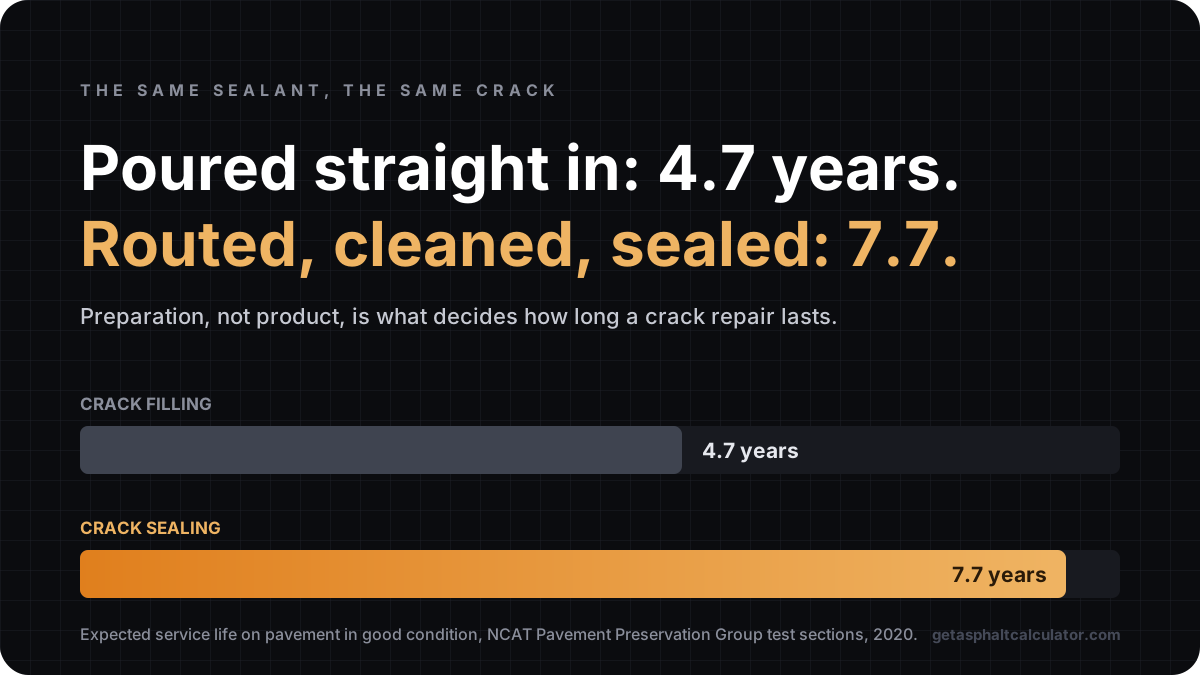
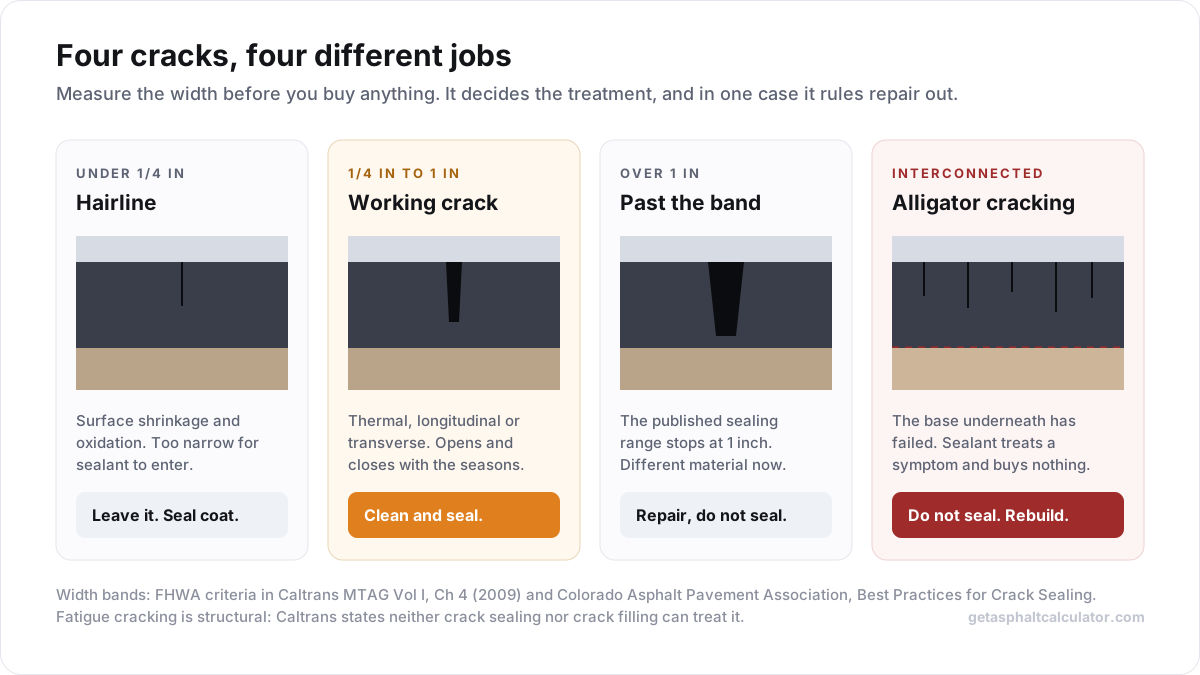
Fixing cracks in an asphalt driveway is worth doing yourself when the cracks are between about 1/4 inch and 1 inch wide. Below that they are too narrow for sealant to enter; above 1 inch you have crossed from sealing into repair, and the material changes with it. The work that decides how long the repair lasts is not the product you buy. It is the preparation: crack sealing on pavement in good condition is expected to last 7.7 years, against 4.7 years for the same material simply filled in (NCAT Pavement Preservation Group, 2020). And if the cracks form an interconnected web, stop. That is a failed base, and no filler treats it.
Can cracked asphalt be repaired?
Yes, if the crack is an isolated line between roughly 0.12 inch and 1 inch wide. That band is the published working range for both crack sealing and crack filling in the FHWA criteria reproduced in Caltrans MTAG Volume I, Chapter 4 (June 2009). Inside it, a cleaned and correctly filled crack keeps water out of the base, which is the entire point of the exercise. Caltrans adds a practical floor to that band: sealing is "usually triggered when the crack width exceeds 1/4 in." On a driveway that is the number to work to, because anything narrower is better handled by a seal coat than by chasing it with a sealant nozzle.
Outside that band the answer changes. A hairline crack will not accept sealant at all, and trying to force it in leaves a smear on the surface. A gap wider than an inch is past the sealing band: the Colorado Asphalt Pavement Association specifies that "Crack Repair shall be considered for any cracks over 1 inch wide," and past about an inch and a half it is a patch. And fatigue cracking — the interconnected alligator pattern — cannot be repaired by filling at any width. Caltrans is blunt about it: this type of cracking is structural, and "neither crack sealing or filling can treat this type of structural failure." The pavement is flexing because what is underneath it has gone soft.
So the first job is not shopping. It is measuring.
Start by measuring the crack, not by buying filler
Take a tape measure and a screwdriver down the driveway before you buy anything. Width tells you which product to use. Depth tells you whether you need to backfill first. Pattern tells you whether to proceed at all.
| Crack width | What it usually is | Correct treatment |
|---|---|---|
| Under 1/4 inch | Surface shrinkage, oxidation, early block cracking | Leave it. A seal coat closes cracking this fine |
| 1/4 inch to 1 inch | Thermal transverse, longitudinal, cold-joint or reflection cracking | Clean and seal. This is the working range |
| 1 inch to 1 1/2 inches | A crack that has widened and lost its edges | Past the sealing band. Repair with a hot-applied mastic, not standard crack sealant |
| Over 1 1/2 inches | No longer a crack | Remove and patch to the full depth of the damage |
| Interconnected web | Alligator (fatigue) cracking — the base has failed | Neither sealing nor filling helps. Full-depth patch or resurface |
Two terms get used interchangeably in the aisle and they are not the same thing. Crack sealing places an elastic material into a crack that moves with the seasons, and expects it to stretch. Crack filling places a cheaper, stiffer material into a crack that barely moves. Caltrans applies sealing when annual horizontal movement is 1/4 inch or more; the FHWA threshold is 1/8 inch. On a driveway you will not be measuring seasonal movement, so the practical rule is simpler: treat transverse cracks running across the driveway as working cracks and use the better material.
Reflection cracking
A crack that has copied itself upward through a new layer from a crack or joint in the pavement underneath. It reappears in the same line no matter how well you fill it, because the movement driving it is below the surface. Filling still helps — it keeps water out — but expect to redo it, and do not read its return as a failure of your workmanship.
Which asphalt driveway crack filler is best?
For a driveway you intend to keep, hot-applied rubberized material is the one that lasts. The Caltrans guide, citing FHWA research, puts emulsions and asphalt placed flush in unrouted cracks at 2 to 4 years of service, and hot-applied rubber asphalt at 6 to 8 years. That is the same crack, the same climate, and roughly double the life for the material choice alone.
| Filler type | How it goes in | Suits | The trade-off |
|---|---|---|---|
| Liquid asphalt emulsion | Poured cold from a jug or bottle, struck flush with a squeegee | Cracks 1/4 to 1/2 inch on a light-use driveway | Cheapest and easiest. Shrinks most, and needs a sand blotter before you drive on it |
| Sand-mixed filler or sealer | Troweled cold, or rolled as a filler-sealer | Hairline networks and shallow surface texture | Fills texture rather than sealing a moving crack. Best used as part of a seal coat |
| Rubberized cold-pour | Poured or gunned cold, no equipment | 1/4 to 1 inch cracks where renting a melter is not worth it | No published DOT service life of its own. Cures to a firmer film than hot pour, so it has less give in freeze-thaw |
| Melt-in rope | Pressed into the crack, then melted with a propane torch or heat gun | 1/4 to 1 inch cracks, including deep ones | The cheapest route to hot-applied material. Slow, and it means an open flame at ground level |
| Hot-pour rubberized | Melted in a kettle at 370 to 390 degrees F, poured, squeegeed flush | Long runs and anything in the working range | 6 to 8 years of service. Needs a melter, which is why it is the contractor standard |
Years of service by material and preparation
Read the two pairs separately. The first and third bars are about what you pour in. The second and fourth are about how you prepare the crack before you pour. Both roughly double the life of the repair, and they compound, which is why the preparation steps below matter more than the shelf you buy from.
What you need
Nothing here is specialist. The one item people skip is the wire brush, and it is the one that decides whether the sealant sticks to the crack walls or to the dirt in them.
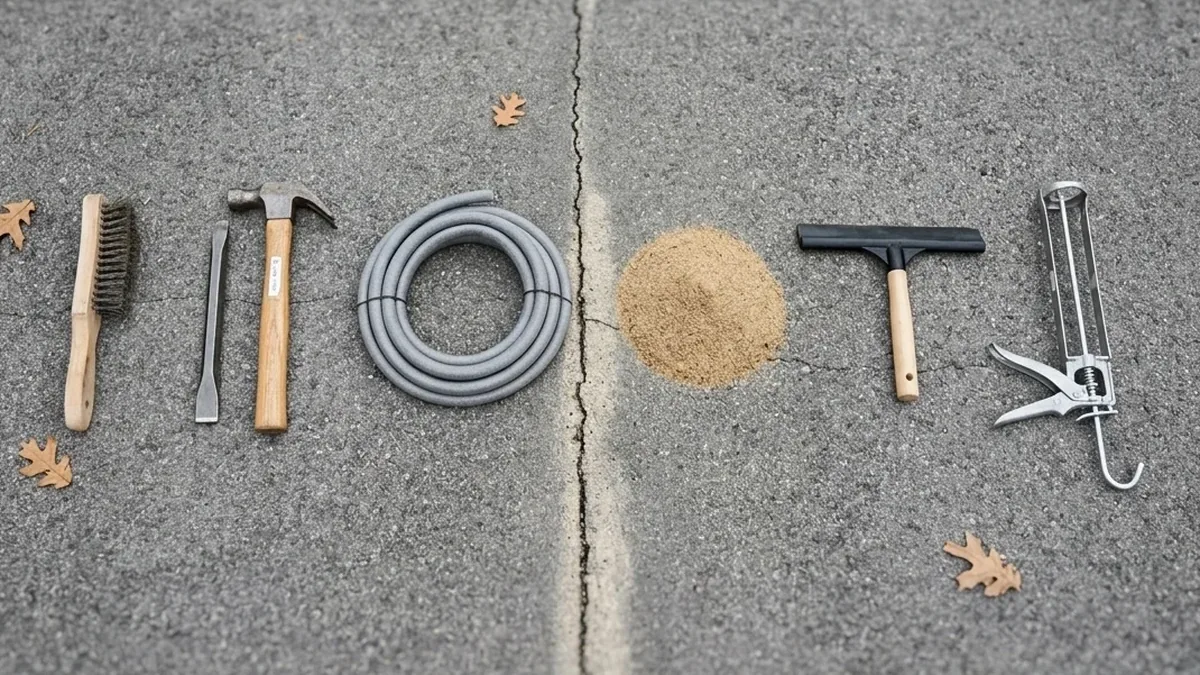
- Stiff wire brush — to scrub the crack walls back to clean asphalt. A wire wheel on a drill does the same job faster.
- Cold chisel and hammer, or a masonry blade — to knock back crumbling edges and square up a ragged crack.
- Leaf blower or shop vac, or a compressor — to blow the crack out. Contractors use compressed air at a minimum of 97 psi with moisture and oil traps fitted, because oil in the air line will stop the sealant bonding.
- Weed killer and a screwdriver — vegetation has to come out at the root, not be cut off at the surface.
- Coarse dry sand or foam backer rod — to build a floor in cracks deeper than half an inch.
- Your filler, sized to the widest crack you measured, plus about 20 percent more than the linear footage suggests.
- A rubber squeegee — the only finishing tool Caltrans recommends for material left proud of the surface.
- A tamper or a length of 4x4 — only if you are also patching, not for crack filling.
How to fix cracks in an asphalt driveway, step by step
1. Wait for the right weather
Crack treatments should go down in cool, dry weather, when the crack is open at its midpoint to widest. Caltrans names spring, fall and winter, and points to autumn air temperatures of 45 to 65 degrees F as the ideal window. Fill a crack in August, when it is squeezed shut by heat, and you place a thin bead that gets pulled apart the following January.
Against that, cold-pour products need warmth to cure. Asphalt Kingdom's application guide asks for several dry days in a row and temperatures over 60 degrees F, with a floor of 50 degrees F for alligator-patch coatings. Check your own product's label, because the threshold varies by formulation. Those two constraints meet in early autumn, which is the best time of year to do this work on most driveways. Do not start if freezing temperatures are forecast. On a newly paved surface, wait for the asphalt itself to harden first, which our guide to how long asphalt takes to cure puts at 6 to 12 months before any sealing work.
2. Get everything living out of the crack
Grass or weeds growing in a crack mean the crack has reached soil. Treat it with weed killer and give it several days, then dig the roots out with a screwdriver. Sealing over live vegetation guarantees the repair lifts, because the plant keeps growing underneath it.
3. Clean the crack down to bare walls
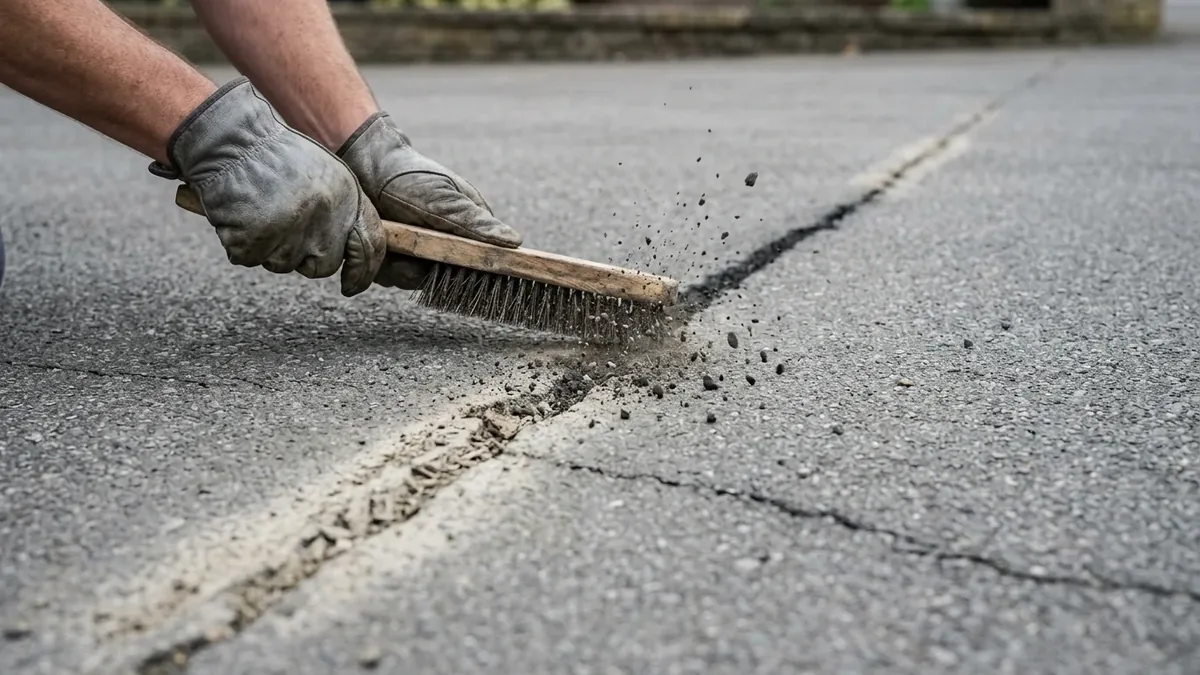
This is the step that decides everything else. Caltrans lists four accepted cleaning methods: air blasting, hot air blasting, sandblasting and wire brushing. The reason is stated plainly. Debris left in a crack reduces both adhesion and cohesion, and "reduced adhesion or cohesion normally results in early failures."
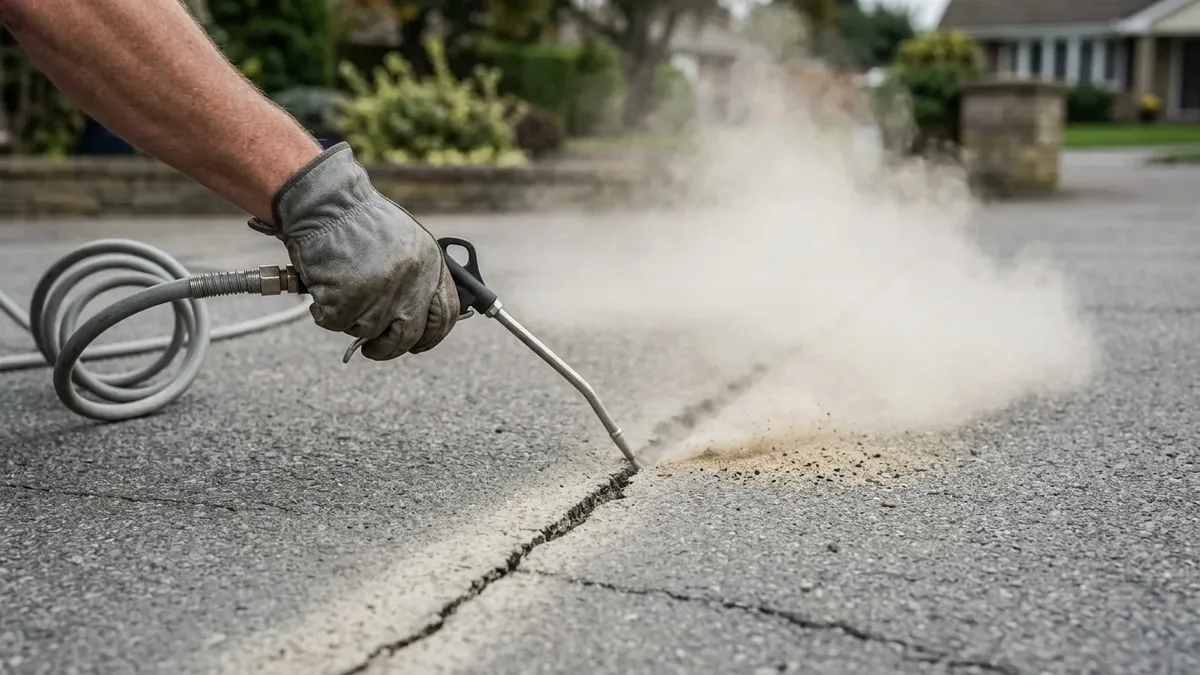
For a driveway, run a wire brush hard down the full length of the crack, then blow it out with a leaf blower or vacuum it. Scrub the walls of the crack, not just the bottom. The sealant has to grip those two faces, and it cannot grip dust. The crack must also be dry: sealant placed into a damp crack will not bond.
4. Square up ragged edges
Where the crack edges have crumbled, chisel the loose material away until you reach asphalt that does not move. You are not trying to widen the crack for its own sake; you are removing the pieces that will break out from under your sealant in the first winter.
Contractors go further and cut a clean reservoir with a router, typically 0.5 to 1.0 inch wide and 0.5 to 1.0 inch deep, and up to 1.5 inches wide in very cold climates. Renting a crack router is worth considering only if you have a long, straight run of transverse cracks. For a handful of cracks, a chisel and a wire brush get you most of the benefit.
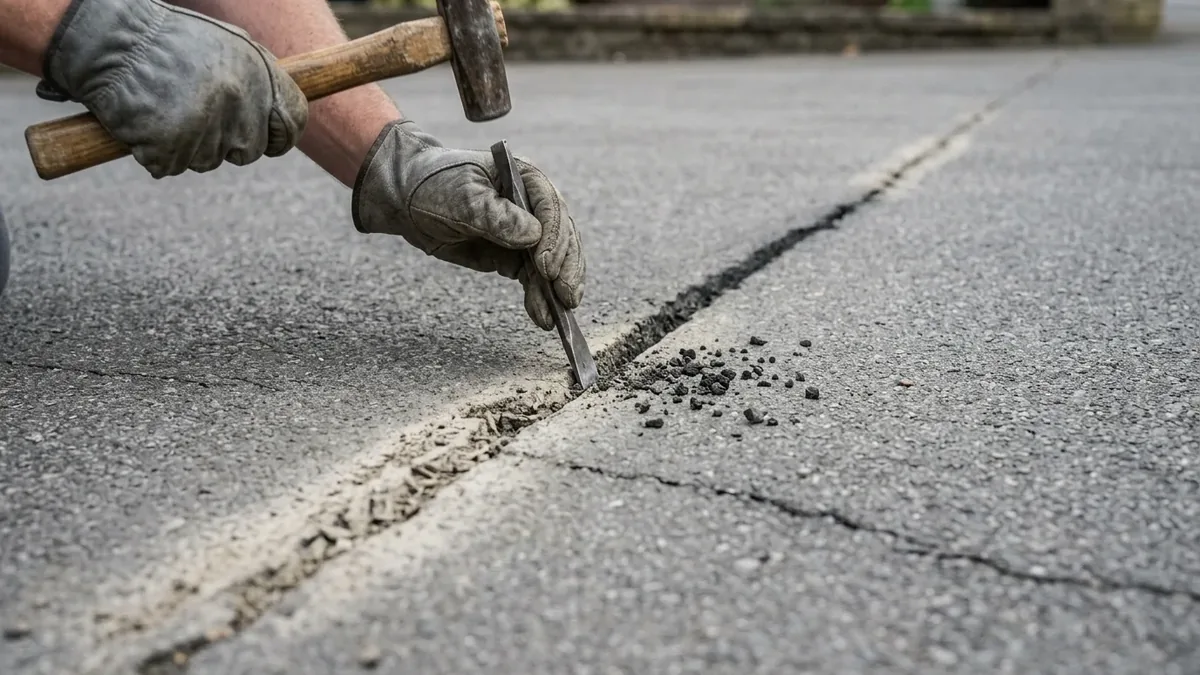
5. Build a floor under deep cracks
A crack deeper than about half an inch will swallow whatever you pour into it. Fill it with coarse dry sand, or press in a foam backer rod, until the void stops about half an inch below the surface. Then seal that last half inch.
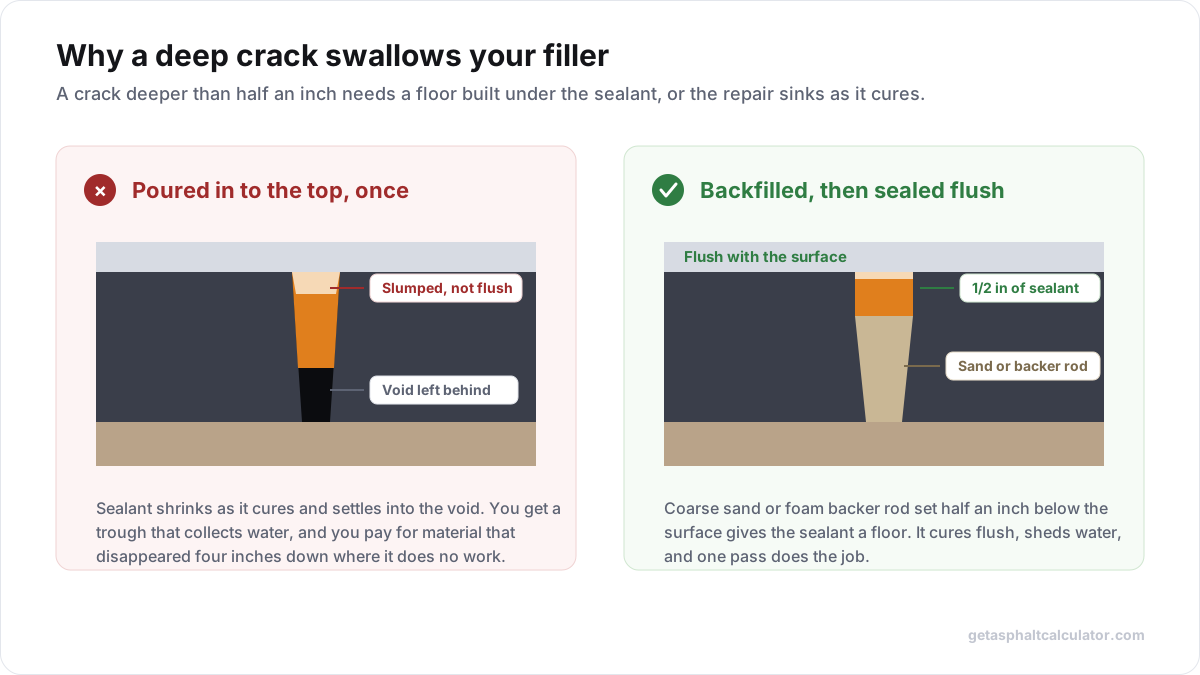
Skip this and one of two things happens. Either the sealant sinks as it cures, leaving a trough that collects the water you were trying to keep out. Or you spend three times the material burying most of it four inches down, where it does no structural work at all.
6. Lay the filler and strike it flush
Work along the crack in one continuous pass rather than dabbing at it. Overfill very slightly, then pull a rubber squeegee down the line to bring the material flush with the surface. Caltrans notes that a squeegee finish is the only method it recommends for sealant left on the surface. Any overband should not extend more than half an inch past the crack on either side. A wide black smear does not seal better. It just picks up under tires and looks like a repair.
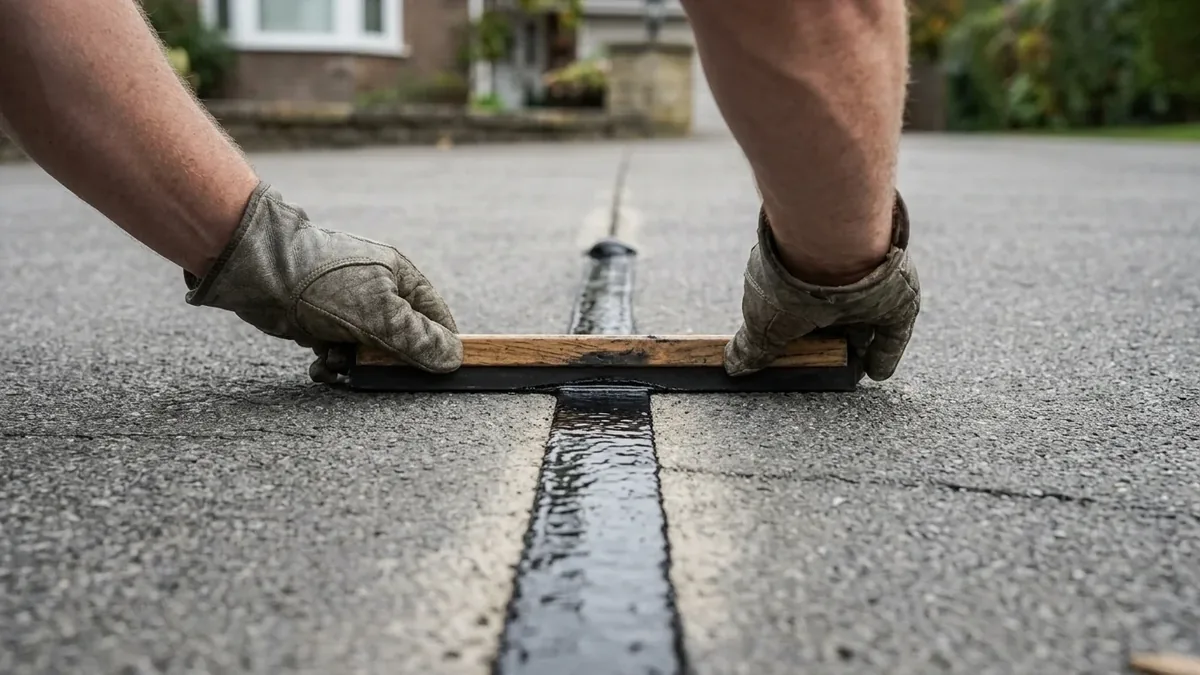
If you are using melt-in rope, press the rope down into the crack first, then run the torch along it until it flows and wets both walls. The point of the heat is adhesion to the crack faces, not a molten puddle on top.
7. Blot it, then leave it alone
Emulsion-based fillers must be blotted with clean, dry sand before anything drives over them, or they will pick up on tires. Hot-applied rubberized materials have enough adhesion that they do not need it. Contractor guidance is to keep traffic off for 24 to 48 hours; melt-in rope products claim foot traffic in about 20 minutes. When in doubt, give it the full weekend. A repair that cures untouched is the cheapest insurance available on the job.
When filling is the wrong repair
Filling seals a line. It does not rebuild a surface. Three situations call for something else, and spending on sealant in any of them is money gone.
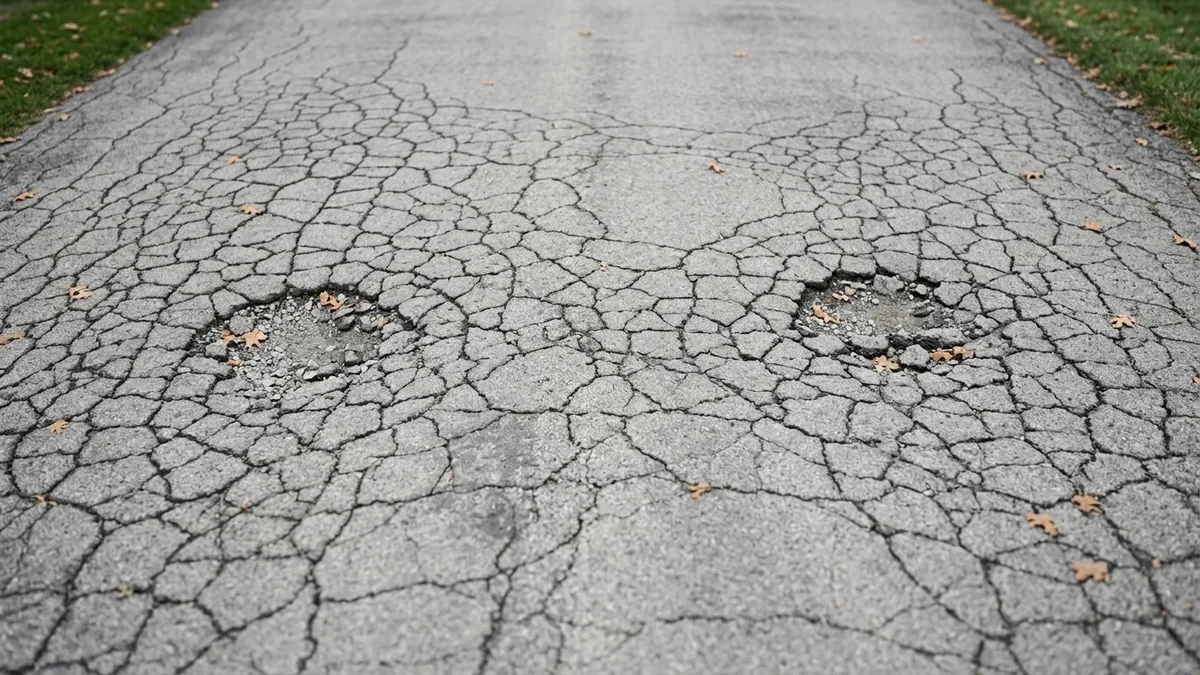
- Alligator cracking. An interconnected web means the base beneath has failed under load. Caltrans lists fatigue cracking among the distresses crack treatment cannot address. A gator patch coating restores appearance and sheds some water, but the structure underneath is unchanged. The real repair is a full-depth patch or resurfacing. A driveway that alligators under ordinary car traffic usually was not built thick enough for it — see how thick an asphalt driveway should be.
- Anything wider than about an inch and a half. Past that width you are filling a void, and cold asphalt patch compacted with a tamper is the correct material, not sealant. Between 1 and 1 1/2 inches a hot-applied mastic is the material, not standard crack sealant.
- Cracks that have already opened into potholes. Once the surface has collapsed there is a void under it. Filling the visible hole leaves the void in place, still collecting water.
How long does asphalt crack filler last?
Between two and nine years, and the spread is mostly down to preparation. The figures below come from FHWA research and NCAT field sections rather than product marketing, which is why they are worth more than the numbers on the jug.
| Treatment | Expected service life | Source |
|---|---|---|
| Emulsion or asphalt, flush, unrouted crack | 2 to 4 years | FHWA (1999), via Caltrans MTAG |
| Crack filling, pavement in good condition | 4.7 years | NCAT Pavement Preservation Group, 2020 |
| Hot-applied rubber asphalt, flush or overbanded | 6 to 8 years | FHWA (1999), via Caltrans MTAG |
| Routed and sealed, pavement in good condition | 7.7 years | NCAT Pavement Preservation Group, 2020 |
| Best case, full preparation and material selection | Sealants up to 9 years, fillers up to 8 years | FHWA (1999), via Caltrans MTAG |
One caveat worth holding onto: these are highway numbers, measured on pavement carrying traffic no driveway sees. The preparation ratio — roughly double the life for cleaning and routing — transfers cleanly to a driveway. The absolute years should transfer favorably. Set against a driveway that lasts 15 to 30 years, it also means you will be resealing the same cracks two or three times over the surface's life. That is the job, not a sign the first repair failed.
DIY or hire it out: what each costs
A contractor charges by the linear foot, and the rate turns on whether the cracks get routed first. Direct sealing on a residential or small commercial job runs about $0.90 to $1.50 per linear foot in 2026; routing and sealing runs $1.50 to $3.00. Small jobs land higher in practice because minimum call-out charges get spread over very little footage. That same minimum dominates a driveway sealcoating quote, where crack sealing is usually quoted as an add-on to the sealcoat itself.
What it costs a contractor to seal 200 linear feet of driveway cracks
That is the number to hold a DIY decision against. A driveway with 60 feet of cracking is roughly a $55 to $90 job professionally, before any minimum charge. That is close to what the material alone will cost you. The honest question at that size is whether you want to spend a Saturday on it, not whether you will save a fortune. Minimum call-out charges usually swallow jobs that small anyway. The arithmetic changes completely at 300 or 400 linear feet, where doing it yourself saves real money.
Does routing actually pay for itself?
Not on money alone, which is worth knowing before you pay a premium for it. Put the two sourced figures side by side and routing buys 64% more service life for 88% more money. Divide one by the other and the routed repair works out slightly more expensive per year, not less.
| Approach | Expected service life | Contractor rate | Cost per linear foot per year |
|---|---|---|---|
| Crack filling, no routing | 4.7 years | $1.20 per linear foot | $0.26 |
| Routed and sealed | 7.7 years | $2.25 per linear foot | $0.29 |
So the case for routing is not that it saves money. It is that it halves how often you are out there: on 200 linear feet over twenty years, three treatments instead of five, with the crack sealed continuously in between rather than reopening every few winters.
| Format | Typical pack | Stated coverage | Suits |
|---|---|---|---|
| Caulk cartridge | 10.1 fl oz | 55 linear feet at a 3/16 inch bead | Short cracks up to 1/2 inch |
| Melt-in rope, 1/4 inch | 60 ft roll | 60 linear feet | Narrow cracks around 1/4 inch |
| Melt-in rope, 1/2 inch | 30 ft roll | 30 linear feet | Cracks up to 1 inch, including deep ones |
| Rope, 1/2 inch, bulk | 125 ft roll | 125 linear feet | Long runs of 1/4 to 1/2 inch cracks |
| Sand-mix filler and sealer | 4.75 gal pail | 400 to 500 sq ft | Hairline networks, as part of a seal coat |
| Cold patch | 50 lb bag | 2 bags fill 2 ft x 2 ft x 2 in deep | Anything wider than 1 1/2 inches |
Measure your cracks in linear feet before you buy, and add about 20 percent. Running out halfway down a driveway on a Saturday afternoon is how repairs end up with two different products in the same crack, curing at different rates.
Past filling and into patching? Enter the area and depth of the repair to get the tonnage and material cost, so you can see how much of any contractor quote is asphalt and how much is the visit.
Open the asphalt calculatorFive things that make a crack repair fail
- Filling a damp crack. Sealant does not bond to wet asphalt. Give the driveway a dry day after rain, and longer if the cracks are deep.
- Sealing in high summer. The crack is at its narrowest, so you place the thinnest possible bead, and it gets stretched hardest six months later.
- Pouring straight into a deep crack. The material sinks as it cures. Backfill to half an inch below the surface first.
- Overbanding wide. Caltrans limits an overband to half an inch past the crack on each side, squeegeed flush. Wider bands pick up under tires and ride rough.
- Sealing alligator cracking. It treats a symptom of a failed base. The money is better spent on a full-depth patch, or saved toward resurfacing.
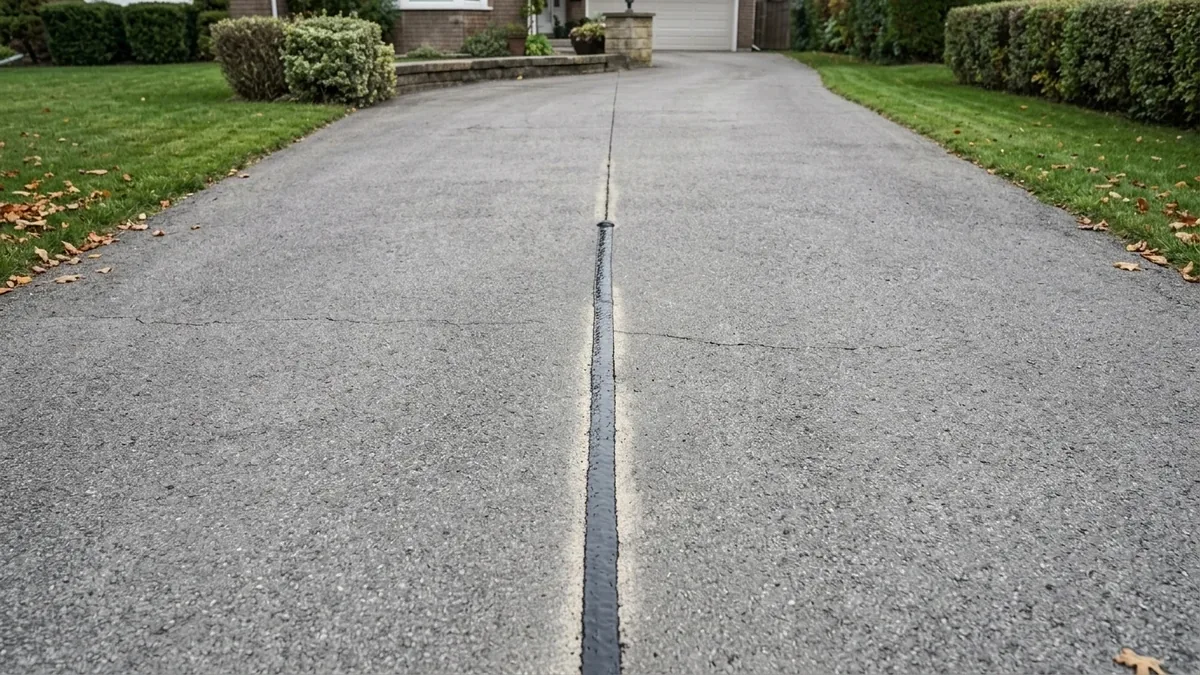
A crack repair done properly does not look impressive. It looks like a thin, flush, dark line, which is exactly what a driveway with no water getting into its base looks like.
At a glance: fixing asphalt driveway cracks in seven numbers
- 10.12 to 1 inch — the published width range in which crack sealing and crack filling both work, per the FHWA criteria in Caltrans MTAG Chapter 4.
- 27.7 vs 4.7 years — expected service life of routed and sealed cracks against filled cracks on pavement in good condition (NCAT, 2020).
- 32 to 4 years — service life of emulsion placed flush in an unrouted crack, against 6 to 8 years for hot-applied rubber asphalt.
- 445 to 65 degrees F — the air temperature window Caltrans points to for crack treatment, which puts the job in early autumn for most driveways.
- 51/2 inch — how far below the surface to stop your sand or backer rod backfill, and the maximum an overband should extend past the crack on each side.
- 6$0.90 to $3.00 per linear foot — 2026 contractor pricing, the lower half without routing and the upper half with it.
- 724 to 48 hours — how long to keep vehicles off a cold-pour repair before it is driven on.
Sources and citations
- Caltrans Division of Maintenance — Maintenance Technical Advisory Guide, Volume I, Flexible Pavement Preservation, Chapter 4: Crack Sealing, Crack Filling and Joint Sealing, June 9 2009 — dot.ca.gov
- National Center for Asphalt Technology (NCAT), Auburn University — "How Effective is Crack Sealing?", Pavement Preservation Group, Spring 2020 — eng.auburn.edu
- National Center for Asphalt Technology (NCAT) — "Crack Sealing: A Cost-Effective Option for Extending Pavement Life", Spring 2019 — eng.auburn.edu
- Federal Highway Administration — Materials and Procedures for Sealing and Filling Cracks in Asphalt-Surfaced Pavements, 1999, as cited throughout Caltrans MTAG Chapter 4
- Colorado Asphalt Pavement Association — Best Practices for Crack Sealing — co-asphalt.com
- Caltrans Division of Maintenance — Common Distresses on Flexible Pavements — dot.ca.gov
- TruTec — Crack Sealing Cost Per Linear Foot, March 2026, including the Lancaster County, Nebraska awarded bid unit price — trutec.ai
- Asphalt Kingdom — Asphalt Crack Filling Guide — info.asphaltkingdom.com
- Bob Vila — The Best Asphalt Driveway Crack Fillers, Vetted, updated June 2023 — bobvila.com
- Crafco — Hot-Pour Crack Sealant product information — crafco.com
Frequently asked questions
Yes, provided the cracks are isolated lines rather than an interconnected web. Cracks between about 0.12 inch and 1 inch wide sit in the published working range for crack sealing and crack filling under the FHWA criteria reproduced in Caltrans MTAG Chapter 4. Below 1/4 inch a crack is too narrow to accept sealant and is better handled by a seal coat. Above 1 inch the Colorado Asphalt Pavement Association treats it as repair rather than sealing, and past about an inch and a half it is a patch. Alligator cracking cannot be repaired by filling at any width, because the failure is in the base beneath the surface rather than in the surface itself.
Between two and nine years, depending almost entirely on preparation and material. Caltrans, citing FHWA research, puts emulsion placed flush in an unrouted crack at 2 to 4 years and hot-applied rubber asphalt at 6 to 8 years. NCAT's field sections found expected service life of 7.7 years for routed and sealed cracks against 4.7 years for filled cracks on pavement in good condition. With full preparation and the right material, FHWA figures put sealants at up to 9 years and fillers at up to 8.
Clean the crack down to bare walls with a wire brush, then blow it out. Backfill anything deeper than half an inch with coarse sand or foam backer rod, stopping half an inch below the surface. Place a hot-applied rubberized sealant and strike it flush with a rubber squeegee. Do the work in cool, dry weather, ideally at air temperatures of 45 to 65 degrees F when the crack is open. The cleaning step matters more than the product: NCAT measured roughly 60 percent more service life from routed and sealed cracks than from filled ones using comparable material.
Yes, for cracks in the 1/4 to 1 inch range, which is most residential driveway cracking. The tools are a wire brush, a chisel, a leaf blower, sand or backer rod, a squeegee and the filler itself. The limits are honest ones: alligator cracking, cracks wider than about an inch and a half, and potholes are beyond a DIY crack repair. For reference, a contractor charges roughly $0.90 to $1.50 per linear foot without routing in 2026, so on a short run the saving is modest; on 300 or more linear feet it becomes substantial.
Hot-applied rubberized material, by service life. FHWA figures reproduced by Caltrans put hot-applied rubber asphalt at 6 to 8 years against 2 to 4 years for emulsion placed flush in an unrouted crack. For a homeowner without a melter, melt-in rope products give access to hot-applied material using a propane torch or heat gun, and handle cracks up to about an inch wide. Rubberised cold-pour is the practical compromise where an open flame is not an option.
Hot pour lasts longer, cold pour is easier. Hot-applied rubberized sealant is placed at 370 to 390 degrees F and stays flexible through freeze-thaw cycles, which is why contractors use it. Cold pour needs no equipment and cures at ambient temperature, but sets to a firmer film with less give. For a driveway in a freeze-thaw climate that you intend to keep for another decade, the hot-applied material is usually worth the extra effort. For a few short cracks, cold pour is a reasonable trade.
Wider than 1 inch you have left the sealing band. The Colorado Asphalt Pavement Association specifies sealing for cracks "¼ inch to 1 inch" and states that "Crack Repair shall be considered for any cracks over 1 inch wide", which matches the 0.12 to 1 inch range in the FHWA criteria reproduced by Caltrans. Between 1 and 1 1/2 inches the material changes to a hot-applied mastic rather than standard crack sealant. Beyond about 1 1/2 inches, remove and patch to the full depth with cold asphalt patch compacted with a tamper. Depth is a separate question from width: any crack deeper than half an inch should be backfilled with coarse sand or foam backer rod to within half an inch of the surface, whatever its width.
Contractor guidance is 24 to 48 hours for cold-pour material before opening the area to traffic. Melt-in rope products, which are hot-applied, claim foot traffic in about 20 minutes. Emulsion-based fillers must be blotted with clean, dry sand before anything drives over them or they will pick up on tires; hot-applied rubberized sealants have enough adhesion that they do not need a blotter coat.
Not necessarily, but it is the single change with the largest effect on how long the repair lasts. Routing cuts a clean reservoir, typically 0.5 to 1.0 inch wide and deep, giving the sealant fresh walls to bond to and room to stretch. NCAT's test sections put routed and sealed cracks at 7.7 years of expected service against 4.7 for filled cracks. Renting a crack router is worth it for a long run of transverse cracks; for a handful, a cold chisel to knock back crumbling edges plus thorough wire brushing captures much of the benefit.
Fill the cracks first, always — a seal coat is a thin surface film and will not bridge a crack. Let the filler cure fully before sealing over it, following the product's own instructions, since cure times differ widely between cold-pour and hot-applied material. Whether the driveway needs a seal coat at all is a separate question that should be answered by condition rather than by a calendar interval.