A well-installed asphalt driveway lasts 15 to 30 years. Minimal maintenance (no sealcoating, ignored cracks) lands you at 10 to 15 years. Regular sealcoating and prompt crack repair push that to 20 to 25 years, and staying on top of both from year one can reach 25 to 30. Climate and traffic shift the range further, and concrete lasts roughly 10 years longer on average but costs more upfront.
Asphalt driveway lifespan swings by close to 20 years depending on one thing you control directly: maintenance. A driveway that gets sealcoated every 2 to 3 years and has cracks filled before they spread can run 25 to 30 years. The identical driveway, same mix, same install, left alone after the first winter can fail in 10 to 15. Climate, base preparation, and traffic load matter too, but maintenance is the lever with the biggest swing, and it is the one most guides skip in favor of a single flat number.
How long does an asphalt driveway last?
A properly installed asphalt driveway lasts 15 to 30 years (Bob Vila, NerdWallet). That is a wide range because it is really three different ranges stacked together, one for each maintenance tier a homeowner realistically falls into.
| Maintenance level | What it looks like | Typical lifespan |
|---|---|---|
| Minimal | No sealcoating, cracks and potholes patched only when they get bad | 10 to 15 years |
| Regular | Sealcoat every 3 to 5 years, cracks filled within a season of appearing | 20 to 25 years |
| Excellent | Sealcoat every 2 to 3 years starting in year one, cracks and drainage issues fixed immediately | 25 to 30 years |
Asphalt driveway lifespan by maintenance level
The gap between the top and bottom row is not really about the asphalt itself. Two driveways poured from the same truck on the same day can land 15 years apart in how long they last, purely based on whether anyone sealed and patched them on schedule.
How climate affects asphalt driveway lifespan
Freeze-thaw cycling is one of the leading causes of premature asphalt failure in cold regions. As water seeps into small surface cracks and repeatedly freezes and expands, it reduces the pavement's fracture resistance and shortens its fatigue life, with the effect becoming more pronounced as the number of freeze-thaw cycles increases (ScienceDirect). Chloride-based de-icing salts compound the problem, accelerating the same erosion-and-cracking cycle through the winter months.
Heat causes a different failure mode. In hot climates, asphalt can soften and turn gooey when temperatures spike, then re-harden as it cools. That repeated softening and re-hardening cycle can cause cracking or sagging over time, and heavily loaded areas like the spot under a parked car can rut or indent in extreme heat (Bob Vila; NerdWallet).
Neither climate rules asphalt out. It is the standard driveway surface in both snowbelt states and the Sun Belt. But a driveway in a hard freeze-thaw climate or a consistently 100°F-plus summer will generally sit at the lower end of its maintenance-tier range unless upkeep is a little more aggressive than the schedule above.
What shortens an asphalt driveway's lifespan
- Weak base preparation. Asphalt is only as stable as what is underneath it. A base that was not properly compacted before paving lets the surface settle and crack from below, no matter how well the top layer is maintained afterward.
- Poor drainage. Water that pools instead of running off is the raw material for freeze-thaw damage and base erosion. A driveway graded to shed water lasts longer than an identical one that holds puddles.
- Heavy or concentrated traffic. RVs, box trucks, and dumpsters parked in the same spot repeatedly stress the surface far more than routine car traffic, and can cause localized rutting.
- De-icing salt use. Salt-heavy winter maintenance accelerates the same freeze-thaw erosion that already threatens cold-climate driveways.
- Skipped sealcoating. Without a seal coat, UV rays and oxidation dry out the asphalt binder faster, turning the surface brittle and crack-prone years ahead of schedule.
How often should you seal and crack-fill an asphalt driveway?
Most guidance points to sealcoating every 2 to 3 years for a driveway with regular sun and traffic exposure, with some sources extending that to every 3 to 5 years for lighter-use residential surfaces (Bob Vila). It is worth letting a brand-new driveway cure for roughly a year before the first seal coat goes down, since sealing too early can trap moisture in asphalt that has not fully hardened.
Crack filling runs on a different clock: as soon as you see one, not on a schedule. A hairline crack sealed within a season costs a few dollars in filler. The same crack left through a winter of freeze-thaw cycling can widen into a pothole or invite base failure underneath it, which is a repair that costs considerably more.
Asphalt vs. concrete driveway lifespan
Typical driveway lifespan: asphalt vs. concrete
Concrete generally outlasts asphalt by about a decade, running 30 to 40 years against asphalt's 20 to 30 (Bob Vila). Concrete's rigid slab construction resists long-term wear better, though it is also less forgiving of ground movement and can crack under the same freeze-thaw stress that asphalt simply flexes through. Asphalt also costs less upfront and takes days rather than a week to cure before it can handle traffic.
Signs your asphalt driveway needs replacing, not just repair
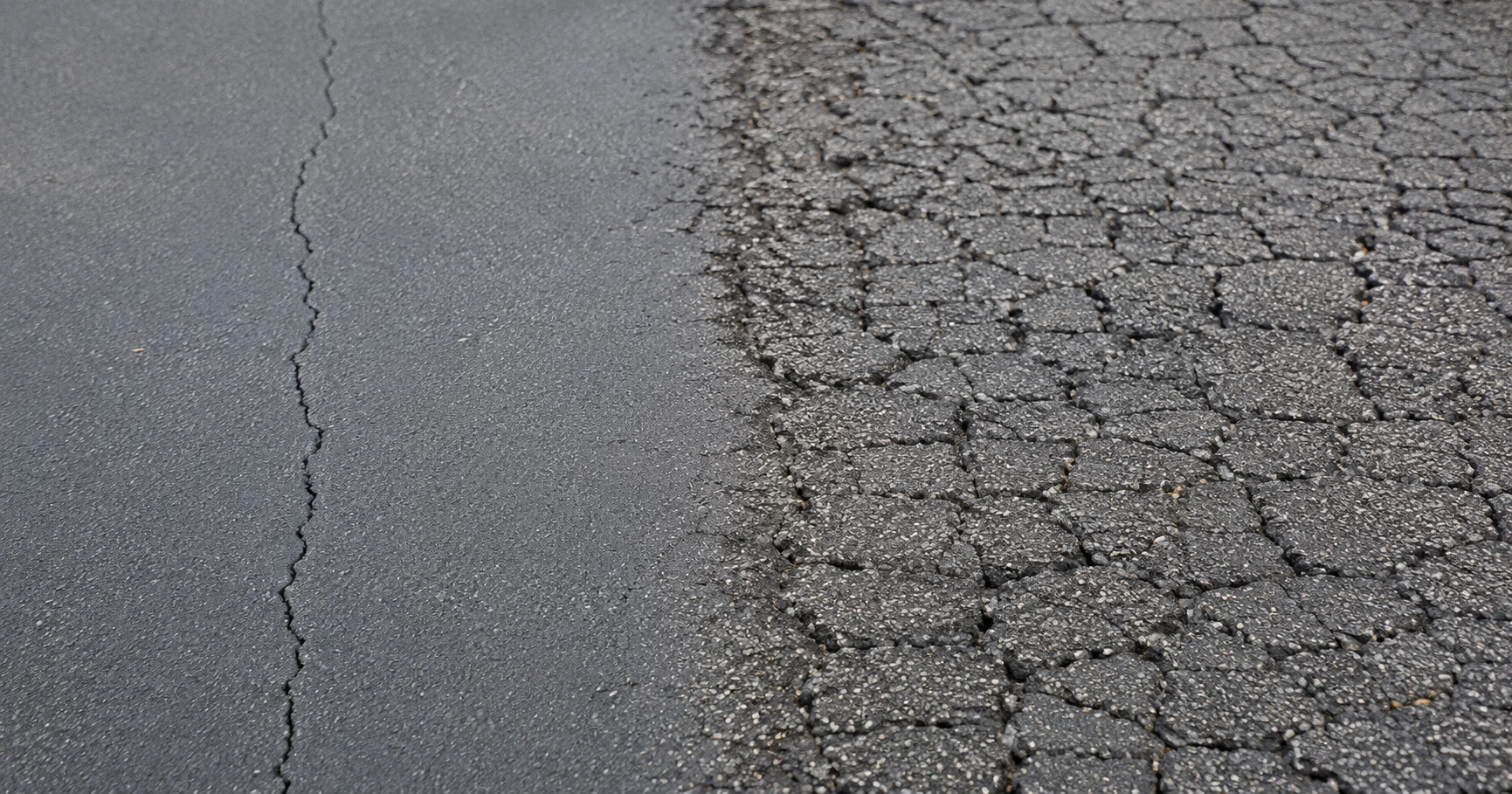
- Alligator cracking across a large area. This interconnected, hide-like crack pattern is a sign of fatigue failure from repeated traffic loading, and is often linked to sub-base failure or inadequate drainage underneath the surface (FHWA). A few isolated patches are repairable; alligator cracking across most of the surface usually is not.
- Potholes that keep coming back. A pothole that reopens after patching points to a base problem, not a surface one.
- Sunken or birdbath areas that hold water. Standing water after every rain means the base has settled, and that section will keep degrading from beneath.
- Cracks wider than about a quarter inch, spreading. Once cracking outpaces what routine filling can keep up with, resurfacing or replacement is usually the more cost-effective call.
- The driveway is nearing 20 to 25 years old with a thin maintenance history. Age alone is not the deciding factor, but an older, under-maintained driveway showing any of the signs above is a strong replacement candidate rather than a repair candidate.
If your driveway is showing one or two of these signs rather than several at once, resurfacing is often the cheaper path. Our guide on resurfacing vs. replacing an asphalt driveway walks through how to tell which one your driveway actually needs.
What are the disadvantages of asphalt driveways?
- Needs sealcoating on a schedule. Skip it and the surface ages faster than the maintenance-tier table above suggests.
- Softens in extreme heat. Repeated softening and re-hardening in hot climates can cause cracking, sagging, or rutting under parked vehicles.
- Shorter lifespan than concrete. Even at the excellent-maintenance tier, asphalt tops out around where concrete's typical range begins.
- One aesthetic option. Asphalt comes in uniform black. Stamping, coloring, and exposed-aggregate finishes are concrete-only options.
- Softer surface, more prone to gouging. Kickstands, sharp furniture legs, and dropped tools can dent asphalt in hot weather in a way they would not mark concrete.
Extending your driveway's lifespan (and what replacement costs if you wait too long)
The gap between a 12-year driveway and a 28-year driveway is almost entirely maintenance: sealcoat on schedule, fill cracks the season they appear, and keep water moving off the surface instead of pooling on it. None of that is expensive compared to what it prevents.
What it prevents is a full replacement, which runs $7 to $15 per square foot installed in 2026, averaging around $5,258 nationally with a typical range of $3,128 to $7,391 depending on driveway size and site conditions (NerdWallet). A few hundred dollars in sealcoating spread across a decade is a small fraction of that.
At a glance: asphalt driveway lifespan in seven numbers
- 115 to 30 years — typical lifespan range for a properly installed asphalt driveway.
- 210 to 15 vs. 25 to 30 years — minimal maintenance versus excellent maintenance, the biggest single factor in where a driveway lands.
- 32 to 3 years — how often to sealcoat a driveway with regular sun and traffic exposure.
- 420 to 30 vs. 30 to 40 years — asphalt versus concrete typical lifespan.
- 5$7 to $15 per sq ft — installed cost of a new or replacement asphalt driveway in 2026.
- 6$5,258 — national average cost for a full driveway installation.
- 7Alligator cracking + standing water — the two clearest signs a driveway needs replacement, not just patching.
Sources and citations
- Bob Vila — Concrete vs. Asphalt Driveways
- NerdWallet — Asphalt vs. Concrete Driveway Cost
- Federal Highway Administration — Distress Identification Manual for the LTPP Program
- ScienceDirect — Effect of Freeze-Thaw Cycles on the Properties of Asphalt Pavements in Cold Regions: A Review
- National Asphalt Pavement Association — asphaltpavement.org
- Asphalt Institute — asphaltinstitute.org
- Asphalt Driveway Cost Calculator (internal tool)
- Asphalt Calculator (internal tool)
- Asphalt vs. Concrete Driveway (internal guide)
- Asphalt Driveway Thickness Guide (internal guide)
- Asphalt Resurfacing vs. Replacement (internal guide)
Frequently asked questions
A properly installed asphalt driveway lasts 15 to 30 years. Minimal maintenance lands you at 10 to 15 years, regular sealcoating and prompt crack repair push that to 20 to 25, and staying on top of both from year one can reach 25 to 30.
Most sources put the average asphalt driveway lifespan at around 20 years, roughly the midpoint of the 15 to 30 year range. Where a specific driveway falls depends mainly on maintenance history, local climate, and how much traffic it carries.
Concrete typically lasts about a decade longer than asphalt: 30 to 40 years versus asphalt's 20 to 30. Asphalt costs less upfront, cures faster, and flexes better with freeze-thaw ground movement, while concrete needs less routine maintenance over its longer lifespan.
There is no fixed age for replacement. A well-maintained driveway can go 25 to 30 years before it needs full replacement rather than resurfacing or patching, while a neglected one can need replacement in 10 to 15. Watch the condition, not the calendar: alligator cracking across most of the surface, recurring potholes, and standing water are the signs that mean replacement rather than repair.
Sealcoat every 2 to 3 years for a driveway with regular sun and traffic exposure, or every 3 to 5 years for lighter residential use. Wait roughly a year after a new installation before the first seal coat so the asphalt fully cures first.
Asphalt needs sealcoating on a schedule to reach its full lifespan, can soften and sag or rut in extreme summer heat, has a shorter lifespan than concrete, and offers only one aesthetic option: uniform black. It is also softer than concrete, making it more prone to gouging from sharp objects in hot weather.
Freeze-thaw cycling is one of the leading causes of premature asphalt failure in cold regions, as water in small cracks repeatedly freezes and expands, reducing the pavement's fracture resistance over time. De-icing salt use compounds the effect. Regular sealcoating and prompt crack filling are the main defenses.
A full asphalt driveway replacement costs $7 to $15 per square foot installed in 2026, averaging around $5,258 nationally with a typical range of $3,128 to $7,391 depending on driveway size and site conditions.