The best time to pave an asphalt driveway is late spring through early fall, roughly May through September in most of the US. The surface being paved needs to be above 50°F and rising, and the ground underneath needs to be dry and settled. The 50°F figure is a simplification: state specifications set the minimum by lift thickness, from 36°F for a 3-inch layer up to 60°F for a thin surface course. On the asphalt cement index, the cheapest workable month is April, about 5 points below the August peak. October is still about 2 percent above the annual average, which is higher than May, so October's advantage is crew availability and not the material price. Avoid early spring as well as the frozen months: while the subgrade is still thawing, the ground is at its weakest.
What is the best time of year to pave an asphalt driveway?
Late spring through early fall, May to September across most of the United States. That window gives you three things at once: surface temperatures comfortably above the minimum for placing and compacting hot mix, dry weather, and a subgrade that has finished draining after the winter thaw. Miss any one of those three and the driveway can be laid perfectly and still fail early.
Most guides stop at "pave when it's warm." That is not wrong, but it is not the constraint a contractor is actually working against. The binding constraint is how long the mix stays hot enough to compact after it leaves the truck. That depends on the temperature of the ground it lands on, the thickness of the layer, and the wind, far more than on the number in the weather forecast.
Paving season timing in five points
- 1May to September: the prime window in most of the US, warm surfaces, dry ground, and a settled subgrade.
- 250°F and rising: the common minimum surface temperature, but it applies to a 1 to 1.4 inch lift. Thicker layers can go colder; thinner ones need more.
- 3April and October: the shoulder months. Still workable in most regions and easier to book. On the material index April sits below the annual average, while October is still about 2 percent above it.
- 4Early spring: the most misunderstood risk. The ground is thawing from the top down and the subgrade is at its weakest of the year.
- 5Late fall: a hard stop. Some surface courses are barred by date regardless of temperature, and plants close for the winter.
What is the minimum temperature for laying asphalt?
There is no single number, the minimum surface temperature is set by how thick the compacted layer is. Ohio DOT's construction manual sets four bands: 36°F for a lift of 3 inches or more, 40°F for 1.5 to 2.9 inches, 50°F for 1.0 to 1.4 inches, and 60°F for anything under an inch (Ohio Department of Transportation, Construction Manual §401.06, retrieved 2026-09-16).
The logic runs the other way from what most people assume. A thicker layer holds its heat longer, so it tolerates a colder day. A thin surface course sheds heat into the ground almost immediately, so it needs a warm surface to have any working time at all. This is why the "50 degree rule" you see repeated everywhere is really a rule about one specific lift thickness that happens to be common on driveways.
| Compacted lift thickness | Minimum surface temperature | What this is typically used for |
|---|---|---|
| Less than 1.0 inch | 60°F | Thin overlays and skim coats |
| 1.0 to 1.4 inches | 50°F | A standard driveway surface course |
| 1.5 to 2.9 inches | 40°F | A full-depth driveway lift or binder course |
| 3.0 inches or more | 36°F | Base courses and heavy-duty construction |
Minimum surface temperature by compacted lift thickness
Surface temperature, not air temperature
Specifications are written against the temperature of the surface the asphalt is being placed on, not the ambient air. The Federal Highway Administration's inspection guidance requires the reading to be taken on the surface to be paved, as the average of three measurements taken about 8 metres apart. A 55°F afternoon over ground that is still 42°F is a colder job than the forecast suggests.
Why ground temperature beats the forecast
Because the clock that matters is compaction time, and cold ground drains it fast. Hot mix has to reach at least 93 percent of its laboratory maximum density before it cools past roughly 175°F. Below that cessation temperature the mix is too stiff to move, and further rolling starts crushing aggregate instead of compacting the mat (Dave Johnson, P.E., Asphalt Institute, The reality of cold weather compaction, Asphalt magazine, 5 December 2016).
How much time that leaves is startlingly sensitive to how the job is built. Modelling typical late-season conditions in Billings, Montana, the Asphalt Institute found a single 3-inch compacted lift gave the crew about 60 minutes of working time. Splitting the same depth into two 1.5-inch lifts cut it to roughly 20 minutes for the first and 18 for the second.
Minutes available to compact, modelled late-season conditions
That is the real reason cold-weather paving goes wrong. Nothing announces itself on the day, the mat looks fine, the crew leaves, and the surface ravels two winters later because it never reached density. Wind and cloud cover shorten the window further; the same site is measurably less forgiving on an overcast day than a sunny one at identical air temperature.
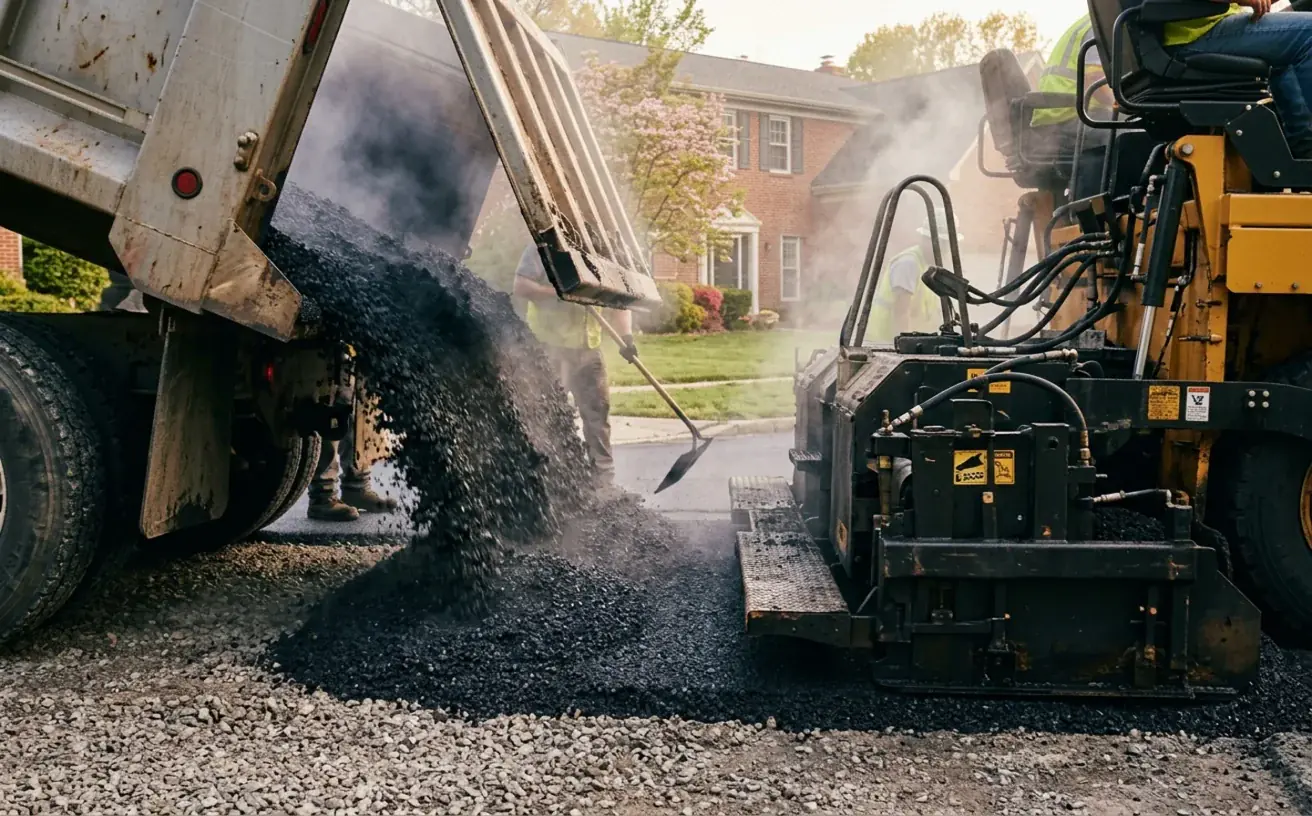
There is one genuine technology lever here. Warm mix asphalt, made with additives that keep the binder workable at lower temperatures, drops the cessation temperature to around 160°F, worth roughly five extra minutes, or about 28 percent more working time in that 18-minute scenario. It is no longer a niche product: warm mix accounted for 40 percent of all asphalt produced in the United States in 2024 (National Asphalt Pavement Association, retrieved 2026-09-16). If you are paving at the cold edge of the season, it is a reasonable thing to ask your contractor whether the plant is running it.
Month by month: when you can pave and what it costs
The pavable months and the cheap months are not the same months, and the overlap is where the value sits. The table below pairs the seasonal position of the asphalt cement price index with whether the work is realistically possible, for a northern or frost-belt climate.
| Month | Index vs. its annual average | Can you pave? |
|---|---|---|
| January | −6.0% | No, frozen ground, most plants closed |
| February | −4.8% | No, frozen ground, most plants closed |
| March | −3.4% | Rarely, subgrade is thawing and weakest |
| April | −1.4% | Late April, once the ground has drained |
| May | +0.8% | Yes |
| June | +3.1% | Yes |
| July | +3.3% | Yes |
| August | +4.0% | Yes, and the index peaks here |
| September | +3.7% | Yes |
| October | +2.1% | Yes, early to mid-month |
| November | −0.1% | Narrow window, and calendar cutoffs apply |
| December | −1.4% | No |
Is it cheaper to pave in the off-season?
Partly, and less dramatically than most paving sites claim. We ran the numbers rather than repeating them. Across 25 years of monthly asphalt cement index data published by the Maryland Asphalt Association, the index follows a consistent seasonal shape. It bottoms in January at about 6 percent below the annual average, climbs through spring, and peaks in August at about 4 percent above it before falling back through late autumn. Peak to trough, that is a swing of roughly 10 percentage points. Split into five-year blocks, the low always falls between December and February and the high between June and September, though the size of the swing varies from block to block.
Seasonal shape of the asphalt price index (100 = annual average)
The catch is that the cheapest months are the ones you cannot pave in. Of the months that are actually workable, April sits about 5 points below the August peak and November about 4 points below it. That is a real discount on the material, but the material is only one line on the quote. A 4 to 5 percent move on the binder index is not a 4 to 5 percent move on your driveway.
What the savings claim is really about
Most of the published off-season discount comes from contractor capacity. Crews that are booked six weeks out in July are quoting for work in late October, and that shows up in the labour and mobilisation lines rather than the tonnage.
So the off-season advice comes down to this. Shoulder-season timing is worth asking about. The savings come mostly from a contractor who wants to keep a crew working, and the material index gives you a small tailwind rather than the headline. Anyone quoting you a precise percentage for seasonal savings is estimating, because no one publishes installed driveway prices by month. What you can do is separate the part of the quote that is material from the part that is not. Our guide to how much an asphalt driveway costs breaks a quote into those parts.
See how much of your quote is actually asphalt. Enter your driveway dimensions and depth to get the tonnage and material cost, so you can tell a genuine shoulder-season discount from a repackaged one. Open the driveway cost calculator.
Want to see where prices are right now? The asphalt price index lists the current state DOT binder index for each state we track, month by month. Pair it with asphalt price per ton by mix type to see what the mix your job needs should cost before the seasonal adjustment.
When should you not pave your driveway?
The spring thaw is the real risk, more than the frozen months, because it does not look dangerous. In winter, water in the soil freezes into ice lenses. In spring the ground thaws from the top down, and the meltwater is trapped above a layer that is still frozen and cannot drain. The subgrade ends up saturated, unconsolidated and at its weakest point of the year, exactly when the weather starts to feel like building season.
Thaw weakening
Frost action needs three things at once: a frost-susceptible soil with a significant fraction of fines, subfreezing temperatures penetrating the soil, and available water. Remove any one and the effect largely disappears. During thaw the subgrade loses bearing capacity and stiffness because the melted ice cannot drain away fast enough, leaving the soil saturated and loosened by the original freeze.
This is not a theoretical concern. It is why northern and frost-belt states impose seasonal load restrictions on their roads every spring. Michigan, for example, cuts permitted truck weights by 35 percent on flexible (asphalt) pavements and 25 percent on rigid (concrete) ones for the duration of the restriction, lifting them only once frost depths and road conditions confirm the roadbed has regained stability (Michigan Department of Transportation, retrieved 2026-09-16). State agencies do this to protect roads that are already built. A driveway being built on that subgrade is more exposed, not less.
- While the ground is still thawing. Wait until the subgrade has drained and firmed up. In the frost belt that usually means late April rather than late March.
- On wet ground, in any season. Water in the base is the problem whether it came from thaw or from three days of rain. Compaction against a soft subgrade produces a surface that deforms under the first heavy vehicle.
- When rain is forecast inside 24 hours. Fresh asphalt that has not set can be damaged by rain in the first day or two.
- After the local calendar cutoff, even if the week turns unseasonably mild. The cutoff exists because the trend matters more than the day.
- As an emergency winter fix. If a surface fails in January, the answer is a cold mix repair to get through to spring, not a new driveway laid in the cold.
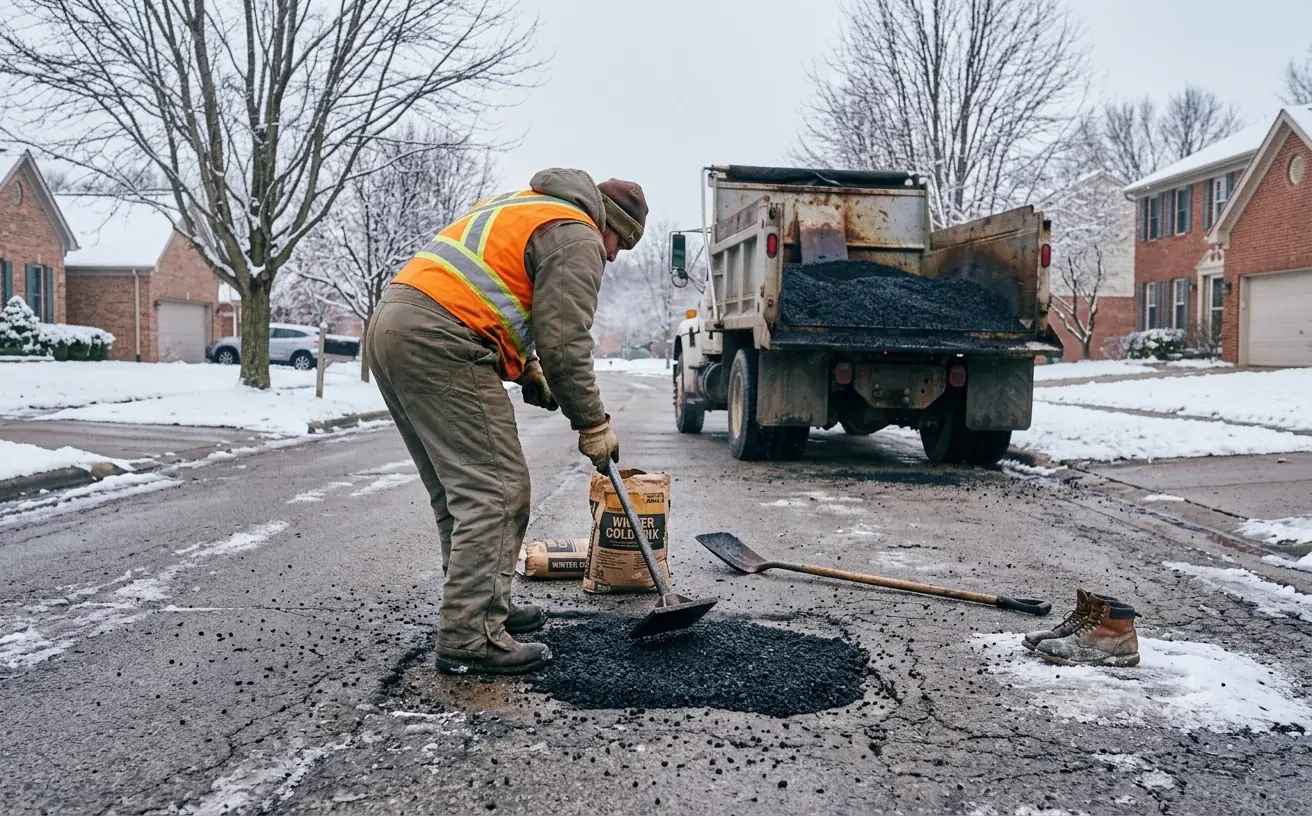
Best time of year to pave a driveway in the Northeast and other regions
The further north you are, the narrower the window and the more the shoulder months matter. Southern states can pave through most of the year, while frost-belt states lose both the winter and the spring thaw.
| Region | Realistic paving window | What drives the limit |
|---|---|---|
| Northeast | Late April to early November | Spring thaw at the front, plant closures and calendar cutoffs at the back. Mid-May to late September is the comfortable core. |
| Midwest / Upper Midwest | May to late October | The deepest frost penetration in the country, so the spring wait is the longest. |
| Mid-Atlantic | April to early November | A genuine shoulder at both ends; October is workable and usually easier to book than midsummer. |
| South / Gulf | Most of the year | Heat and afternoon storms, not cold. Summer rain delays are the scheduling risk. |
| Southwest / desert | Most of the year, avoiding peak summer | Very high surface temperatures can make the mat tender and slow to set. |
| Pacific Northwest | Late spring to early autumn | Rain rather than frost defines the season. |
| Mountain West | June to September at elevation | Short season and wide day-to-night temperature swings. |
The Federal Highway Administration's own inspection guidance shows how sharply this varies even inside a single state. Top-course placement is permitted from 1 April to the third Saturday of November in some counties, and only from 1 May to the third Saturday of October in others. If a state agency draws that line differently county by county, a national rule of thumb is not going to settle your driveway.
How long should the ground sit before paving?
Compact the base. Waiting for it to settle does not make it sound. This question usually comes from a reasonable instinct: new ground needs time to bed in. But waiting is not what makes a base sound. Mechanical compaction is. A properly prepared aggregate base is graded, compacted in layers with a roller or plate compactor, and paved over once it is firm and draining, which can be the same week.
Where waiting genuinely helps is after excavation in wet conditions, or over disturbed ground that needs a dry spell to drain. The wait is for moisture to leave the subgrade. If a contractor proposes laying asphalt over a base that is rutting under the truck tyres, the answer is more compaction or more drainage, not a thicker mat over the top.
Getting the structure right matters more than the date. How thick should an asphalt driveway be covers the surface and base depths for residential use, and as the compaction figures above show, lift thickness is also what decides how cold a day the job can survive.
How long should you stay off a new asphalt driveway?
Walk on it after about 24 hours, drive on it after 48 to 72 hours, and keep heavy vehicles off for the first few weeks. In cool weather that traffic-ready window stretches to about a week, because the mat sheds heat more slowly into cold ground and stays soft longer, one more reason the shoulder-season discount comes with a scheduling cost.
- 24 hours: foot traffic is fine.
- 48 to 72 hours: normal cars, in warm conditions. Up to a week when it is cold.
- First 2 weeks: avoid parking in one spot for long periods, turning the wheel while stationary, or putting kickstands and trailer jacks directly on the surface. The mat is still firming up and will take an impression.
- 6 to 12 months: full cure, as the binder finishes oxidising and hardening. It is normal for a new surface to still feel slightly soft after a fortnight.
- Before the first sealcoat: wait until the surface has cured, at least 6 to 12 months.
The full timeline, including what rain does in the first 72 hours: How long does asphalt take to cure separates drying from curing and walks through the first year. When the surface is ready to protect, asphalt driveway sealcoating cost covers what that job should run.
Paving season cutoff and plant shutdown dates
The season ends on a date, not on a temperature. Ohio DOT's specification prohibits contractors from scheduling a surface course with a polymer-modified binder after 1 November, regardless of the pavement or air temperature. A mild first week of November does not reopen the window.
Behind that sits a supply constraint that catches homeowners out every autumn: hot mix plants shut down for the winter. A plant is a heating operation, and running one for scattered small jobs in December does not pay. Closing dates are set regionally, announced each autumn, and once the nearest plant closes your options narrow to whatever is still running within haul distance. That matters, because hot mix loses workability the longer it sits in transit.
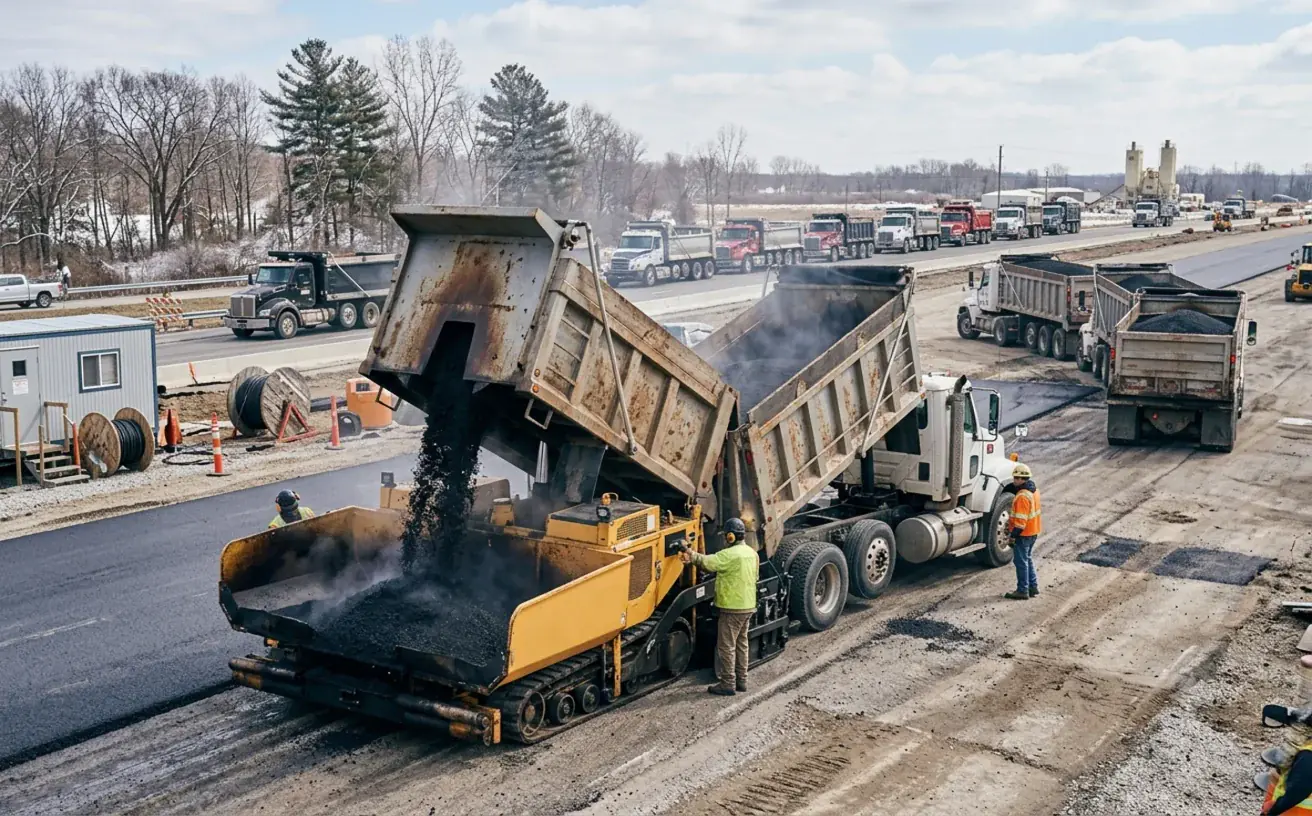
The practical move, if you are aiming at the shoulder, is to call a contractor in late summer for an October slot, or in late winter for an April one. Both avoid the midsummer rush, both are still inside the workable window, and both need booking ahead. Ringing round in the third week of October to get something done before winter tends to mean a rushed job at the cold edge of the season.
Sources and citations
- Ohio Department of Transportation, Asphalt Concrete Pavements, General (Construction Manual §401)
- Federal Highway Administration, Asphalt Pavement Construction Review Guidance
- Asphalt Institute, The reality of cold weather compaction, Dave Johnson, P.E., Asphalt magazine, 5 December 2016
- Colorado Asphalt Pavement Association, Cold Weather Paving (CDOT Table 401-4)
- National Asphalt Pavement Association, Asphalt again leads America's recycling effort (2024 Recycled Materials and Warm Mix Usage survey)
- Maryland Asphalt Association, Monthly Asphalt Index, posted with Maryland SHA approval. Seasonal analysis in this article is our own.
- Pavement Interactive, Frost Action
- Minnesota Department of Transportation, Seasonal Load Limits: frost and thaw depths
- Michigan Department of Transportation, Annual spring weight restrictions begin Tuesday to protect Michigan's roads
- Asphalt Driveway Cost Calculator (internal tool)
- Asphalt Price Index (internal tool)
- How Long Does Asphalt Take to Cure? (internal guide)
- Cold Mix vs Hot Mix Asphalt (internal guide)
- How Thick Should an Asphalt Driveway Be? (internal guide)
Frequently asked questions
Late spring through early fall, roughly May to September in most of the US. That window gives warm surface temperatures, dry weather and a subgrade that has finished draining after the winter thaw. April and October still work in most regions and tend to be easier to book. On the asphalt index April is slightly below the annual average, and October is still slightly above it.
It depends on how thick the compacted layer is. Ohio DOT requires a minimum surface temperature of 60°F for a lift under 1 inch, 50°F for 1.0 to 1.4 inches, 40°F for 1.5 to 2.9 inches, and 36°F for 3 inches or more. Thicker layers hold heat longer, so they tolerate colder ground. The reading is taken on the surface being paved, not from the air temperature.
Modestly, and mostly for reasons that are not the material price. Our analysis of 25 years of Maryland asphalt index data shows the index peaks in August and bottoms in January, a swing of about 10 percentage points. But of the months you can actually pave in, April and November sit only about 4 to 5 points below the peak. The larger off-season saving comes from contractor capacity in the shoulder months, which no one publishes as a fixed percentage.
During the spring thaw, on wet ground, with rain forecast inside 24 hours, or after your region's late-autumn cutoff. Early spring is the most underrated risk: the ground thaws from the top down and meltwater is trapped above a still-frozen layer, leaving the subgrade saturated and at its weakest point of the year. Michigan, for example, cuts permitted truck weights by 35 percent on asphalt roads during that period for exactly this reason.
Walk on it after about 24 hours and drive on it after 48 to 72 hours, or up to a week in cool weather. For the first two weeks avoid parking in one spot for long periods or turning the wheel while stationary, since the mat will still take an impression. Full curing takes 6 to 12 months.
The base should be compacted rather than left to settle, so there is often no waiting period at all, a properly graded and roller-compacted aggregate base can be paved the same week. Waiting only helps when the subgrade needs a dry spell to drain after excavation in wet conditions. The wait is for the moisture to leave.
In most of the country, no. Frozen or thawing ground cannot support the work, hot mix loses compaction time too quickly against a cold surface, and most plants close for the season. If a surface fails in winter, the right response is a cold mix repair to hold it until spring rather than a new driveway laid in the cold.
Early fall is one of the best times of the year. September still has warm ground and settled weather, and early October often combines a workable surface with better contractor availability than midsummer. Late fall is where it gets risky, some surface courses are barred by calendar date regardless of temperature, and plants begin shutting down for the winter.