Illustration: getasphaltcalculator.com
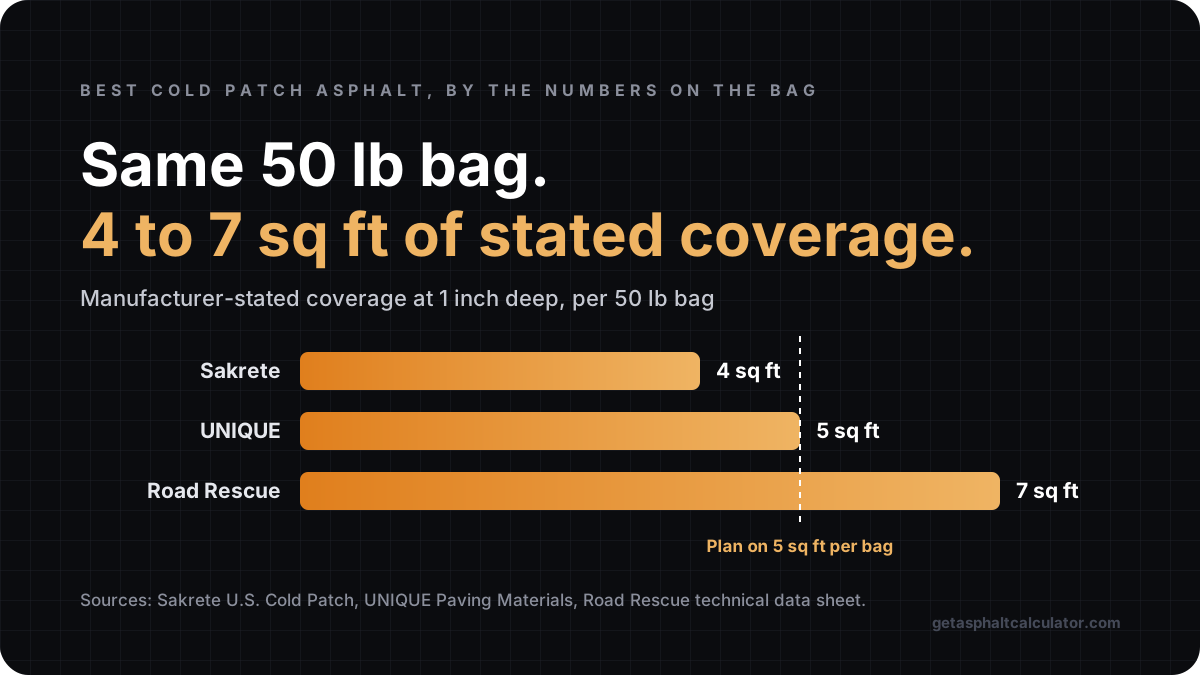
The best asphalt patch for most driveway potholes is a 50 lb bag of compactable cold patch, placed in 2 inch layers and tamped hard. Road Rescue Asphalt Patch is the general pick, ProLine is worth a look for holes that will not dry out, Sakrete U.S. Cold Patch suits small deep holes, an 11 lb pail covers one small repair, and ADFORS Peel & Seal is a waterproof cap that goes over a fill rather than replacing it. The brands differ most in what they claim to cover, from 4 to 7 square feet per bag at 1 inch deep. Plan on about 5 square feet per 50 lb bag and you will not run short.
Key takeaways
- 1Compact every layer: Every data sheet in this guide calls for compacting each layer. In the SHRP H-106 field study reported by FHWA, simple throw-and-roll patches proved as effective as the semi-permanent procedure in most situations, and patches made with quality materials can stay in service for several years.
- 2Stated coverage is not comparable: Manufacturers state 4 to 7 sq ft per 50 lb bag at 1 inch deep for similar products. Size your order on about 5 sq ft per bag.
- 3Layers, not one pour: Every data sheet we read calls for holes deeper than 2 inches to be filled in layers of 2 inches or less, each compacted before the next.
- 4Peel-and-stick is a cap: ADFORS tells buyers to fill the hole with cold or hot mix first, then seal over it with the patch.
- 5Know when to stop: A hole that reopens in the same place has a failed base. No bagged product fixes that.
How we chose these cold patch products
This is a spec-based buyer's guide, not a hands-on test. We read each manufacturer's technical data sheet where one exists, compared the stated coverage, depth limits, layer thickness and curing instructions, and checked the Amazon listing against it. Where a figure comes only from a seller's listing, we say so.
We weighted three things for a homeowner patching a driveway: a published coverage figure, so you can work out how many bags to buy; clear depth and layer instructions, because compaction decides whether a patch survives; and availability in a size that matches the job. Price is not in the ranking. Amazon's rules bar us from quoting its prices, and retail bag prices for the main brands are already covered in our pothole repair cost guide.
Best cold patch asphalt at a glance
| Product | Type | Size | Stated coverage | Best for |
|---|---|---|---|---|
| Road Rescue Asphalt Patch, 2-pack | Bagged cold patch | 50 lb bags (2) | About 7 sq ft at 1 in per bag | Most driveway potholes |
| Sakrete U.S. Cold Patch | Bagged recycled-asphalt patch | 50 lb bag | 4 sq ft at 1 in per bag | Small, deep holes up to 2.5 ft square |
| 11 lb Blacktop Patch pail (HE304044-A) | Pail of asphalt and aggregate | 11 lb pail | About 2 sq ft at 1 in for Henry HE304 (confirm the label matches) | One small hole or a broken edge |
| ADFORS Peel & Seal Driveway Patch | Self-adhesive patch over a fill | 19.6 in x 10 ft roll | 16.3 sq ft of surface (cap only) | Sealing the top of a filled pothole |
1. Road Rescue Asphalt Patch: best for most driveway potholes
Road Rescue is the most flexible bag here, with the fullest instructions. Its data sheet says it can be applied in hot or cold and wet or dry conditions, needs no mixing, and takes traffic as soon as it is compacted. The Amazon listing is a two-pack of 50 lb bags and adds that the edges of the hole do not need squaring and that the product contains zero VOCs.
The instructions are specific. Sweep out loose debris, fill to half an inch above the surrounding surface, then tamp or drive over it. Holes over 1 square foot and 2 inches deep go in 2 inch layers, each packed down before the next. The sheet asks you to wait 30 days before sealing over the patch.
Best for: a typical driveway pothole you want to fill in one afternoon. Watch out for: the coverage claim. Road Rescue states that each compacted 50 lb bag covers about 7 square feet at 1 inch. That is the most generous figure among the bags we compared, and the section on bag counts below explains why we would not order on it.
2. Sakrete U.S. Cold Patch: best for small, deep holes
Sakrete is the most conservative and the most precisely specified bag. Its product page states a yield of 4 square feet at 1 inch deep and an application depth of 1 to 4 inches, not exceeding 2.5 ft by 2.5 ft (about 6 square feet) overall. The data sheet includes a bag-count table and says the product is made from more than 95% recycled asphalt, can be used in all weather, and is ready for traffic right after compaction.
Sakrete calls for repairs over 2 inches deep to go in 1 to 2 inch lifts, each compacted with a post or tamper, and the finished patch to be slightly crowned. You can compact the last layer with a tamper, a shovel, or your car's wheels.
Best for: a compact, deep pothole within its 6 square foot limit, where you want a bag count you can trust. Watch out for: its own size cap. A hole larger than 2.5 ft by 2.5 ft is outside what Sakrete says the product is for.
3. 11 lb blacktop patch pail (HE304044-A): best for one small repair
A pail is the right size when a full bag would be mostly wasted. The Amazon listing is an 11 lb pail with manufacturer number HE304044-A, which matches Henry's HE304 Driveway Asphalt Pothole Patch. Note that the brand field on the listing reads MOLLIFII rather than Henry, so check the label in the listing photos before you buy. If it is not Henry HE304, the coverage and cure times below do not apply.
Henry's HE304 data sheet describes a ready-to-use asphalt and aggregate compound for potholes and cracks in driveways, parking areas and pathways. It takes traffic right after compacting, should go in layers of no more than 2 inches in holes deeper than that, and needs 3 weeks to cure before sealing. Henry states coverage of about 2 square feet at 1 inch per 11 lb pail.
Best for: a single hole the size of a dinner plate, a crumbled driveway edge, or a corner by the garage apron. Watch out for: that coverage figure. The same data sheet lists a weight of 11.1 to 11.5 lb per gallon, so an 11 lb pail holds just under one gallon of loose material. Spread 1 inch deep, a gallon covers about 1.5 square feet before any compaction, and compaction only makes it smaller. Plan on 1.5 square feet per pail, not 2.
4. ADFORS Peel & Seal Driveway Patch: best as a waterproof cap
Peel & Seal does not fill a pothole. It seals the top of one you have already filled. ADFORS, the Saint-Gobain business behind American Road Patch, instructs buyers to fill the hole with cold or hot asphalt mix first, then apply the patch over it. The patch is a bitumen-backed sheet with an aggregate top that bonds to asphalt and concrete.
ADFORS lists a 19.6 inch by 10 foot roll covering 16.3 square feet, about 1/8 to 3/16 inch thick. Cut it to extend 4 inches past the repair on every side, and overlap pieces by 3 inches on larger or irregular repairs. ADFORS says the driveway can take traffic immediately and that a typical repair takes 10 to 20 minutes.
Best for: keeping water out of a fresh fill, since water getting under the patch is one of the main ways a repair breaks up. Watch out for: it adds a step and a second product, so it only pays off on a hole you expect to see heavy water or traffic.
Also consider: ProLine Cold Asphalt for wet or cold-weather holes
ProLine is outside our ranking because it publishes no coverage figure, but it is the one to look at when a hole will not dry out. It is a polymer-modified cold asphalt, and its Amazon listing says it works in water. Trade listings for the maker, Logan County Asphalt Co., describe it as a permanent, ready-to-use material that is poured and compacted, and say it will feed from a patching truck at 20°F without heat.
Be clear about where that evidence comes from: the wet-hole claim is the seller's. We found no independent test of ProLine specifically. The general idea is credible, since UNIQUE Paving Materials makes the same claim for its own cold mix and says removing water from the pothole is not necessary. Even so, a hole that keeps holding water is telling you something about drainage under the pavement (see when to skip the patch, near the end).
Best for: winter and early-spring holes that cannot be pumped dry. Watch out for: the listing does not state a coverage figure, so use the planning rule below to size the order.
Compact every layer: a steel hand tamper
Whatever patch you buy, you need a way to compact each layer. Every data sheet above allows driving over the final layer, but each layer below it has to be packed before the next goes in, and you cannot drive into a hole halfway through filling it. A flat steel tamper on a long handle does that job.
- Walensee 8 x 8 in steel tamper: solid steel head of about 9 lb, 48 inch three-piece detachable handle, per the listing. The smaller face puts more force on each blow and fits narrow holes.
- BlumeTrec 10 x 10 in steel tamper: about 11.9 lb with an all-steel 48 inch handle, per the listing. Covers a wide hole in fewer strokes.
How many bags of cold patch do you need?
Plan on about 5 square feet per 50 lb bag at 1 inch deep, and round up. That is 10 lb of cold patch per square foot per inch of depth, the figure UNIQUE Paving Materials publishes for its own mix and the one our pothole repair cost guide uses. The bags in this guide do not agree with it, or with each other.
Stated coverage at 1 inch deep, per 50 lb of material (sq ft)
Compacted hot mix weighs about 145 lb per cubic foot, so 50 lb of it covers only 4.1 square feet at 1 inch. Cold mix compacts less densely: UNIQUE's figure of 10 lb per square foot per inch works out to about 120 lb per cubic foot. Road Rescue's 7 square feet implies about 86 lb per cubic foot, and Henry's figure, scaled up, even less. Those numbers may hold for those mixes, but they are the manufacturer's, and running short halfway through a hole is worse than having a bag left over.
So order on the planning figure, and keep any spare. Unopened bags keep: Road Rescue quotes a one-year shelf life for a sealed bag.
| Hole size | Material at 10 lb/sq ft/in | 50 lb bags to buy | Sakrete's own table | 11 lb pails |
|---|---|---|---|---|
| 1 ft × 1 ft, 2 in deep | 20 lb | 1 | 1 bag | 2 |
| 2 ft × 2 ft, 2 in deep | 80 lb | 2 | 2 bags | Use bags |
| 2 ft × 2 ft, 4 in deep | 160 lb | 4 | 5 bags | Use bags |
| 2.5 ft × 2.5 ft, 4 in deep | 250 lb | 5 | 6 bags | Use bags |
| 3 ft × 3 ft, 4 in deep | 360 lb | 8 | Over Sakrete's size limit | Use bags |
Sakrete's own table asks for more bags than the planning rule on the deeper holes, and on the 2 ft × 2 ft, 4 inch hole it asks for one more bag (5) than even its own 4 sq ft yield implies (4). If you buy Sakrete, buy to Sakrete's table. Once a hole needs seven or eight bags, the material alone approaches the low end of a professional quote (our cost guide puts that at about $150 for a hot-mix patch), which is where it draws the DIY line.
Which patch for which hole?
| What you have | What to use | Why |
|---|---|---|
| A crack, not a hole | Crack filler, not cold patch | Sakrete's minimum patch depth is 1 inch; cracks need a pourable or tube filler |
| One small hole or a broken edge | 11 lb pail | A 50 lb bag would mostly go to waste |
| Pothole up to 2.5 ft square, 1 to 4 in deep | Sakrete or Road Rescue bag | Inside Sakrete's stated limits; both give layer instructions |
| Larger or deeper pothole | Road Rescue bags in 2 in layers, or a contractor | Past Sakrete's limit, and beyond about 8 bags a professional quote becomes competitive |
| Hole with water that will not drain | Polymer-modified cold patch such as ProLine | Sold for wet application, but check why the water is there |
| Filled hole on a heavily used or wet spot | Fill, then cap with ADFORS Peel & Seal | Seals the top so water cannot get into the fill |
For cracks, our guide to fixing cracks in an asphalt driveway covers the working width range and preparation. Sealing a crack while it is still a line is the cheapest way to avoid the pothole altogether.
How to install cold patch so it lasts
Follow the data sheet: thin layers, each one compacted. Every manufacturer in this guide gives the same core method. The best field evidence on cold patching is mixed but useful. The SHRP H-106 study, reported by the Federal Highway Administration, placed more than 1,250 cold-mix patches at eight test sites in the United States and Canada, and 56% were still in service at the final round of monitoring in 1995. It found that simple throw-and-roll patching was as effective as the semi-permanent procedure in most situations, and more cost-effective, and that patches made with quality materials can stay in service for several years.
- Clean the hole. Sweep out loose stone and debris. Henry also says to brush away standing water and kill any weed roots.
- Fill in layers. On holes deeper than 2 inches, place no more than 2 inches at a time (Sakrete says 1 to 2 inches).
- Compact every layer. Use a steel tamper on each layer before adding the next. This is the step people skip.
- Overfill the top. Road Rescue says to finish half an inch above the surface; UNIQUE says to crown the final layer about 25% above the hole's depth so it compacts down flush.
- Compact the top hard. Tamp it, then drive over it. Henry suggests laying plywood over the patch before rolling it with a wheel, for a cleaner finish.
- Wait before sealing. Road Rescue says 30 days and Henry says 3 weeks before applying sealer over the patch.
What is better than cold patch asphalt?
A saw-cut, full-depth repair with hot mix asphalt is the better fix, but it is a contractor job. It is the only option that removes a failed base rather than covering it. Cold patch is the right material for a homeowner, for winter, and for holes where the base is still sound. Our cold mix vs hot mix asphalt comparison covers the temperature limits and durability data for each.
Skip the patch altogether if the same hole has reopened after an earlier repair, if the edges crumble when you sweep them, or if water stands in or beside it after rain. Any of those means material is washing out from underneath, and the pothole repair cost guide explains what a full-depth repair involves and costs. If holes are appearing faster than you can patch them, compare asphalt resurfacing versus replacement instead.
Pricing a bigger repair? Enter the area and depth to get tonnage and current hot mix cost, and compare it with what the same job would take in bags.
Open the asphalt cost calculatorSources and citations
- Road Rescue, Residential/Commercial Grade Asphalt Patch technical data sheet, thdstatic.com, retrieved 30 October 2026
- Sakrete, U.S. Cold Patch product page, sakrete.com, and data sheet (rev. 04/16), sakrete.com, retrieved 30 October 2026
- Henry, HE304 Driveway Asphalt Pothole Patch technical data sheet (rev. 09/09/2015), lowes.com, retrieved 30 October 2026
- ADFORS, Peel & Seal Driveway Patch product page and FAQ, adfors.com, retrieved 30 October 2026
- Logan County Asphalt Co., ProLine Cold Asphalt Patching Material, For Construction Pros product listing, forconstructionpros.com
- UNIQUE Paving Materials, cold patch coverage and application, uniquepavingmaterials.com, retrieved 30 October 2026
- FHWA Focus, January 2000, SHRP H-106 pothole patching study, fhwa.dot.gov
- Amazon product listings for each linked item, checked 30 October 2026
- Asphalt Cost Calculator (internal tool)
Frequently asked questions
For most driveway potholes, a 50 lb bag of compactable cold patch such as Road Rescue Asphalt Patch or Sakrete U.S. Cold Patch. Road Rescue is rated for hot or cold, wet or dry conditions and gives clear layer instructions. Sakrete states the most conservative coverage, 4 sq ft at 1 inch per bag, and is meant for holes up to 2.5 ft by 2.5 ft and 1 to 4 inches deep. For a single small hole, an 11 lb pail is enough. Whichever you choose, compact each layer as the data sheet directs.
Yes, once it is compacted, and it keeps firming as it cures. Sakrete says compacted U.S. Cold Patch becomes as hard as hot asphalt, which is a manufacturer claim. The data sheets set curing periods before you seal over a patch: 30 days for Road Rescue and 3 weeks for Henry HE304. If a patch stays soft and ruts under tires, check it was placed in layers of 2 inches or less and compacted as each data sheet asks.
Into a hole in asphalt, yes. As a thin layer over a sound surface, no. Sakrete gives a minimum application depth of 1 inch, and none of the data sheets describe skimming cold patch over intact pavement. Feathered edges thinner than that break up under traffic. For surface cracks use a crack filler, and for a worn surface use sealer or resurfacer.
Multiply the hole's length by its width in feet, multiply by its depth in inches, then divide by 5 and round up. That works on about 10 lb of cold patch per square foot per inch, the figure UNIQUE Paving Materials publishes. A 2 ft by 2 ft hole 4 inches deep needs about 160 lb, so buy four 50 lb bags. If you are using Sakrete, follow its own table, which calls for five bags for that hole.
Some products are sold for it. ProLine's listing says it works in water, and UNIQUE says removing water from the pothole is not necessary for its mix. Henry, by contrast, says to brush away standing water first. If you can clear the water, do. If water keeps collecting in or beside the hole after rain, the base underneath is likely failing, and a patch will not hold for long.