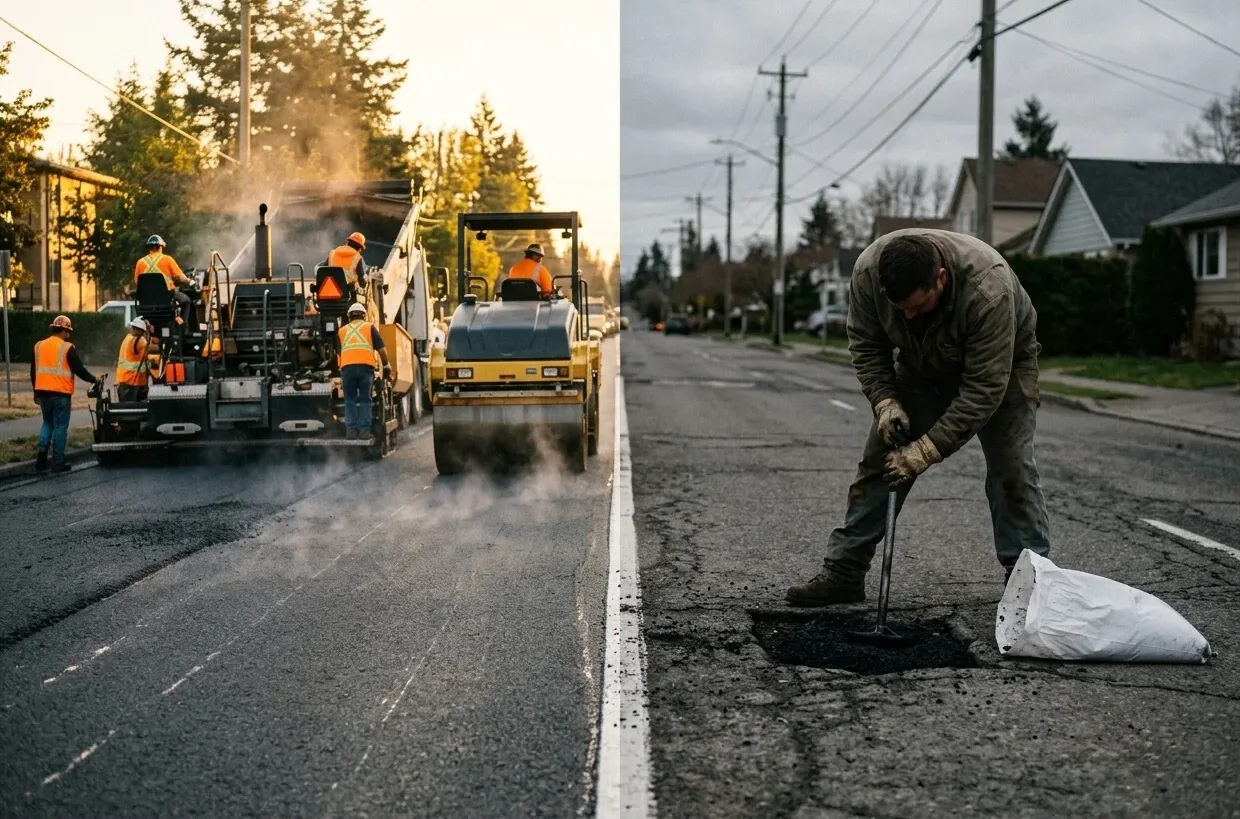
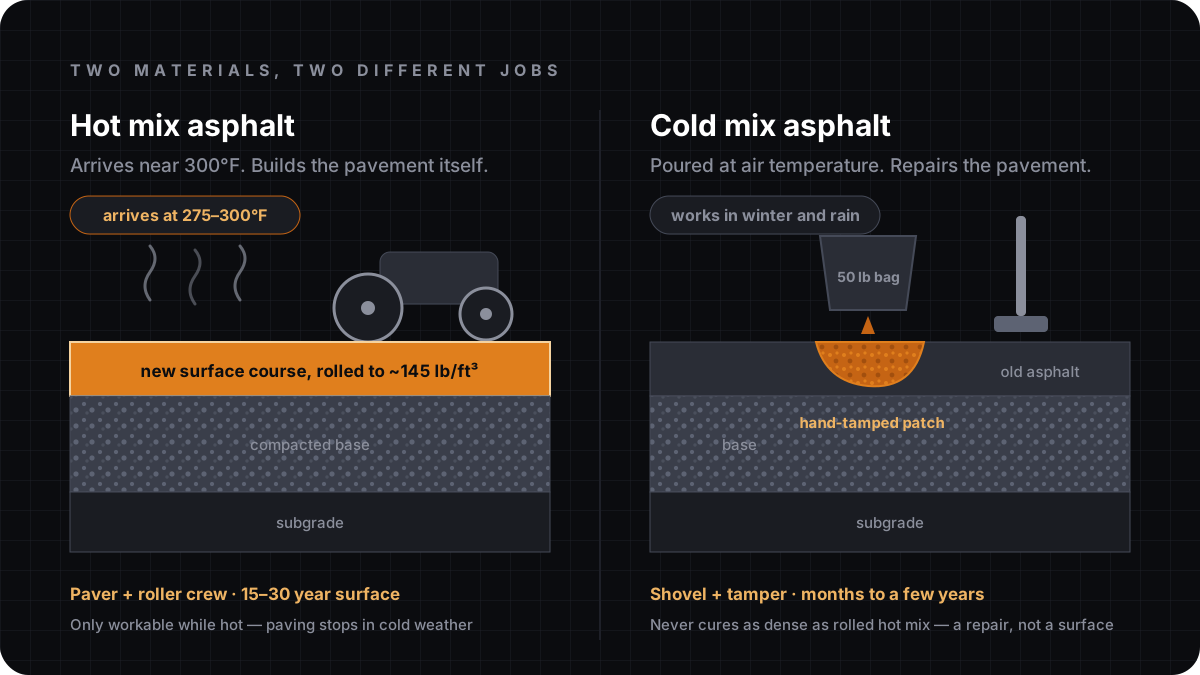
Hot mix asphalt is the permanent material: it arrives at 275 to 300°F, needs a paver and roller crew, and builds surfaces that last 15 to 30 years. Cold mix works at air temperature straight from a bag or stockpile, which makes it the right material for pothole repairs and winter fixes, and the wrong one for anything structural. Choose hot mix for any new surface. Choose cold mix when you are filling a hole, not building a pavement.
Cold mix and hot mix asphalt are not two grades of the same product. They are two different tools. Hot mix is what every road, driveway, and parking lot surface is actually built from. Cold mix exists to repair hot mix when a full crew, a 300°F delivery, and a compaction roller are not available. That is why cold mix is sold in 50 lb bags at hardware stores, while hot mix is sold by the ton from a plant.
Most pages comparing the two are written by a paving contractor selling hot mix installs or a manufacturer selling bagged cold patch. This site runs a free calculator, not a paving crew, so the comparison below has no product behind it — just the numbers, what each material physically is, and the situations where each one wins.
Cold mix vs hot mix at a glance
| Factor | Hot mix asphalt (HMA) | Cold mix asphalt |
|---|---|---|
| Best for | New surfaces: driveways, lots, roads | Pothole and utility-cut repairs |
| Temperature at placement | 275 to 300°F on arrival | Air temperature, straight from bag or pile |
| Bulk material cost (2026) | $100 to $150 per ton | $80 to $130 per ton |
| Bagged retail cost | Not sold bagged | About $20 to $33 per 50 lb bag (≈$800 to $880 per ton) |
| Equipment needed | Paver, roller, full crew | Shovel and hand tamper |
| Ready for traffic | 24 to 72 hours | Immediately after compaction |
| Expected life | 15 to 30 years as a surface | Months to a few years as a patch |
| Season | Warm, dry weather only | Works in winter and rain |
| Structural use | Yes — load-bearing surface course | No — temporary repairs only |
What actually makes them different?
Both materials are the same two ingredients: crushed stone aggregate and asphalt binder, the sticky petroleum product that glues it together. The difference is entirely in how the binder is made workable. Our what is asphalt guide covers the chemistry in full; the short version is that heat and solvents are two routes to the same temporary softness.
Hot mix asphalt (HMA)
Aggregate and binder heated to 300 to 350°F at a plant and combined while hot. Heat is what makes the binder fluid enough to coat the stone and compact tightly. Once it cools, it locks into a dense, load-bearing solid — which is also why the clock starts the moment it leaves the plant.
Cold mix asphalt
Aggregate coated with a binder that has been made workable without heat, using an asphalt emulsion (binder suspended in water) or a cutback (binder thinned with a solvent). It stays soft and workable at air temperature and only stiffens as the water or solvent slowly evaporates after placement.
There is a third member of the family worth knowing about: warm mix asphalt, produced 30 to 120°F cooler than hot mix using additives that keep the binder workable at lower temperatures. It is a production variation of hot mix used by paving crews to save fuel and extend the season, not a repair product. For a homeowner or property manager, the practical choice is still hot mix for surfaces and cold mix for patches.
Temperature: the constraint that decides everything
Hot mix leaves the plant at 300 to 350°F and arrives on site at roughly 275 to 300°F. From there the physics are unforgiving: the Asphalt Institute puts the minimum workable temperature behind the paver at about 250°F, and once the mat cools to around 185°F, compaction is effectively over (Asphalt Institute, Asphalt magazine). The crew's working window is measured in minutes. That single fact explains most of what makes hot mix expensive: the paver, the roller, the full crew, and a plant close enough to deliver hot.
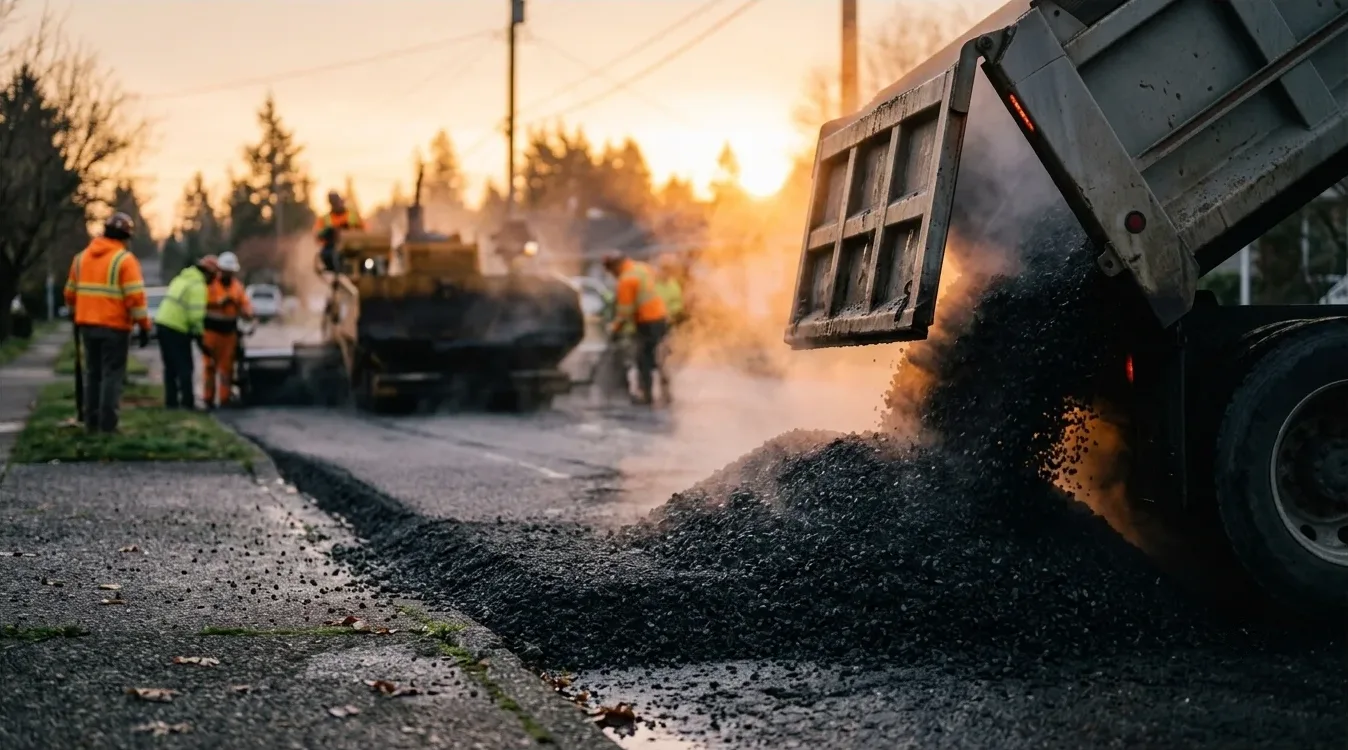
It also explains paving season. Cold ground steals the mat's heat before it can be compacted, so agencies set hard floors on when hot mix may be placed at all. Ohio DOT's specification is typical — the thinner the lift, the warmer the ground has to be:
| Lift thickness | Minimum surface temperature (Ohio DOT) |
|---|---|
| 3.0 inches or more | 36°F |
| 1.5 to 2.9 inches | 40°F |
| 1.0 to 1.4 inches | 50°F |
| Under 1.0 inch | 60°F |
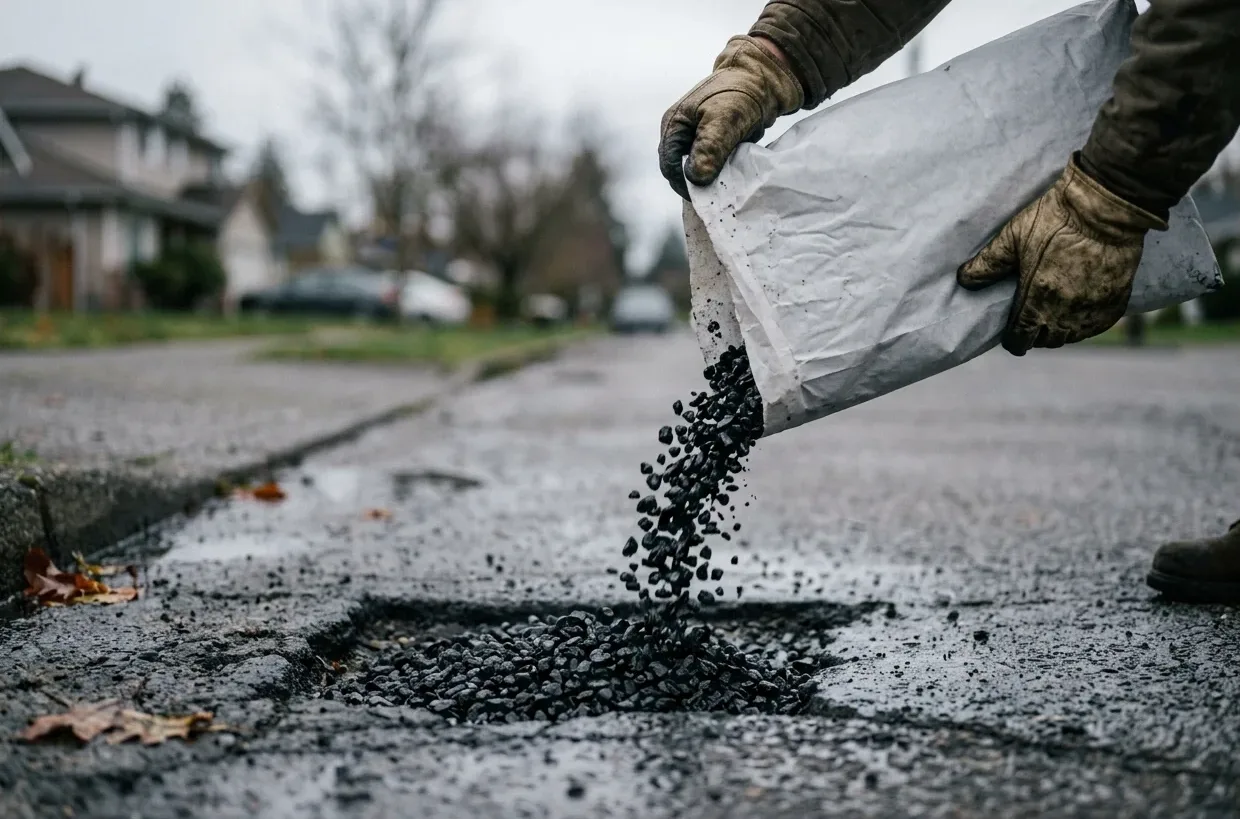
Cold mix has no such constraint. Bagged cold patch is sold rated for use in freezing weather, with retailer specifications listing workable ranges down to around 0°F. Purpose-made products tolerate damp holes too: Quikrete's technical data sheet states outright that water standing in the hole "will be displaced" and does not need to be removed first. That is exactly why highway departments patch winter potholes with cold patch and come back with hot mix in spring — a cycle we cover in the pothole repair cost guide.
| Product | Rated workable range | Wet holes? |
|---|---|---|
| QPR Permanent Pavement Repair | 5 to 105°F | Yes — works in water-filled holes |
| Sakrete U.S. Cold Patch | 0 to 105°F | Not specified |
| Quikrete Asphalt Cold Patch | Not published — sold for cold-weather use | Yes — displaces standing water per its data sheet |
| UPM Cold Mix, winter grade | Guaranteed workable at 40°F and below | Yes — wet or dry holes |
Cost: cold mix looks cheap until you buy it by the ton
Bought in bulk, the two materials are closer in price than most people expect: cold mix runs $80 to $130 per ton against $100 to $150 per ton for hot mix in 2026. Public bid tabs sit even lower. Mississippi's 2025 statewide contract prices hot mix at $76 to $115 per ton depending on mix type, because agencies buy at volume straight off the plant's schedule (Mississippi DFA statewide contract, 2025).
The number that surprises people is the bagged product. Mainstream 50 lb bags ran just under $20 to $33 at Lowe's and Home Depot in September 2026 — QPR at $19.98, Quikrete commercial-grade at $19.97, Sakrete U.S. Cold Patch at $30.80 to $32.71 — with economy hardware-store bags running lower. That works out to roughly $800 to $880 per ton, six to eight times the bulk price of the same material, at the commercial-grade bag price our pothole repair cost guide verified.
2026 material cost per ton: bulk vs bagged
That premium is not a scam — it is the price of convenience at small volume. A pothole needs one or two bags, not a 5-ton minimum delivery, and hot mix plants will not sell you 100 pounds. The trap is scale: patching a badly broken driveway with a pallet of bags means paying bag-retail prices for a repair a hot mix crew would do with better material. For a new surface the comparison is not close, because cold mix is not an option at all: no reputable contractor will build a driveway or parking lot out of it. Run your project through the asphalt cost calculator to see what the hot mix version actually costs installed.
Durability: is cold mix a permanent repair?
Treat cold mix as a repair that buys time — sometimes years of it, but time. The best field data remains the landmark SHRP H-106 study, which placed more than 1,250 cold-mix patches across eight pothole test sites in the US and Canada starting in 1991. In the follow-up monitoring reported by the Federal Highway Administration, 56% of the patches survived to the final round of observation in 1995 (Evans et al., TRB; FHWA Focus, January 2000).
Read that both ways. Nearly half the patches failed within a few years — but more than half of a material everyone calls "temporary" was still in service years later. The study's most useful finding is about method. Simple throw-and-roll patching (shovel the mix in, compact with truck tires) performed about as well as the elaborate semi-permanent procedure when quality materials were used — and it was roughly ten times more productive per person-hour. It also found that patches surviving their first month had a much better chance of lasting as long as the surrounding pavement. In other words: material quality and early compaction decide the outcome, not ceremony.
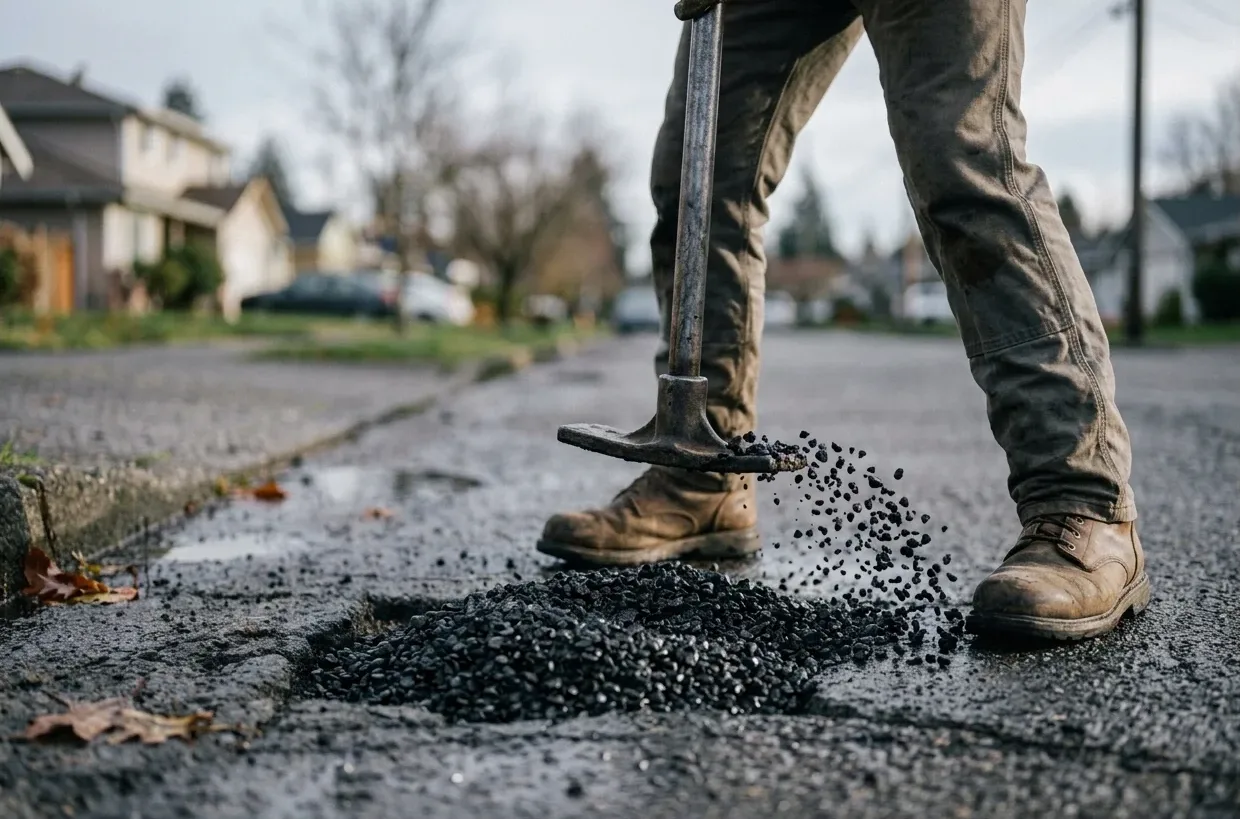
That maps directly onto driveways. Cold patch tamped down firmly in layers, in a hole with a sound base, routinely holds for years. Material dumped in loose, in a hole that keeps collecting water, reopens by spring. Manufacturers market "permanent" cold patch products, and in a low-traffic hole with good drainage the word can even prove true. But highway agencies that use cold patch treat it as interim by policy, and that is the safer expectation to carry.
Hot mix plays in a different league. Placed and compacted properly, it is the 15-to-30-year surface documented in our asphalt driveway lifespan guide. It pays for that durability with a slow cure that continues for months after the surface feels solid, covered in how long asphalt takes to cure.
Load-bearing: why major roads are always hot mix
Compacted hot mix reaches about 145 lb per cubic foot — dense enough that engineers design highway surface courses around it. Cold mix physically cannot get there. Its binder stays soft until the water or solvent evaporates, and a hand tamper cannot deliver what a vibratory roller does, so a cold mix patch always carries more air voids and less stiffness than the pavement around it. Our tonnage and coverage guide makes the same point from the estimating side: cold mix density is too loose and inconsistent to use in structural math.
Federal guidance is blunt about the hierarchy: hot mix has higher stability and durability than cold mix. That is why FHWA limits cold-mixed material to the lower pavement layers of low-volume roads, and why even cold-recycled pavement on busier routes gets capped with a hot mix surface course (FHWA pavement recycling guidance). State DOT specifications tell the same story from the maintenance side: cold mix appears in stockpile-patching and utility-cut specs, never as the wearing course of a trafficked road.
A cold mix asphalt specification, where one applies, controls three things. It sets the aggregate gradation, the binder (which emulsion or cutback grade, and how much of it), and workability — how long the mix must stay usable in a stockpile or bag before it stiffens. What no cold mix spec contains is a structural design role under traffic. When a bagged product's spec sheet says "permanent," it means the patch does not have to be dug out before a proper repair — not that the material performs like rolled hot mix.
Can you make cold mix asphalt yourself?
Recipes circulate online — coat gravel with asphalt emulsion, or worse, with used motor oil — and they are worth skipping. Commercial cold mix is a controlled product. A specified aggregate gradation is coated with a measured dose of emulsion or cutback and mixed at a plant, so every stone is filmed evenly and the mix stays workable in the bag for months. A driveway-mixed batch gets none of that, the binder ingredients cost more than the finished bag once bought in small quantities, and oil-based improvisations contaminate soil and never properly harden. At around $20 a bag, the manufactured product is the economical option as well as the one that works.
When cold mix is the right call
None of the above makes cold mix a lesser product. It solves five problems hot mix cannot:
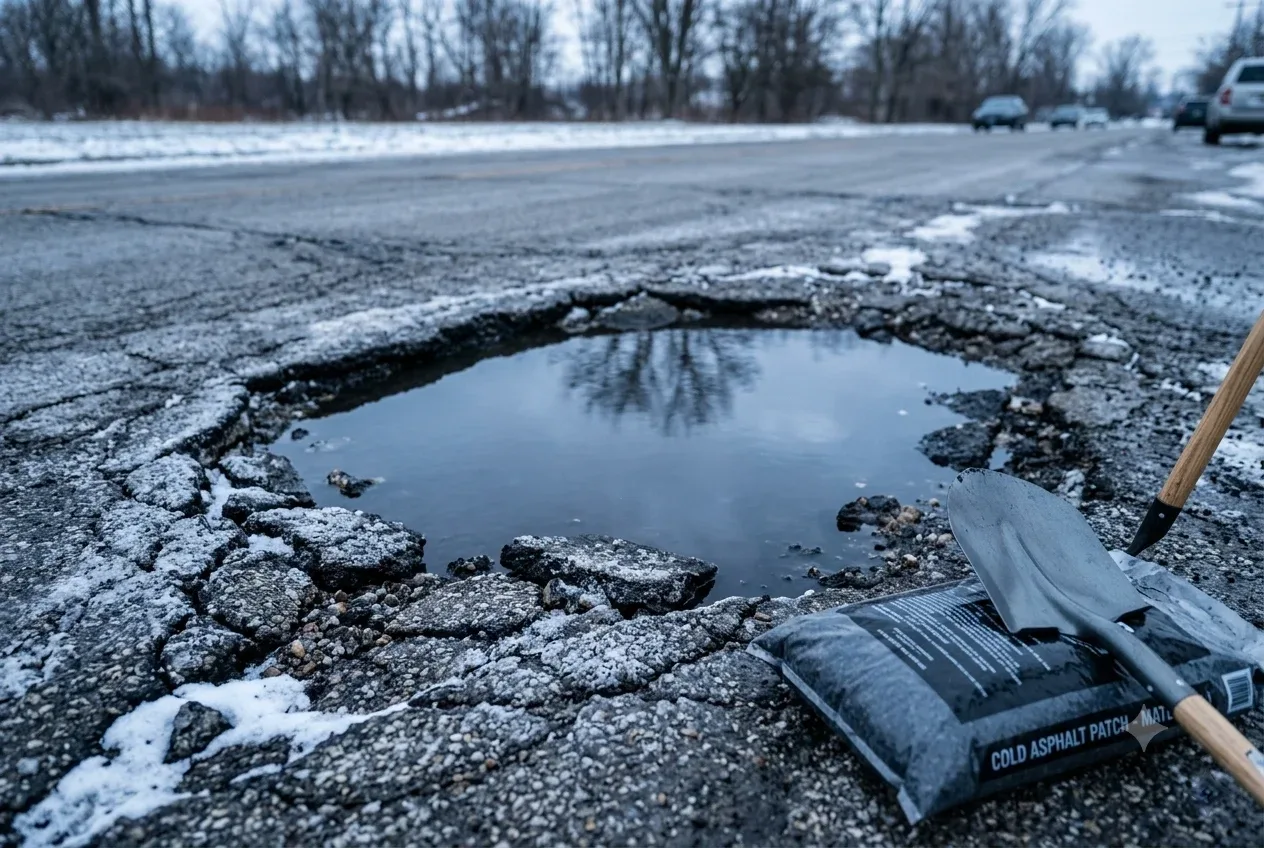
- Winter repairs. Hot mix plants close and cold ground kills compaction, so through the winter months cold patch is the only material that can go in a hole.
- Emergencies. A pothole tearing up tires today cannot wait for a paving crew's minimum charge and schedule. Two bags and a tamper fix it within the hour.
- Wet holes. Water ruins hot mix placement, but purpose-made cold patch displaces standing water — some agencies deliberately use it in wet conditions.
- Small volumes. Plants sell hot mix by the ton with delivery minimums. Cold mix scales down to a single 50 lb bag.
- Holding repairs. A utility cut or failed spot that will get a proper full-depth repair in spring still needs to be safe and drivable all winter.
The pattern in all five: cold mix wins when the job is small, urgent, cold, or temporary. The moment the job is a surface — even a short extension or a wide patch a paving crew could handle — hot mix wins on cost per year by a wide margin. And if the hole keeps reopening in the same place, the problem is under the pavement, not in your choice of patch material: see the guidance on base failures in how to fix cracks in an asphalt driveway.
Building or replacing a surface rather than patching one? Get the tonnage and cost for your project in hot mix — the material it will actually be built from.
Open the hot mix asphalt calculatorWhich is better: hot or cold asphalt?
Neither — they are answers to different questions. The honest decision rule takes one sentence each:
- Homeowner with a pothole or two: cold patch, tamped hard in layers. It is the only asphalt product you can buy and place yourself, and done well it holds for years.
- Homeowner building or resurfacing a driveway: hot mix, installed by a crew. There is no cold mix version of this job.
- Property manager with winter potholes in a parking lot: cold patch now as the safety repair, budgeted hot mix patching in spring — the two-step cycle every highway agency runs.
- Contractor or estimator: the only real question is quantity and price per ton — the hot mix calculator above runs both.
| Category | Winner |
|---|---|
| Bulk price per ton | Cold mix — $80 to $130 vs $100 to $150 |
| Small-repair convenience | Cold mix — one bag, hand tools, no crew |
| Winter and wet-weather work | Cold mix — hot mix cannot be placed at all |
| Durability | Hot mix — 15 to 30 years vs months to a few years |
| Load-bearing strength | Hot mix — compacts to 145 lb/ft³ |
| Building a new surface | Hot mix — cold mix is not an option |
| Overall | Hot mix for surfaces, cold mix for repairs |
Cold mix vs hot mix: the numbers that matter
- 1275 to 300°F vs air temperature — hot mix arrives hot and compaction is effectively over once the mat cools to about 185°F; cold mix places at whatever temperature the day is.
- 2$100 to $150 vs $80 to $130 per ton — bulk 2026 material prices for hot mix and cold mix respectively — close, until bagged cold patch multiplies the cold mix price to roughly $880 per ton.
- 315 to 30 years vs months-to-years — the service life gap between a compacted hot mix surface and a hand-tamped cold mix patch.
- 456% — share of 1,250+ cold-mix test patches still surviving at final monitoring in the FHWA-reported SHRP H-106 study — temporary material, but not as temporary as its reputation.
- 5145 lb/ft³ — compacted hot mix density. Cold mix never reaches it, which is why no agency specifies cold mix for a trafficked surface course.
Sources and citations
- Asphalt Institute, Asphalt magazine — "Feeling the heat": mix production and compaction temperatures — asphaltmagazine.com
- Ohio Department of Transportation — Manual of Procedures 401, minimum surface temperatures by lift thickness — dot.state.oh.us
- Evans, Romine, Anderson — Evaluation of Materials, Procedures, and Equipment for Pavement Maintenance (SHRP H-106), TRB Maintenance Management Conference — onlinepubs.trb.org
- Federal Highway Administration — FHWA Focus, January 2000: SHRP H-106 pothole patching study — fhwa.dot.gov
- Federal Highway Administration — pavement recycling guidance, cold mix in low-volume lower layers — fhwa.dot.gov
- Federal Highway Administration — Warm Mix Asphalt, Every Day Counts — fhwa.dot.gov
- Quikrete — Asphalt Cold Patch technical data sheet: immediate traffic, water displacement, cure before sealing — quikrete.com
- QPR — cold-weather workable range and water-filled-hole use, via SEALS Group product page — sealsgroup.com
- Sakrete U.S. Cold Patch — 0 to 105°F application range, retail listing — farmandfleet.com
- UNIQUE Paving Materials — UPM Cold Mix winter-grade workability — uniquepavingmaterials.com
- Mississippi Department of Finance and Administration — 2025 statewide hot and cold mix asphalt contract — dfa.ms.gov
- Retail bag prices, September 2026 — QPR 50 lb at Lowe's (lowes.com), Quikrete commercial-grade at Home Depot (homedepot.com), Sakrete U.S. Cold Patch at Lowe's (lowes.com)
- Hero photograph: NCDOT Town Creek Culvert paving, public domain (CC0) via rawpixel — rawpixel.com
- Asphalt Price Per Ton by Mix Type (internal guide)
- Pothole Repair Cost (internal guide)
- What Is Asphalt (internal guide)
- Hot Mix Asphalt Calculator (internal tool)
Frequently asked questions
Hot mix is better for any surface you are building — driveways, parking lots, roads — because it compacts to a dense, load-bearing layer that lasts 15 to 30 years. Cold mix is better for repairs, because it works at air temperature with hand tools and can be bought a bag at a time. Neither substitutes for the other.
Plan for it to be temporary. In the FHWA-reported SHRP H-106 study, 56% of more than 1,250 cold-mix patches survived to final monitoring years later, so a well-compacted patch in a hole with a sound base can genuinely last years. But cold mix never reaches the density of rolled hot mix, and highway agencies treat cold patch as an interim repair by policy.
By production temperature: hot mix asphalt (produced at 300 to 350°F, used for all permanent surfaces), warm mix asphalt (the same recipe produced 30 to 120°F cooler to save fuel), and cold mix asphalt (workable at air temperature, used for patching and temporary repairs).
Yes, upfront. An asphalt driveway runs $7 to $13 per square foot installed in 2026 against $8 to $18 for concrete, and asphalt installs faster. Concrete claws back ground over decades through longer life and lower maintenance. Our asphalt vs concrete driveway guide runs the full comparison.
Generally no. Hot mix must be compacted before the mat cools to roughly 185°F, and cold ground steals that heat too fast, so state DOTs set minimum surface temperatures — typically 36 to 60°F depending on lift thickness — and paving largely shuts down in winter. Winter holes get cold patch; permanent hot mix work waits for warm weather.
Immediately — manufacturers state traffic can begin as soon as the patch is compacted, and driving over it actually helps it tighten up. Just do not sealcoat over a fresh patch: Quikrete's data sheet calls for a minimum of 30 days and preferably 90 or more before applying driveway sealer.
About 5 to 6 square feet at a 1 inch compacted depth — roughly 10 pounds per square foot per inch. A pothole 2 feet across and 2 to 3 inches deep takes about two bags; buy one more than the math says, because running out mid-hole is the common mistake.