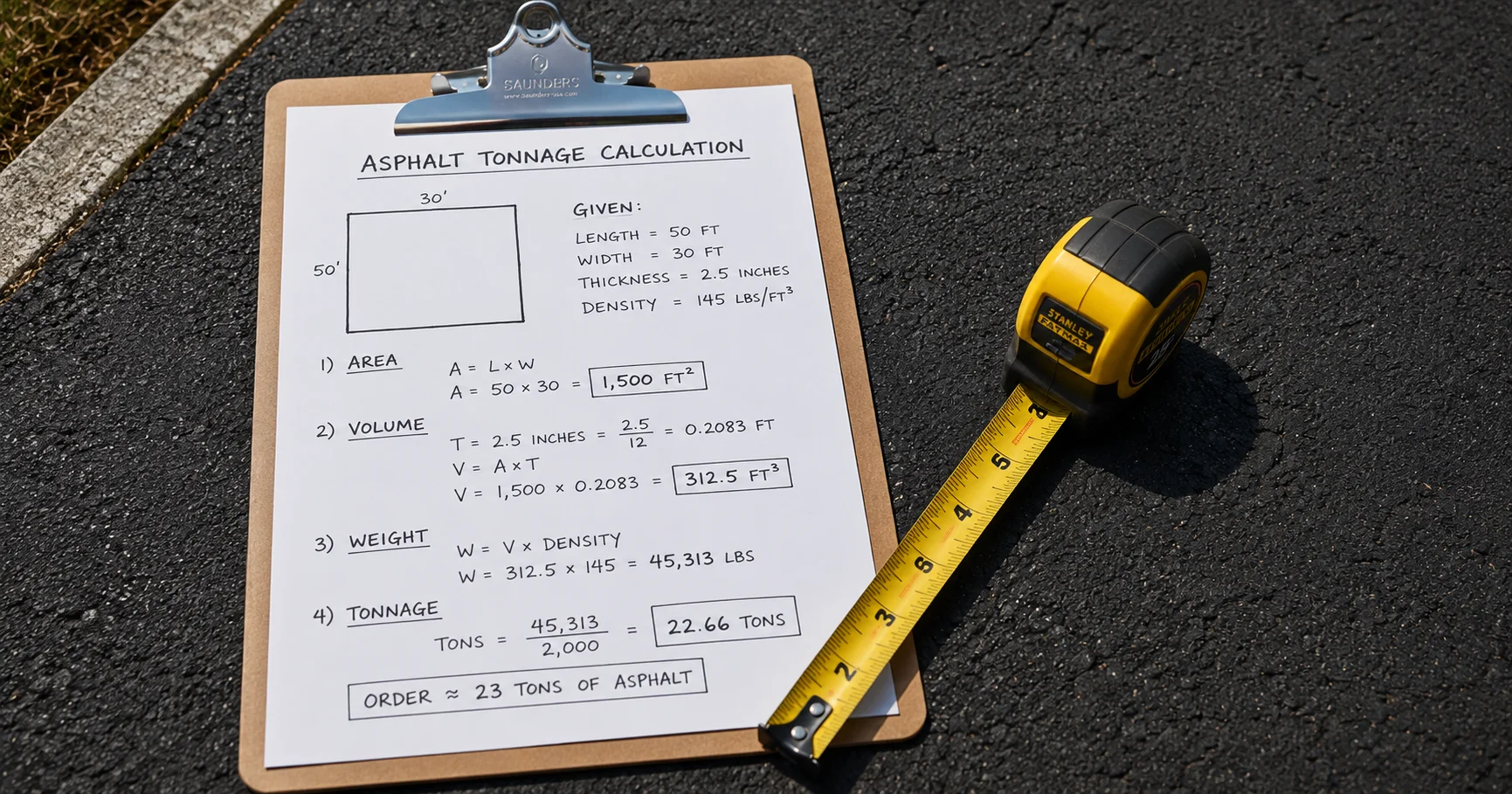
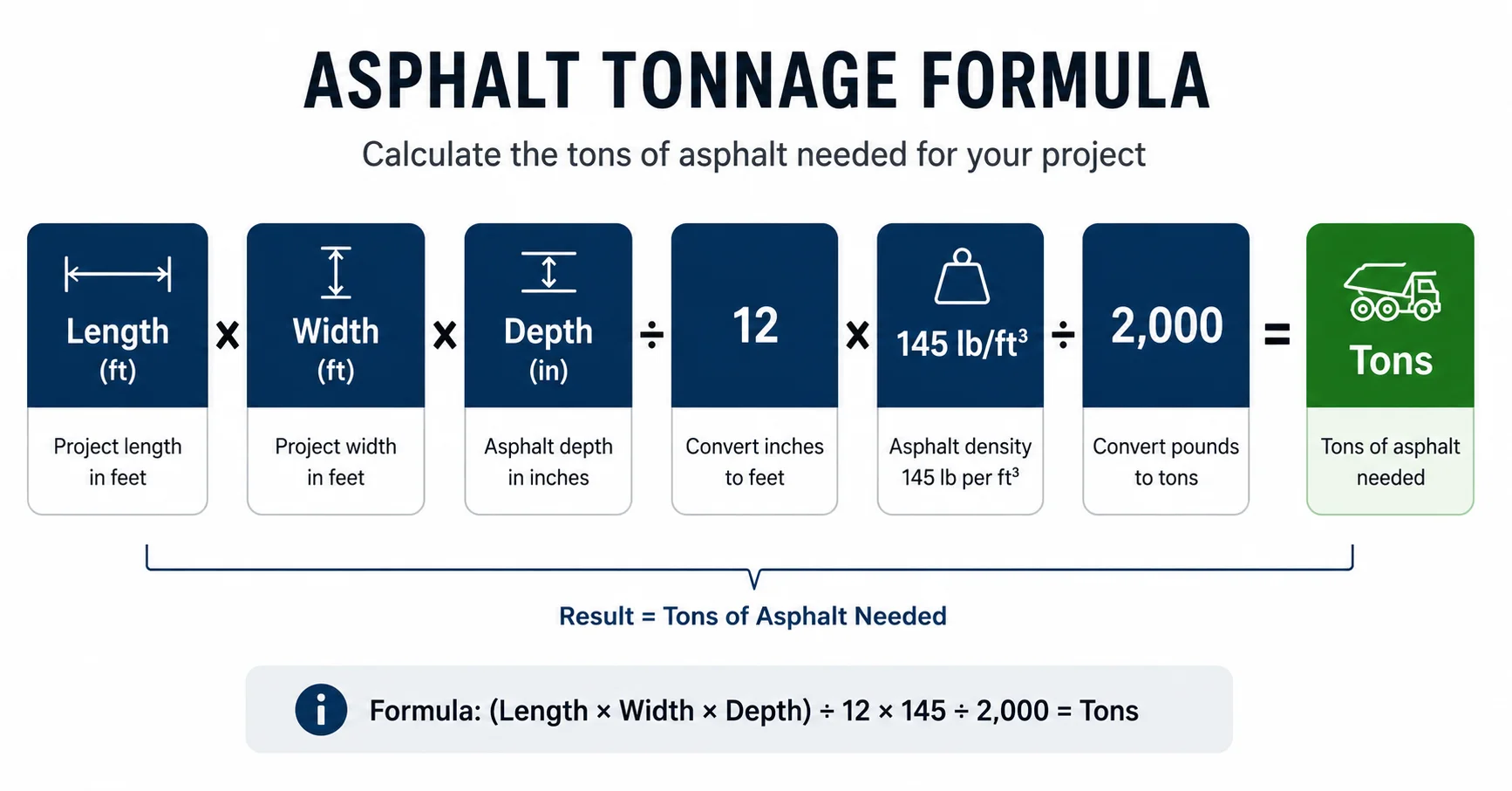
To calculate asphalt tonnage, multiply your area in square feet by the depth in feet, multiply by 145 lb/ft³, then divide by 2,000. That single formula handles any driveway, parking lot, or road section, whether you are ordering material or checking a quote.
This is the same math your supplier and contractor are using behind whatever number they quote you, which is exactly why running it yourself is worth the two minutes it takes. Each piece of it, the 145 lb/ft³ density constant, the 2,000-lb ton, the depth conversion, has a reason behind it, and knowing those reasons is what lets you catch a padded quote or a light delivery before it costs you money.
What is asphalt tonnage?
Asphalt tonnage is the weight of hot mix asphalt a project needs, expressed in US short tons (2,000 lbs each). Plants sell asphalt by the ton, not by volume, so tonnage is the number your supplier actually asks for when you place an order, and the number on your delivery ticket when the truck shows up. For why 145 lb/ft³ is the right number to use, including how it compares to the 110 lb/SY/inch figure you may see elsewhere, see our density and weight guide.
The asphalt tonnage formula
- Measure the area. Length times width in feet. For circles, use pi times radius squared.
- Convert depth to feet. Divide inches by 12. Three inches becomes 0.25 feet.
- Find the volume. Area times depth equals cubic feet.
- Convert to weight. Volume times 145 lb/ft³.
- Convert to tons. Divide by 2,000.
One-line version: Tons = (Length ft × Width ft × Depth in ÷ 12) × 145 ÷ 2,000
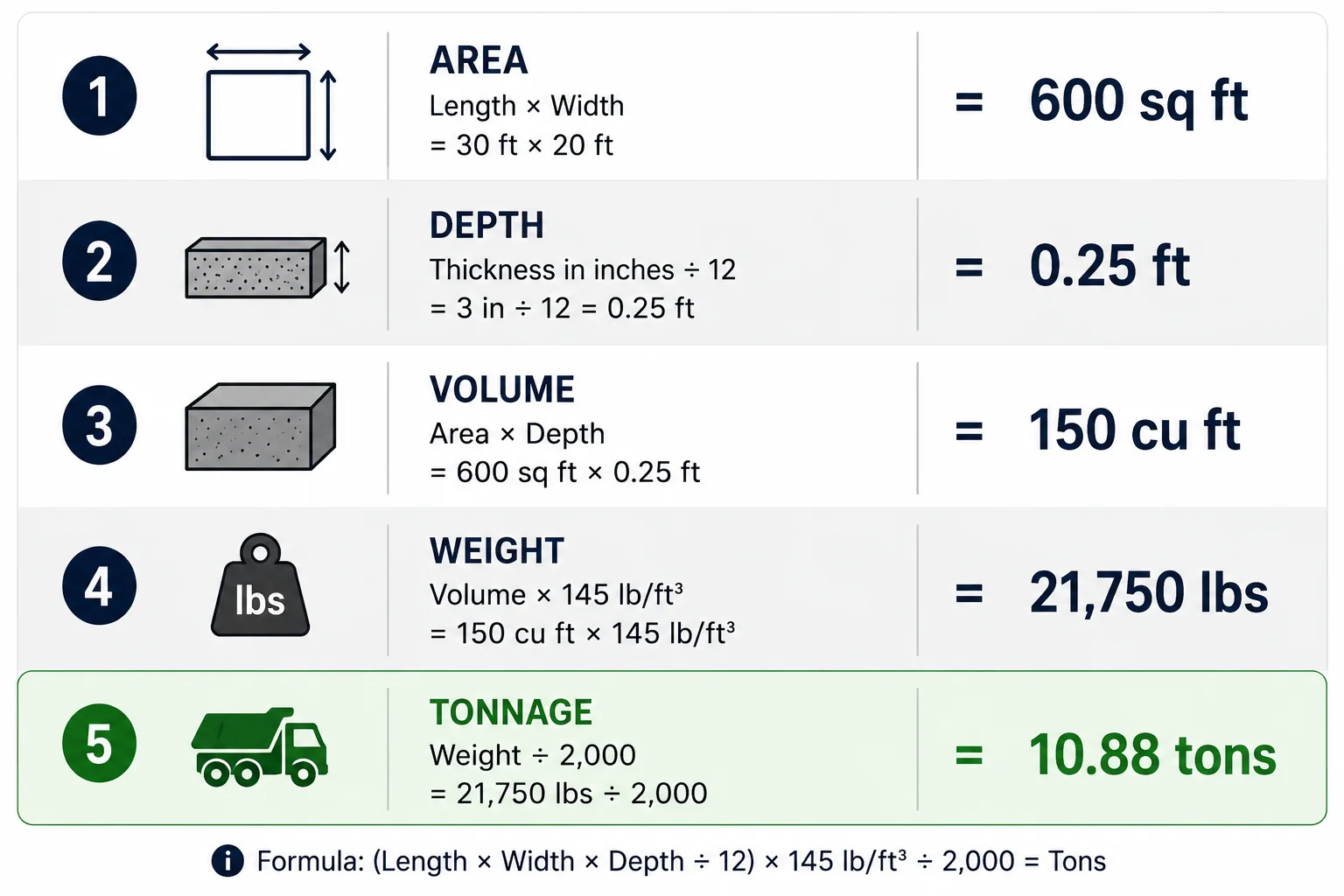
Worked example: 50 by 12 ft driveway at 3 inches
- Area: 50 × 12 = 600 sq ft
- Depth: 3 ÷ 12 = 0.25 ft
- Volume: 600 × 0.25 = 150 cubic ft
- Weight: 150 × 145 = 21,750 lbs
- Tonnage: 21,750 ÷ 2,000 = 10.88 tons
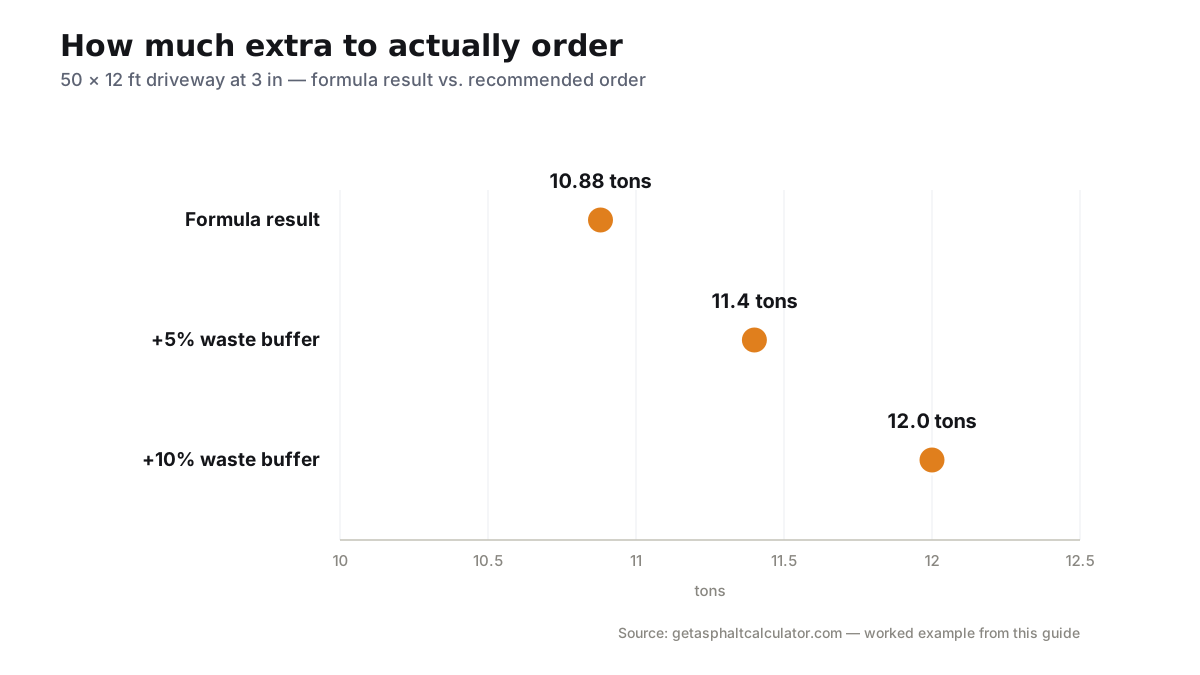
Order 5% to 10% extra to cover compaction, waste, and an uneven base. For this driveway, that means ordering 11.5 to 12 tons rather than the bare 10.88 the formula returns.
Want it done for you? The free asphalt calculator runs this exact formula and adds cost estimating on top of it.
Quick reference: square feet to tons
| Area | 2 in deep | 3 in deep | 4 in deep |
|---|---|---|---|
| 250 sq ft | 3.0 tons | 4.5 tons | 6.0 tons |
| 500 sq ft | 6.0 tons | 9.1 tons | 12.1 tons |
| 1,000 sq ft | 12.1 tons | 18.1 tons | 24.2 tons |
| 5,000 sq ft | 60.4 tons | 90.6 tons | 120.8 tons |
If you are working from a tonnage you already have rather than an area you need to fill, flip this table around: our coverage per ton guide includes a full coverage-per-ton breakdown by thickness so you can go the other direction.
Converting square yards to tons
Road crews and commercial specs often work in square yards instead of square feet. One square yard at 1 inch deep needs about 0.054 tons (110 lbs) of hot mix, so the formula becomes:
Tons = Square yards × Depth in inches × 0.054
A 1,000 square yard street overlay at 2 inches works out to 1,000 × 2 × 0.054, which is about 108 tons. For a full conversion chart across common square yardages and depths, see our square yards to tons guide.
Metric version of the formula
If your specs are in metric units, the same math works with different constants. Compacted hot mix asphalt has a density of about 2,322 kg/m³.
Tonnes = Length (m) × Width (m) × Depth (m) × 2.322
For example, a 15 by 4 meter driveway at 7.5 centimeters (0.075 meters) deep: 15 × 4 × 0.075 = 4.5 cubic meters. Multiply by 2.322 and you get about 10.4 tonnes. Remember that a metric tonne (2,205 lbs) is about 10% heavier than a US short ton (2,000 lbs), so do not mix the two when comparing a metric spec against a US supplier quote.
Common mistakes to avoid
- Mixing units. Keep everything in feet (or meters) before multiplying, or the result comes out off by a factor of 12.
- Using loose density instead of compacted. 145 lb/ft³ is the compacted figure. Loose mix straight off the truck weighs 10% to 20% less per cubic foot until it is rolled.
- Forgetting waste. Handwork areas, edges, and transitions always consume more material than the clean geometric formula suggests.
- Ignoring base failures. Potholes and soft spots need deeper patches than the surrounding mat, and calculating them at the standard project depth will leave you short exactly where you need the most material.
How to read your asphalt delivery ticket
Every load of asphalt should come with a ticket from the plant showing the actual weighed tonnage, not an estimate. This is the number that matters, since it reflects what the truck scale measured, not what anyone calculated on paper beforehand.
Check the ticket against your own calculation. If you ordered 12 tons and the ticket shows significantly less, ask before the crew starts spreading it, not after. A modest difference (a few percent either direction) is normal and expected, since exact loading rarely matches a paper estimate to the pound. A large gap is worth a direct question to the driver or the plant before the material goes down, since it is much easier to address a shortfall before installation than to fix a driveway that came up thin because the load was light.
Is my contractor's tonnage quote reasonable?
Run the numbers yourself using the formula above, then compare. A contractor's tonnage estimate should land close to your own calculation once you account for their stated waste factor, typically 5% to 10%. If a quote comes in dramatically higher than your own math suggests, ask what assumptions they used, since a legitimate reason (a thicker base course, a different density for their specific mix, or unusually complex geometry) is common, but so is simple overestimating on a padded quote.
If a quote comes in dramatically lower instead, be equally cautious. That is often a sign of a thinner spec than what was actually discussed, not a better deal.
At a glance: the tonnage formula in seven numbers
- 1145 lb/ft³ — the compacted density constant every step of the formula runs on.
- 210.88 tons — the raw formula result for the 50 by 12 ft, 3 inch worked example.
- 311.5 to 12 tons — what to actually order for that same driveway, after a 5% to 10% waste buffer.
- 40.054 — the simplified constant for square yards (tons = SY × depth in inches × 0.054).
- 52.322 — the metric density constant in tonnes per cubic meter.
- 610% — how much heavier a metric tonne (2,205 lb) is than a US short ton (2,000 lb). Never mix the two.
- 7A few percent — the normal, expected variance between your calculated order and the plant's actual weighed delivery ticket.
Sources and citations
- National Asphalt Pavement Association — asphaltpavement.org
- Asphalt Institute — asphaltinstitute.org
- Asphalt Calculator (internal tool)
- Asphalt Cost Calculator (internal tool)
- Asphalt Square Yardage Calculator (internal tool)
- Asphalt Driveway Cost Calculator (internal tool)
- How Much Does Asphalt Weigh (internal guide)
Frequently asked questions
Multiply area (sq ft) by depth (ft) to get cubic feet, multiply by 145 lb/ft³, then divide by 2,000. Example: 600 sq ft at 3 inches equals 600 times 0.25 times 145 divided by 2,000, which is about 10.9 tons.
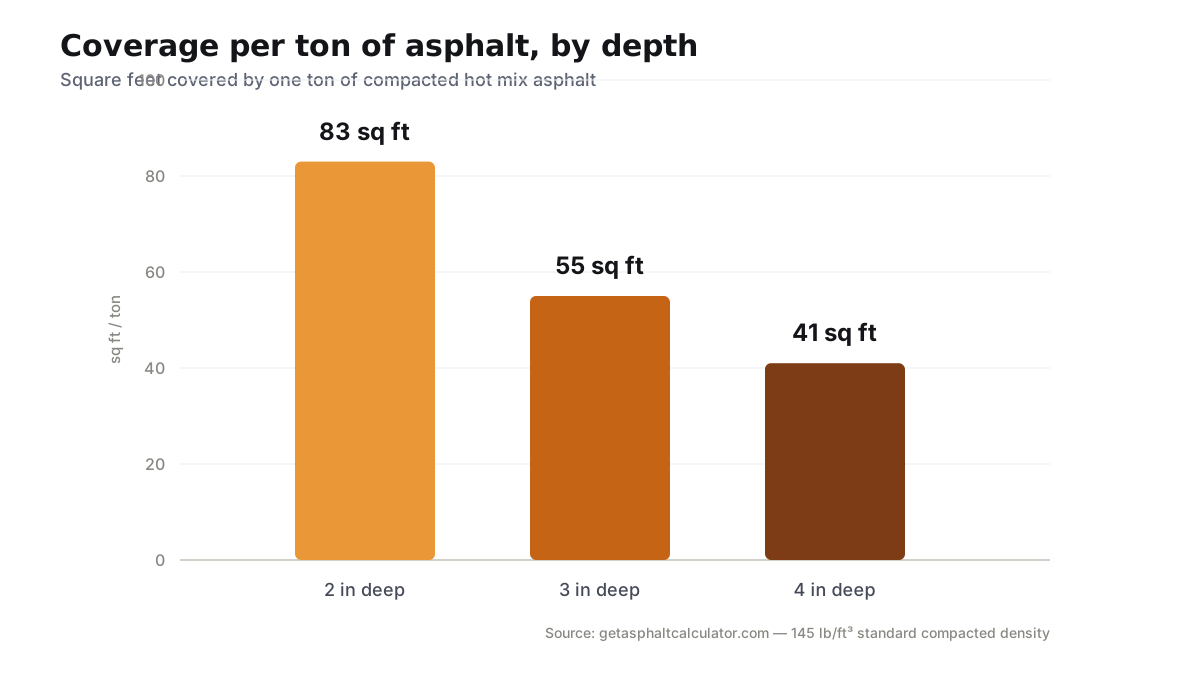
At 2 inches, one ton covers about 83 square feet. At 3 inches, about 55 square feet. At 4 inches, about 41 square feet. Coverage drops as depth increases since the same weight of material spreads over less area.
Use 145 lb/ft³ as the standard for compacted hot mix asphalt planning calculations. This is the accepted industry midpoint, though real density ranges from 140 to 150 lb/ft³ depending on the specific mix. If your supplier gives you a mix-specific density from the job ticket, use that instead for a more precise figure.
One tonne (2,205 lbs) of compacted hot mix asphalt is about 0.43 cubic meters, based on the standard density of 2,322 kg/m³. Divide 1,000 kg by 2,322 to get that figure directly.
One cubic yard of compacted hot mix asphalt weighs about 1.96 US tons, based on the standard density of 145 lb/ft³ and 27 cubic feet per cubic yard. For quick estimating, round up to 2 tons per cubic yard.
For a small residential or driveway-scale order, hot mix material typically runs $100 to $150 per ton, putting a 20 ton load at roughly $2,000 to $3,000 before delivery. Large institutional paving contracts often land lower, closer to $75 to $100 per ton, based on 2025 state and county DOT paving bid tabulations, since bulk municipal orders get volume pricing a homeowner or small contractor will not. For a full regional pricing breakdown, see our asphalt cost calculator.
Run the same formula yourself: your area in square feet times depth in feet times 145, divided by 2,000. Compare that to the contractor's quoted tonnage after accounting for their stated waste factor, usually 5% to 10%. A number dramatically higher or lower than your own calculation is worth a direct question about what assumptions they used before you sign anything.
Check that the ticket shows the actual weighed tonnage from the plant scale, not an estimate, and compare it against your own calculated order quantity. A small variance of a few percent either direction is normal. A large gap between what you ordered and what the ticket shows is worth raising with the driver or plant before the crew starts spreading the load.