Illustration: getasphaltcalculator.com
A tar and chip driveway costs about $2 to $5 per square foot installed, or $700 to $2,900 for a typical two-car driveway, according to HomeGuide. HomeGuide also puts it at 30% to 40% less than asphalt and about twice the price of gravel. Plan on 7 to 10 years from a single seal and 12 to 15 from a double seal. It suits long, low-traffic driveways on a sound gravel base. It is a poor fit if you plow often, want a smooth surface for bikes and strollers, or have a soft base.
A tar and chip driveway is a compacted gravel base sprayed with hot liquid asphalt and covered at once with crushed stone chips that are rolled into it. It is also sold as chip seal, chip and seal, oil and stone, or macadam. The result looks like gravel and drives like a paved surface. It costs less than blacktop because there is no asphalt mix to haul and lay, only a thin binder and a layer of stone.
Tar and chip driveway at a glance
- 1Installed cost: $2 to $5 per sq ft (HomeGuide); $1 to $5, averaging $3 (Angi)
- 2Two-car driveway: $700 to $2,900 on average (HomeGuide)
- 3Single vs double seal: $2 to $3 per sq ft single, $3 to $5 double (HomeGuide and Angi agree)
- 4Lifespan: 7 to 10 years single seal, 12 to 15 years double seal (HomeGuide)
- 5Upkeep: No sealcoating. Sweep loose chips, then re-chip around the 10-year mark (Angi)
- 6Install window: Dry weather, air above 50°F (HomeGuide). Not a DIY job
What is a tar and chip driveway?
Tar and chip is a surface treatment built in layers on site, not a paving mix. The contractor grades and compacts a gravel base, or works on top of an existing gravel driveway. A distributor truck sprays hot liquid asphalt (bitumen or an asphalt emulsion) across it, a spreader drops stone chips into the wet binder straight away, and a roller presses them in. HomeGuide describes a single seal as 3/8" to 3/4" aggregate laid over the binder and compacted, and a double seal as a second binder coat topped with smaller chips (HomeGuide).
The difference from blacktop is the method, not the ingredients. Both use stone and asphalt binder. An asphalt driveway is hot mix, with stone and binder mixed at the plant, laid by a paver and compacted to about 3 inches over a 6 to 8 inch gravel base. Tar and chip is a surface treatment, one or two stones thick, so almost all of its strength comes from the gravel base underneath it. That one fact explains most of its cost advantage and most of its problems.
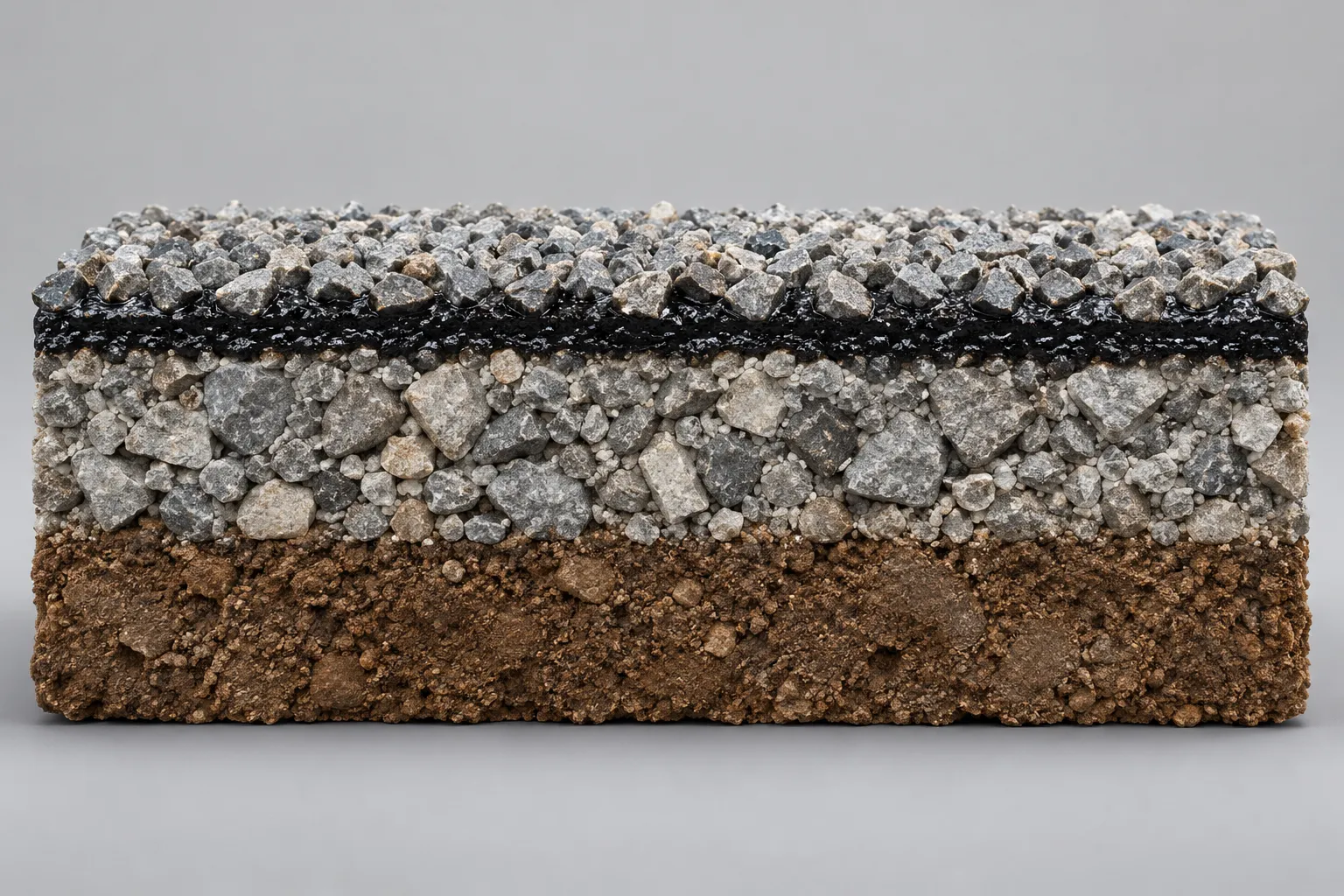
Chip seal, tar and chip, oil and stone, macadam
These are names for the same surface: liquid asphalt sprayed down, stone chips spread on top, then rolled. Road departments tend to say chip seal, and driveway contractors often say tar and chip. HomeGuide also lists macadam, oil and chip, liquid asphalt and stone, and spray tar as names for it.
How much does a tar and chip driveway cost?
HomeGuide puts a chip seal driveway at $2 to $5 per square foot installed. Across 85 project costs reported by its members, the national average is $1,800, the average range $700 to $2,900, the minimum $500 and the maximum $5,000 (HomeGuide). Angi lists $1 to $5 per square foot with an average of $3, and says most homeowners pay $200 to $4,300, averaging $1,600 (Angi).
The biggest single price lever is the number of coats. HomeGuide and Angi both price a single seal, one coat of binder and one layer of chips, at $2 to $3 per square foot, and a double seal, which adds a second coat of binder topped with smaller chips, at $3 to $5. A double seal costs more and lasts longer, so it is the one to quote for a new driveway built on gravel. If you already have a sound gravel or unsealed asphalt driveway, HomeGuide lists resurfacing it with tar and chip at $1 to $3 per square foot, because the base is already there. For comparison, repaving an asphalt driveway with an overlay runs $3 to $7 per square foot (HomeGuide and Bob Vila).
Tar and chip cost by driveway size, next to asphalt and gravel
Here is each published per-square-foot range applied to five common driveway sizes. Every column comes from the same HomeGuide guide, so the four surfaces are priced on the same basis.
| Driveway size | Tar and chip, single seal | Tar and chip, double seal | Asphalt | Gravel |
|---|---|---|---|---|
| Single car, 200 sq ft | $400 to $600 | $600 to $1,000 | $600 to $1,400 | $200 to $600 |
| 2 car, 400 sq ft | $800 to $1,200 | $1,200 to $2,000 | $1,200 to $2,800 | $400 to $1,200 |
| Wide 2 car, 600 sq ft | $1,200 to $1,800 | $1,800 to $3,000 | $1,800 to $4,200 | $600 to $1,800 |
| Long, 800 sq ft | $1,600 to $2,400 | $2,400 to $4,000 | $2,400 to $5,600 | $800 to $2,400 |
| Extra large, 1,000 sq ft | $2,000 to $3,000 | $3,000 to $5,000 | $3,000 to $7,000 | $1,000 to $3,000 |
HomeGuide's own size table lands in the same place: $700 to $2,000 for a 20' x 20' two-car driveway, $1,000 to $2,900 for 24' x 24', and $1,500 to $4,300 for a 24' x 36' three-car driveway.
Cost guides price different scopes of work, so their figures for the same surface do not always match. This site's driveway cost calculator prices gravel at $4 to $10 per square foot and asphalt at $3 to $15, from HomeGuide's gravel and asphalt guides and Bob Vila. Those guides cover a different scope than the chip seal guide, so compare a tar and chip quote against the table above, not against the calculator's figures.
What pushes the price up
- Site prep. HomeGuide lists grading and leveling at $3 to $8 per square foot and excavation at $1 to $5. A new driveway over dirt needs a gravel base laid first, and that base can cost more than the chip seal on top.
- Repairs to an existing driveway. Cracks, potholes and soft spots must be fixed before chips go down, at $300 to $2,500 on average (HomeGuide).
- Stone type and color. Local stone is cheapest. Angi lists crushed granite, limestone and pea gravel at $0.45 to $2 per square foot against up to $11 for lava rock or quartz.
- Distance. HomeGuide notes that prices depend on how far the job is from the installer, the nearest asphalt plant, and the stone supplier.
- Access and slope. Tight access for the distributor truck and chip spreader, and steep grades, both add cost.
- Permits. HomeGuide lists $50 to $200 for a driveway permit where one is required.
Is tar and chip cheaper than asphalt?
Yes. HomeGuide says a tar and chip driveway costs 30% to 40% less than asphalt: $2 to $5 per square foot against $3 to $7. Angi's figures make the gap wider, at $1 to $5 for tar and chip against $7 to $15 for asphalt. Tar and chip also skips sealcoating, which runs $355 to $800 for a typical 400 sq ft asphalt driveway (what a sealcoating quote includes).
The catch is lifespan. Asphalt lasts 15 to 30 years (asphalt driveway lifespan), so tar and chip may need redoing up to three times over the life of one asphalt driveway. Spread the install price over the years each surface lasts and the gap closes.
| Surface | Installed, per sq ft | Years of service | Install cost per sq ft per year |
|---|---|---|---|
| Tar and chip, single seal | $2 to $3 | 7 to 10 | about $0.20 to $0.43 |
| Tar and chip, double seal | $3 to $5 | 12 to 15 | about $0.20 to $0.42 |
| Asphalt | $3 to $7 | 15 to 30 | about $0.10 to $0.47, plus sealcoating |
Per year of service the three options overlap. Tar and chip wins on the cash you spend today. Asphalt wins if you stay long enough to get its full life and keep up with sealing. A re-chip over a base that is still sound costs less than the first install, which tilts the long-run numbers slightly back toward tar and chip.
How long does a tar and chip driveway last?
A tar and chip driveway lasts 7 to 10 years with a single seal and 12 to 15 years with a double seal, according to HomeGuide. Angi says about 10 years, after which you add another layer. Published lifespans vary because the sources measure different things, so here is each claim with what it is based on.
| Source | Lifespan claim | What it is based on |
|---|---|---|
| HomeGuide | 7 to 10 years single seal; 12 to 15 years double seal | Consumer cost guide for residential driveways |
| Angi | About 10 years, then another layer | Consumer cost guide |
| Jalali and Vargas-Nordcbeck, Transportation Research Record (2021) | Median 6.8 to 9.1 years for a single layer; beyond 10 years for double and triple layers | Seven years of field data from low-traffic road test sections in a hot, wet climate |
| Asphalt driveway, for comparison | 15 to 30 years | How long an asphalt driveway lasts |
The Transportation Research Record study is the most rigorous of the three tar and chip sources, and it lines up with the cost guides. It measures chip seal laid over existing road pavement as a preservation treatment, not a driveway built on gravel. A driveway carries far less traffic than a road, but it usually has only gravel under the chips instead of old pavement. That study also found that sealing cracks before chip sealing added 1 to 3 years to median life, which is the same lesson for a driveway: the surface lasts as long as what is under it. Driveways that fail in two or three years usually trace back to one of the causes in the problems section below.
Pros and cons of a tar and chip driveway
Pros
- Cheaper than asphalt or concrete, about 30% to 40% less than asphalt on HomeGuide's figures.
- Good traction in rain and snow, thanks to the rough stone surface.
- No sealcoating. HomeGuide lists it as low maintenance with no sealing required.
- Small cracks seal themselves in warm weather as the binder softens (HomeGuide).
- Less dust and loose stone than gravel, once the excess chips are swept up.
- A natural, rustic look. Stone color depends on what is quarried locally, from gray and black to tan, red and blue.
Cons
- Shorter life than asphalt (15 to 30 years) or concrete (30 to 40 years, per HomeGuide).
- Loose chips, heaviest in the first weeks, and a texture HomeGuide calls too rough for biking, basketball and roller skating.
- Easily damaged by snowplows unless the blade is raised (HomeGuide).
- Can bleed and turn sticky in hot weather when the binder was applied too heavily.
- Adds no structural strength. A weak base will show through as potholes and ruts.
- Hard to find experienced installers in regions where it is uncommon (HomeGuide).
Common tar and chip driveway problems and what causes them
Most tar and chip failures trace back to how the surface was installed or to the base under it, not to the material. Here are the four problems owners report most, with the cause behind each.
Loose chips that never stop
Some loose stone after installation is normal. The contractor spreads more chips than the binder can hold, and the extra sits on top until it is swept off. Chips that keep coming loose months later point to an installation fault. Asphalt Magazine lists the usual causes: too little binder, aggregate that was too dusty or too wet for the binder to stick to, and traffic allowed on at speed before the binder set (Asphalt Magazine). The same article says chips should end up embedded 50% to 70% of their thickness after rolling and traffic. Tires turning in place, at the top of the driveway or in a parking spot, also scrub chips loose.
Bleeding and sticky spots in hot weather
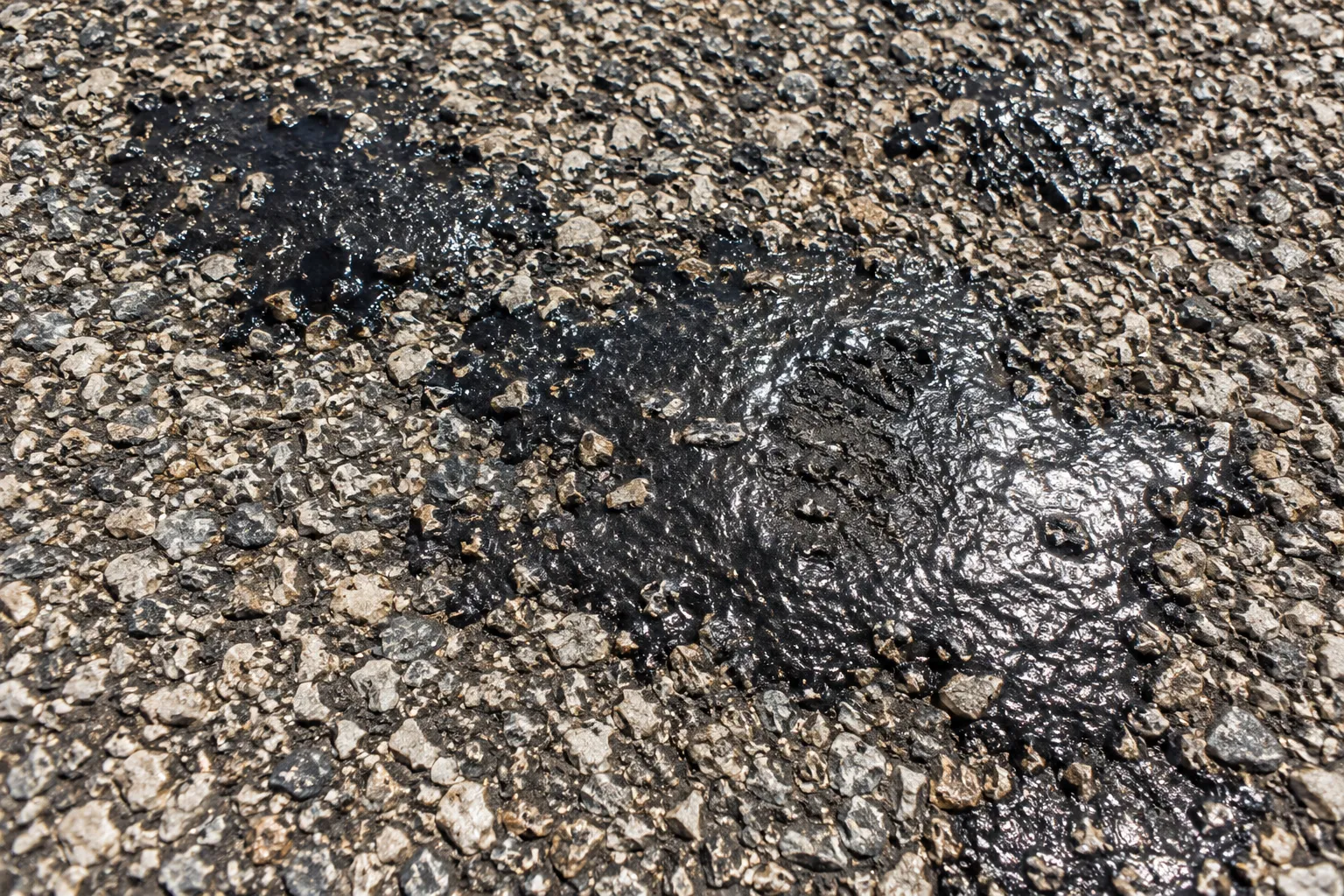
Bleeding is binder rising to the surface, leaving black, shiny patches that go soft and sticky in summer and track onto shoes and into the garage. The cause is too much binder for the chip size, or chips pressed so deep that the binder rises above them. Asphalt Magazine notes that fat streaks and bleeding develop when the binder is applied too heavily. The usual fix is to spread clean, fine chips or sand over the soft spots so traffic presses them in.
Snowplow and snow blower damage
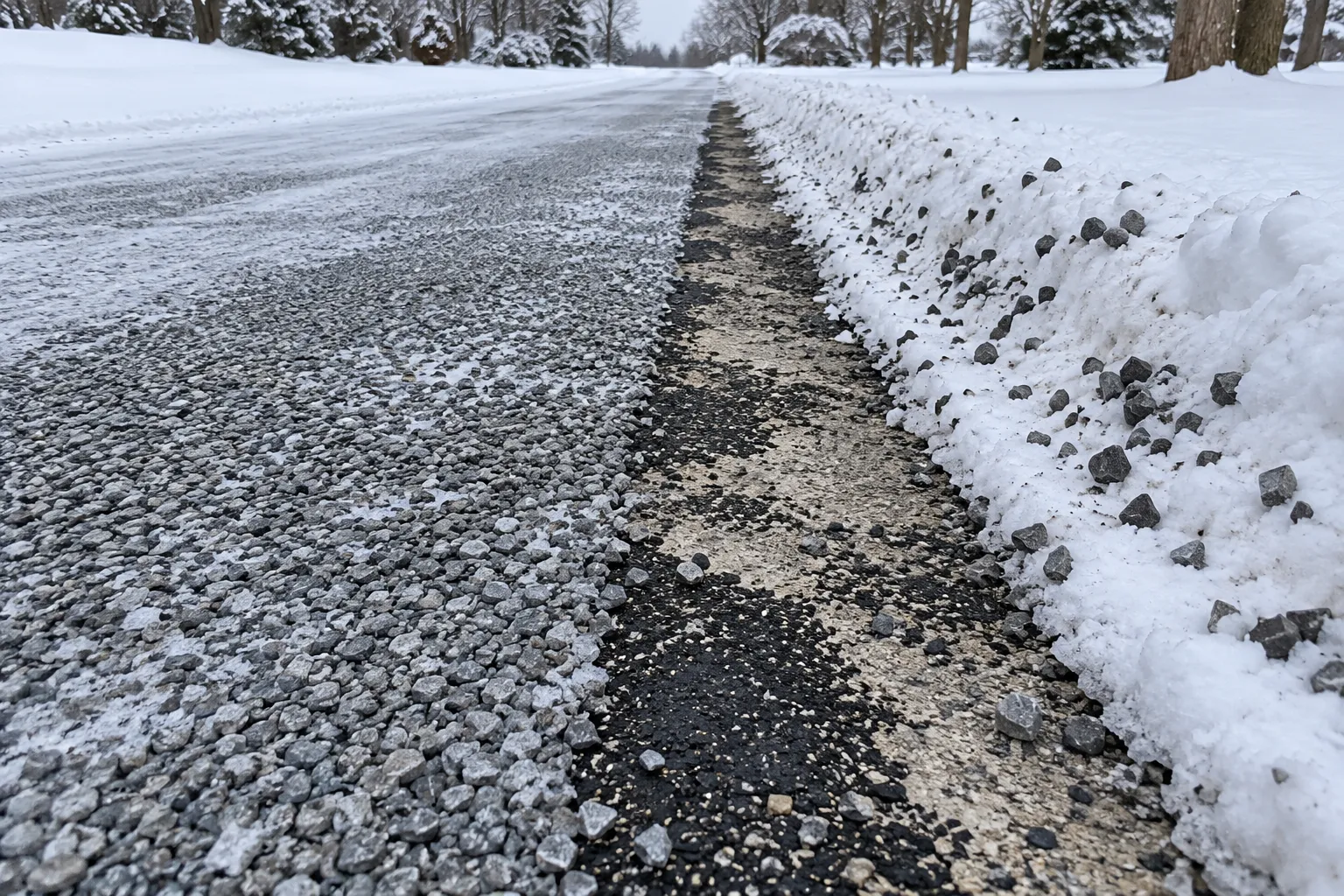
A plow blade set flat on the surface catches the edges of the chips and strips them out, leaving bare binder or exposed base. HomeGuide warns that tar and chip is easily damaged by snowplows if the blade is not raised to 1" before plowing. The same applies to a snow blower: set its skid shoes so the auger housing rides above the stone. The rough texture also leaves a thin layer of snow behind, which is part of why tar and chip grips well in winter.
Potholes, ruts and crumbling edges
These are base failures showing through. HomeGuide is direct about it: chip sealing is not a repair method and does not add structural stability. Over an old asphalt driveway, HomeGuide rates surfaces with cracks wider than 1/4", structural problems or ruts as poor candidates. On gravel, any soft spot, low area or poorly drained section will reappear as a pothole within a season or two, especially under heavy delivery or propane trucks. Unsupported edges break off the same way.
How to repair and maintain a tar and chip driveway
Tar and chip needs less routine care than asphalt, but it does need some. The work comes down to keeping chips in place, fixing the base where it fails, and re-chipping on time.
- Sweep early, then lightly. The first sweep comes by the next morning (FHWA), followed by light sweeps over the first few weeks as loose chips work free. Asphalt Magazine warns that sweeping before the binder sets tears away stone that should stay, and calls for light brooming with minimal downward pressure.
- Skip sealcoat. Sealcoating is an asphalt treatment, and HomeGuide lists tar and chip as needing no sealing. Spend that money on re-chipping when the time comes.
- Patch bare spots early. A contractor sprays binder on the patch and chips it, which keeps water off the base. Leave a bare patch through a winter and it can turn into a pothole.
- Fix the base before resurfacing a pothole. Dig out the soft material, refill with compacted gravel, then binder and chips. Chips laid over a soft spot fail again.
- Keep water moving off the driveway. Clear ditches and culverts and keep the edges from trapping water.
- Re-chip the whole surface at about 10 years (Angi) while the base is sound. HomeGuide lists resurfacing a driveway with tar and chip at $1 to $3 per square foot.
Tar and chip driveway installation: what the process looks like
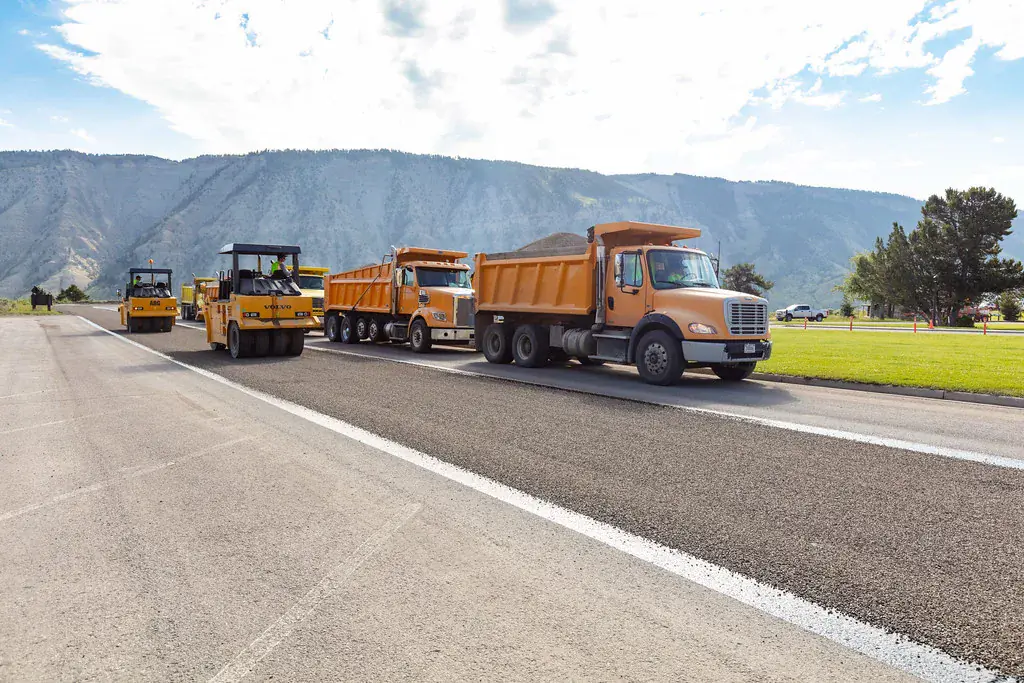
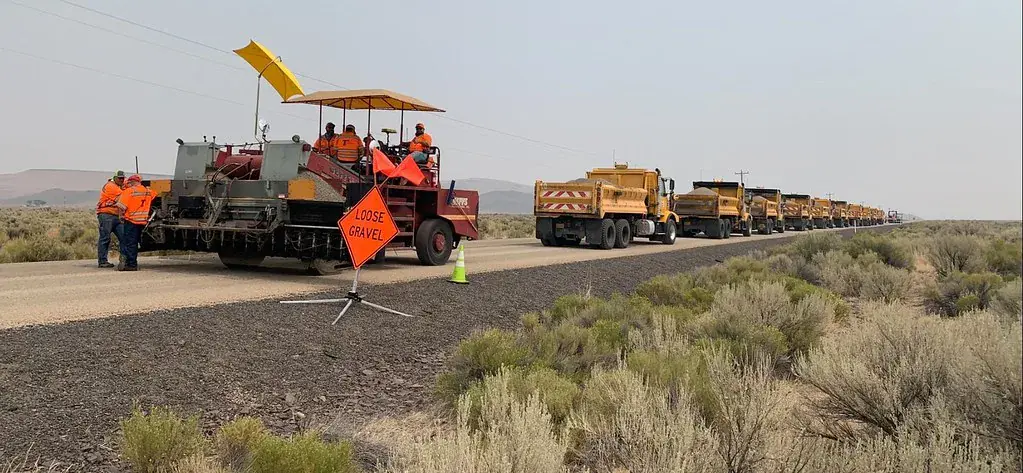
A tar and chip installation is fast once the base is ready. The binder and chips go down together in a single pass, so the crew needs a distributor truck to heat and spray the asphalt, a chip spreader, and a roller working close behind.
- Prepare the base. Grade and compact a gravel base, or repair and level an existing gravel driveway. HomeGuide recommends a minimum 2% slope for drainage. Over bare dirt, the gravel base goes down first.
- Wait for the weather. The Federal Highway Administration's chip seal checklist calls for air and surface temperatures of 50°F and rising, a very low chance of rain, and wind under 20 mph (FHWA). That matches the 50°F-and-rising rule of thumb for when to pave an asphalt driveway.
- Spray the binder. Hot liquid asphalt or asphalt emulsion is sprayed evenly across the surface.
- Spread the chips immediately. Clean stone goes onto the wet binder before it cools. FHWA specifies clean aggregate free of excess fines, and Asphalt Magazine notes that dusty or wet stone will not bond.
- Roll. A roller follows close behind the spreader and presses the chips into the binder. FHWA recommends a pneumatic-tired roller and at least three passes.
- Add the second layer for a double seal. A second binder coat, then smaller chips, then another rolling.
- Let it set, then sweep. FHWA calls for sweeping off excess chips as soon as possible and no later than the next morning, keeping traffic off until the first sweep and slow until the final one.
This is not a DIY job. HomeGuide notes it requires heavy machinery, equipment to heat and spray the asphalt, and a crew working quickly together. Not every asphalt company does chip seal, so get at least three quotes and ask each contractor:
- How many tar and chip driveways have you installed?
- Is this price for a single or a double seal?
- Are base work, grading and drainage included?
- Which stone sizes and colors can you supply?
- What does the warranty cover, and for how long?
Tar and chip vs asphalt vs gravel: which should you choose?
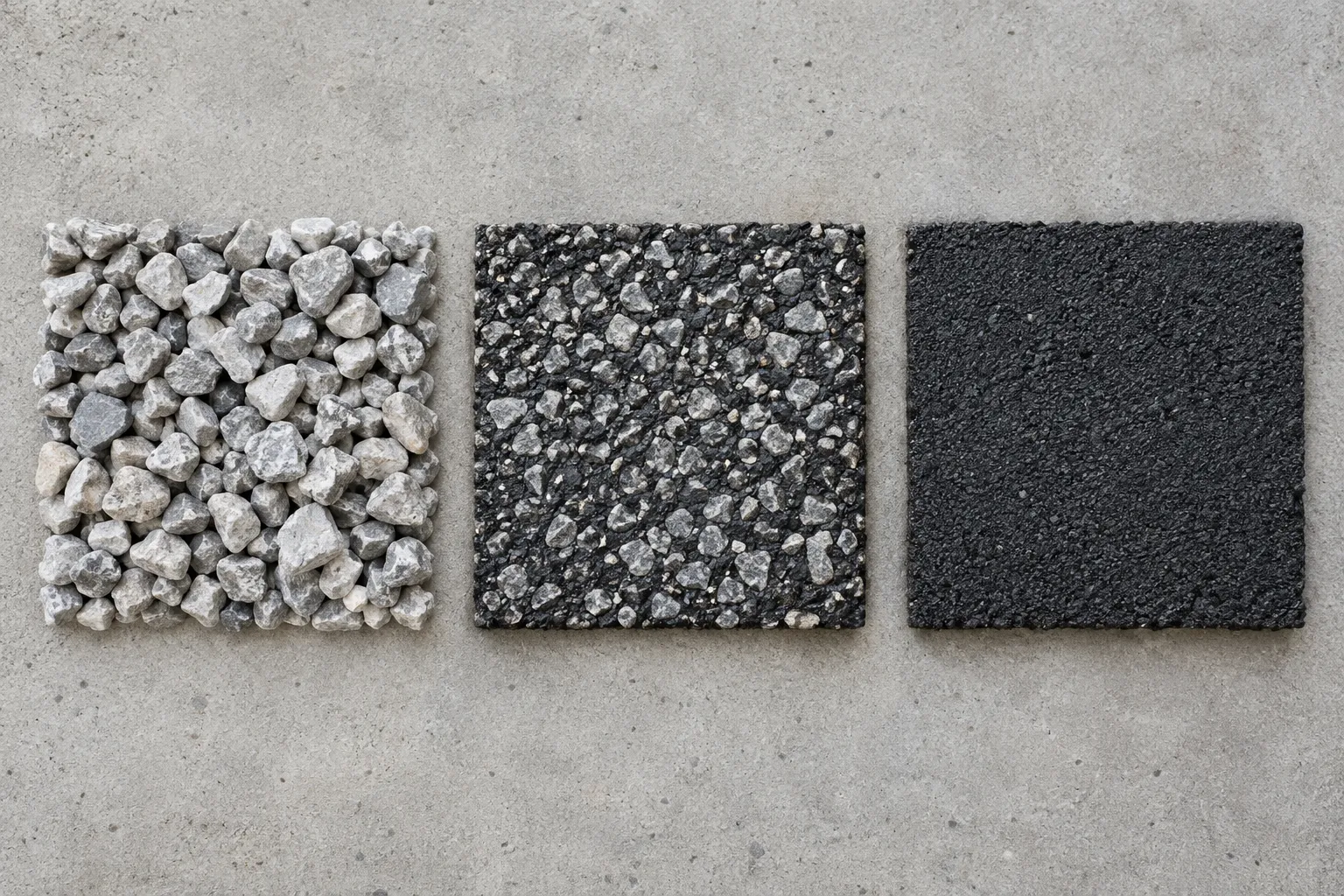
Tar and chip sits between gravel and asphalt on price, and the right choice depends more on how you use the driveway than on the per-foot number.
| Factor | Tar and chip | Asphalt | Gravel |
|---|---|---|---|
| Installed cost per sq ft (HomeGuide) | $2 to $5 | $3 to $7 | $1 to $3 |
| Lifespan | 7 to 10 years, 12 to 15 double seal | 15 to 30 years | Indefinite with regular top-ups |
| Routine upkeep | Sweep loose chips; re-chip at about 10 years | Sealcoat every 2 to 3 years, fill cracks | Regrade and add stone every 2 to 3 years |
| Surface | Rough and textured | Smooth | Loose |
| Snow removal | Plow with the blade raised | Easiest of the three | Hard; the blade scoops stone |
| Loose stone | Some, mostly in the first weeks | None | Constant |
| Best fit | Long, rural, low-traffic driveways | Daily driving, plowing, anything on wheels | Lowest budget, very long driveways |
Tar and chip is the right choice if
- You have a long rural driveway and want a bound, dust-free surface for less than asphalt. Angi notes it works best on rural, low-traffic, slow-speed surfaces.
- You are tired of gravel washing out, rutting and scattering, but the budget does not stretch to asphalt.
- You want the look of stone with a firmer surface underfoot.
- Your gravel base is already sound, which brings resurfacing down to $1 to $3 per square foot (HomeGuide).
Choose asphalt or gravel instead if
- You plow several times a winter, or a plow service will not raise the blade. Asphalt handles plowing best.
- Kids bike, skate or play ball on the driveway, or you push strollers or wheelchairs across it. Asphalt is smooth; tar and chip is not.
- You want the longest life for the money and plan to stay. Asphalt lasts 15 to 30 years; see asphalt vs concrete driveway if you are also weighing concrete.
- Cost is the only deciding factor. Gravel is the cheapest surface on average in both cost guides that price all three together; see asphalt vs gravel driveway.
Sources and citations
- HomeGuide, "How Much Does a Chip Seal or Tar and Chip Driveway Cost?", Kristen Cramer, fact-checked by Tom Grupa, May 27, 2025. Read in the Internet Archive copy captured December 14, 2025, homeguide.com
- Angi, "How Much Does a Tar and Chip Driveway Cost?", Kelly Weimert, updated November 25, 2025. Read in the Internet Archive copy captured February 19, 2026, angi.com
- Farhang Jalali and Adriana Vargas-Nordcbeck, "Life-Extending Benefit of Chip Sealing for Pavement Preservation", Transportation Research Record 2675(6), 2021, trid.trb.org
- Dwight Walker, "Improving chip seal performance", Asphalt Magazine, August 12, 2013, asphaltmagazine.com
- Federal Highway Administration, "Chip Seal Checklist", Pavement Preservation Checklist Series, Publication No. FHWA-HIF-19-029, July 2019, fhwa.dot.gov
- HomeGuide: gravel driveway cost ($4 to $10 per sq ft installed), checked October 2026, homeguide.com
- HomeGuide: asphalt prices ($3 to $7 per sq ft installed), checked October 2026, homeguide.com
- Bob Vila: asphalt driveway cost guide ($7 to $15 per sq ft, including minimal grading; updated May 29, 2024), checked October 2026, bobvila.com
- HomeGuide: asphalt driveway cost (overlay resurfacing $3 to $7 per sq ft), checked October 2026, homeguide.com
- Bob Vila: asphalt driveway cost (resurfacing $3 to $7 per sq ft), checked October 2026, bobvila.com
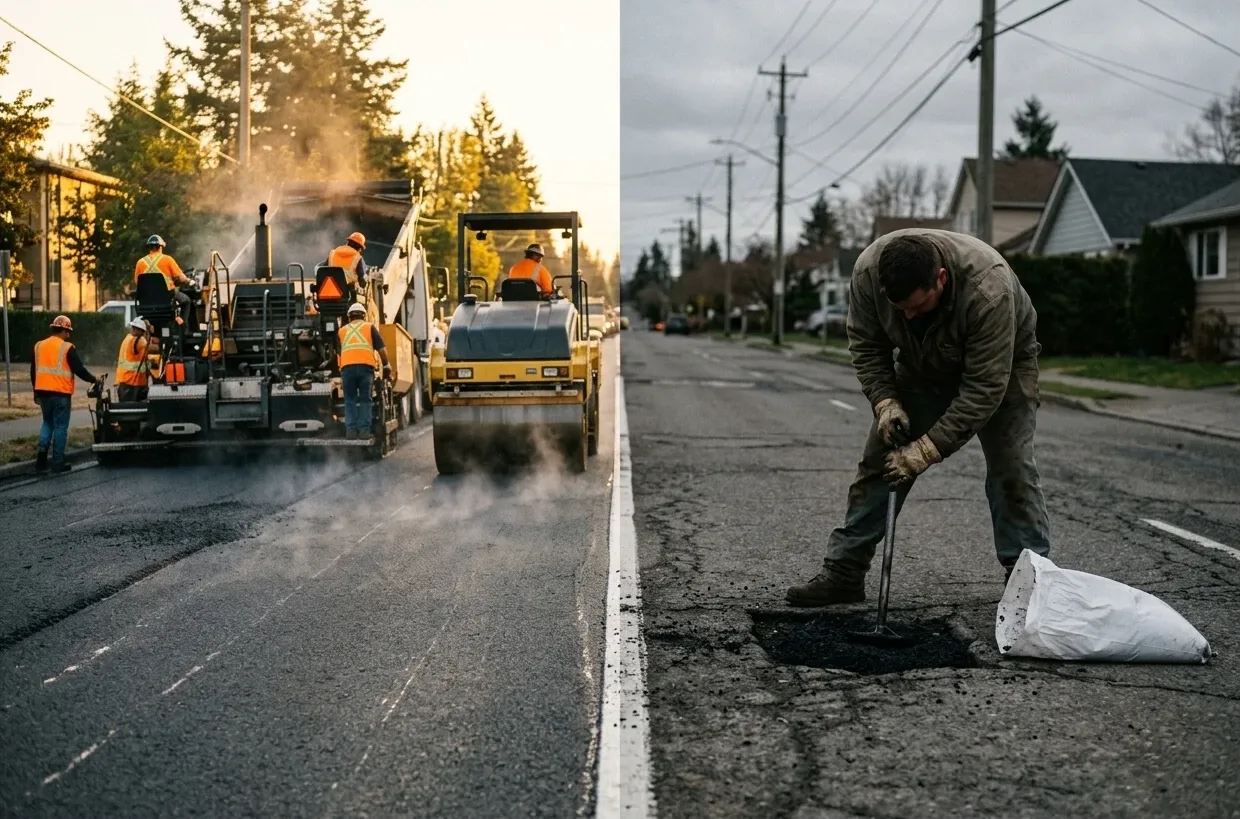
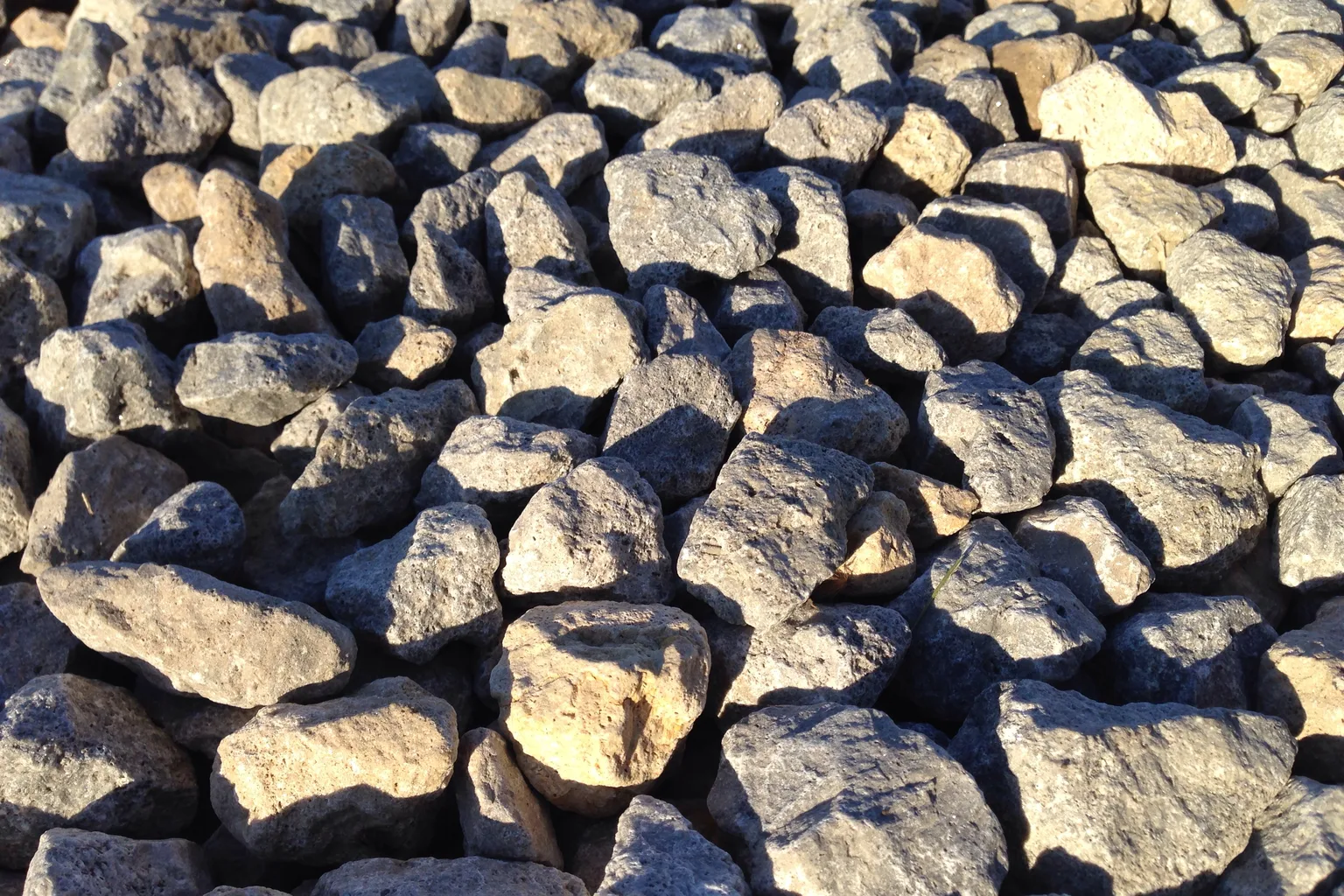
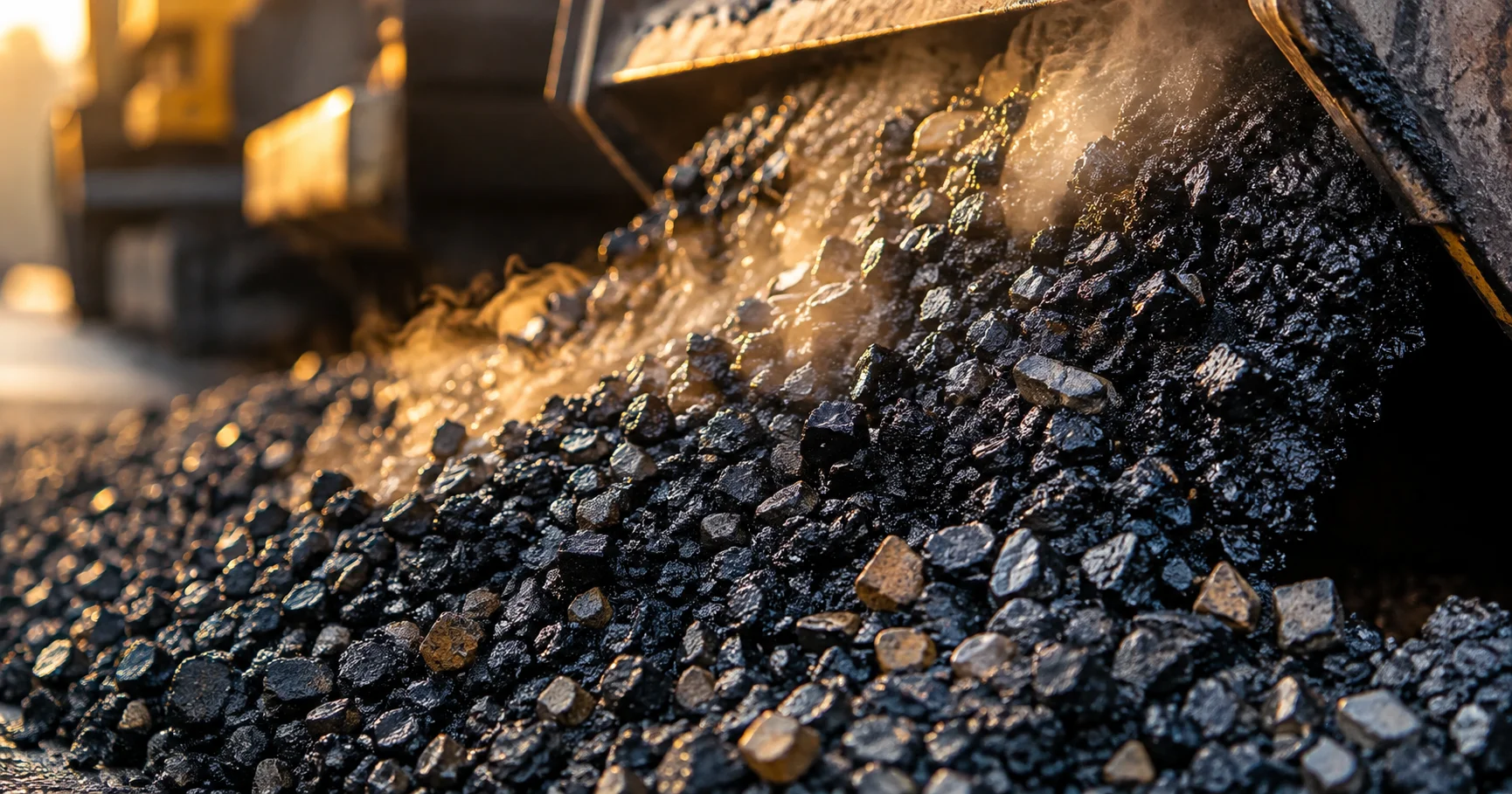
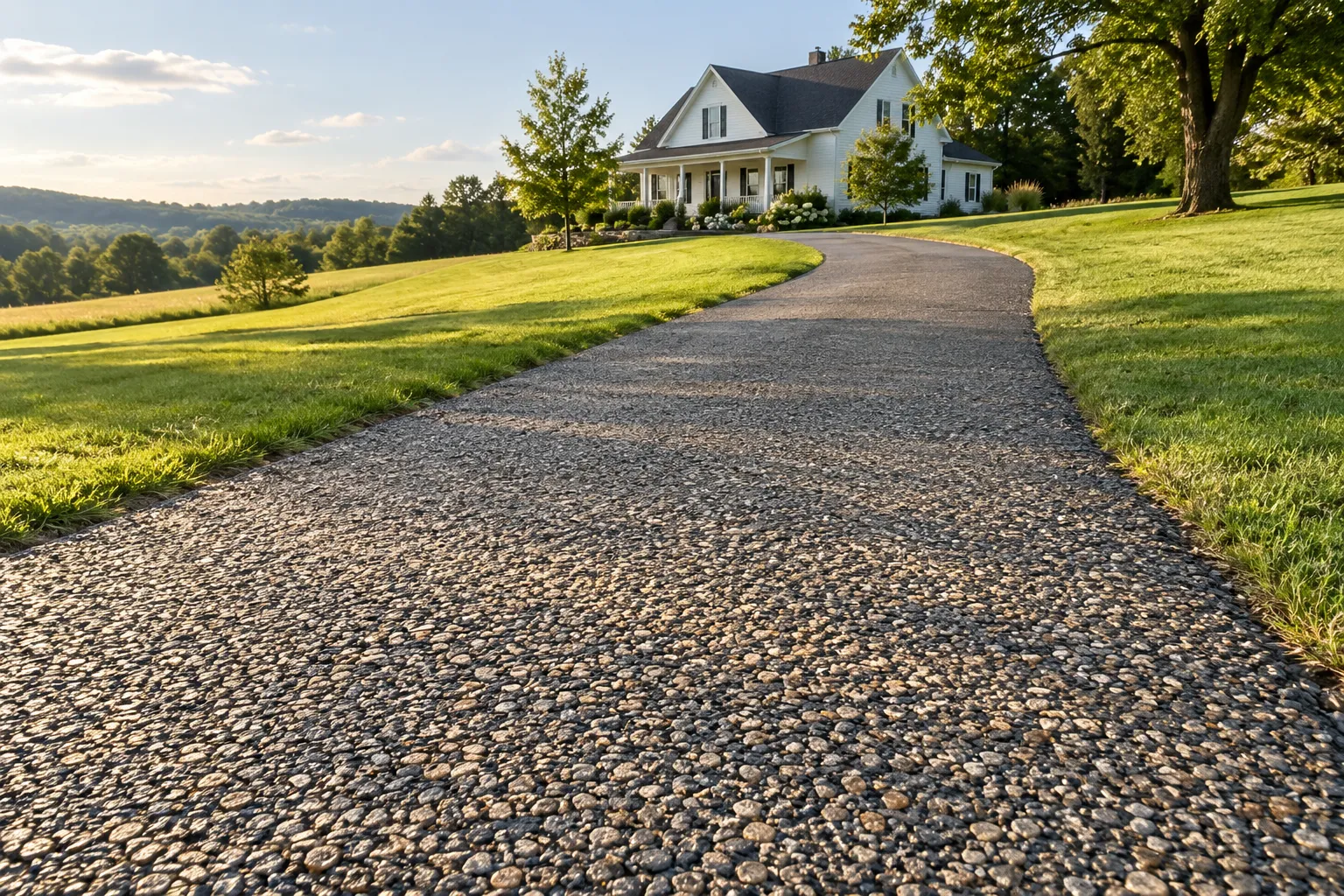
- Photos: Oregon Department of Transportation, "Chip seal spreader and gravel trucks OR 78", CC BY 2.0, via Flickr; Yellowstone National Park, "Chipsealing project in Mammoth Hot Springs", public domain, via Flickr. The hero image and four illustrations are getasphaltcalculator.com illustrations and do not show a specific real driveway.
- Asphalt Driveway Cost Calculator (internal tool)
Frequently asked questions
Tar and chip is a good driveway surface for long, rural, low-traffic driveways on a sound gravel base. According to HomeGuide, it costs about $2 to $5 per square foot installed, roughly 30% to 40% less than asphalt. It needs no sealcoating and grips well in rain and snow. It is a poor choice if you plow often, need a smooth surface for bikes or strollers, or have a soft, poorly drained base, because the chip layer adds no structural strength.
A tar and chip driveway costs $2 to $5 per square foot installed, according to HomeGuide, or $700 to $2,900 for a typical two-car driveway. A single seal runs $2 to $3 per square foot and a double seal $3 to $5. Resurfacing an existing gravel or asphalt driveway with tar and chip costs $1 to $3 per square foot. Grading, base work and permits are extra.
A tar and chip driveway lasts 7 to 10 years with a single seal and 12 to 15 years with a double seal, according to HomeGuide. Angi puts it at about 10 years before another layer is needed. A 2021 Transportation Research Record study of low-traffic roads found a median life of 6.8 to 9.1 years for a single layer and more than 10 years for double layers. A weak base or a cold, wet installation shortens all of these.
Yes. Chip seal, tar and chip, chip and seal, oil and stone, and macadam all describe the same surface: hot liquid asphalt sprayed over a base, covered with stone chips and rolled. Road departments usually say chip seal, while many driveway contractors say tar and chip. Chip seal is different from sealcoating, which is a liquid coating brushed or sprayed onto existing asphalt.
Yes, if the existing driveway is structurally sound. HomeGuide says chip seal can go over gravel, concrete, or asphalt that has never been sealed, at $1 to $3 per square foot. Cracks and potholes must be repaired first, and surfaces with cracks wider than 1/4 inch, ruts or structural problems are poor candidates, because chip sealing does not add strength.
Yes, but raise the blade. HomeGuide warns that tar and chip is easily damaged by snowplows if the blade is not raised about 1 inch before plowing, because a flat blade catches the chips and strips them out. Set a snow blower's skid shoes so the housing rides above the stone. If you rely on a plow service that will not raise the blade, asphalt is the safer surface.