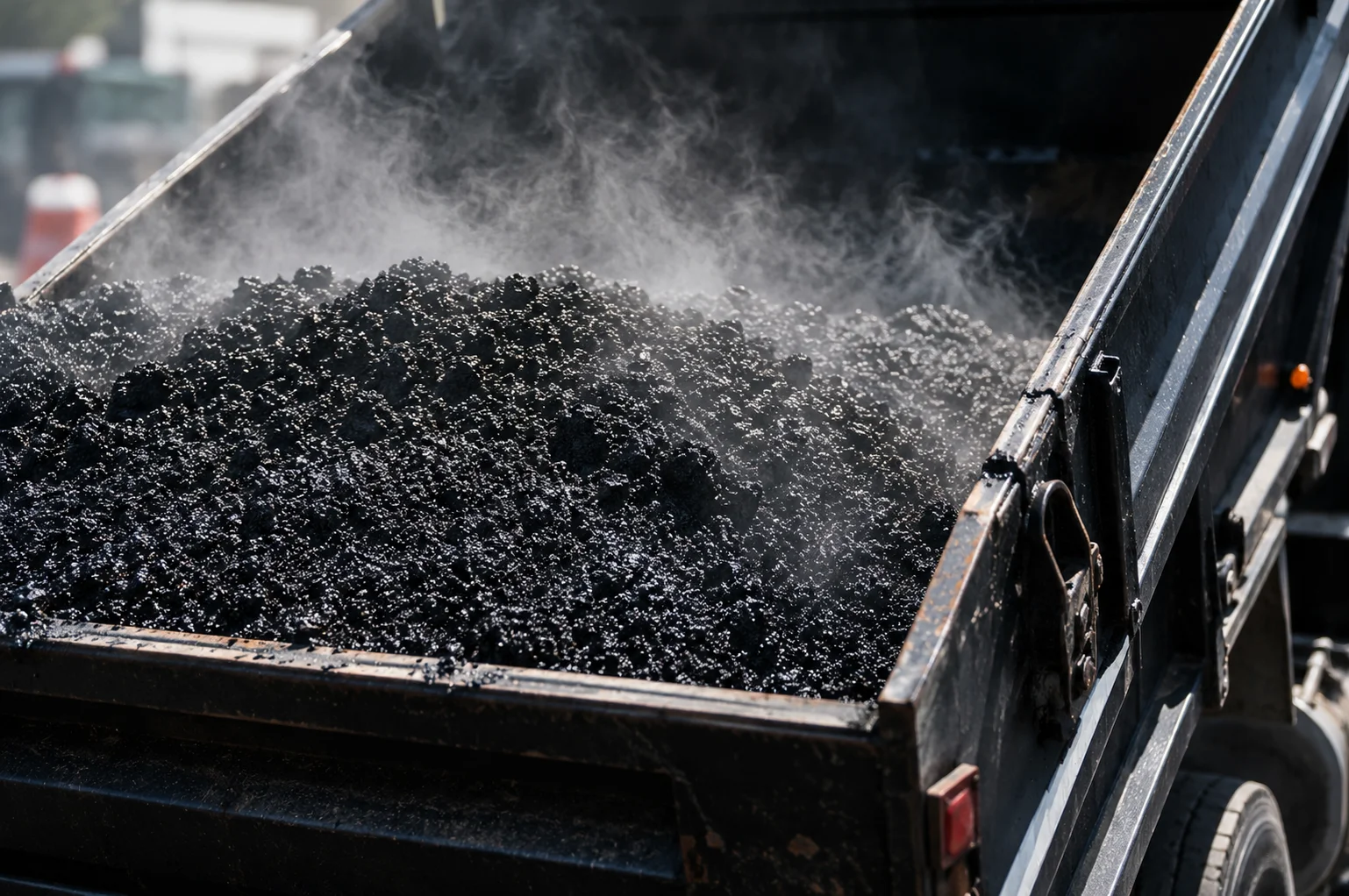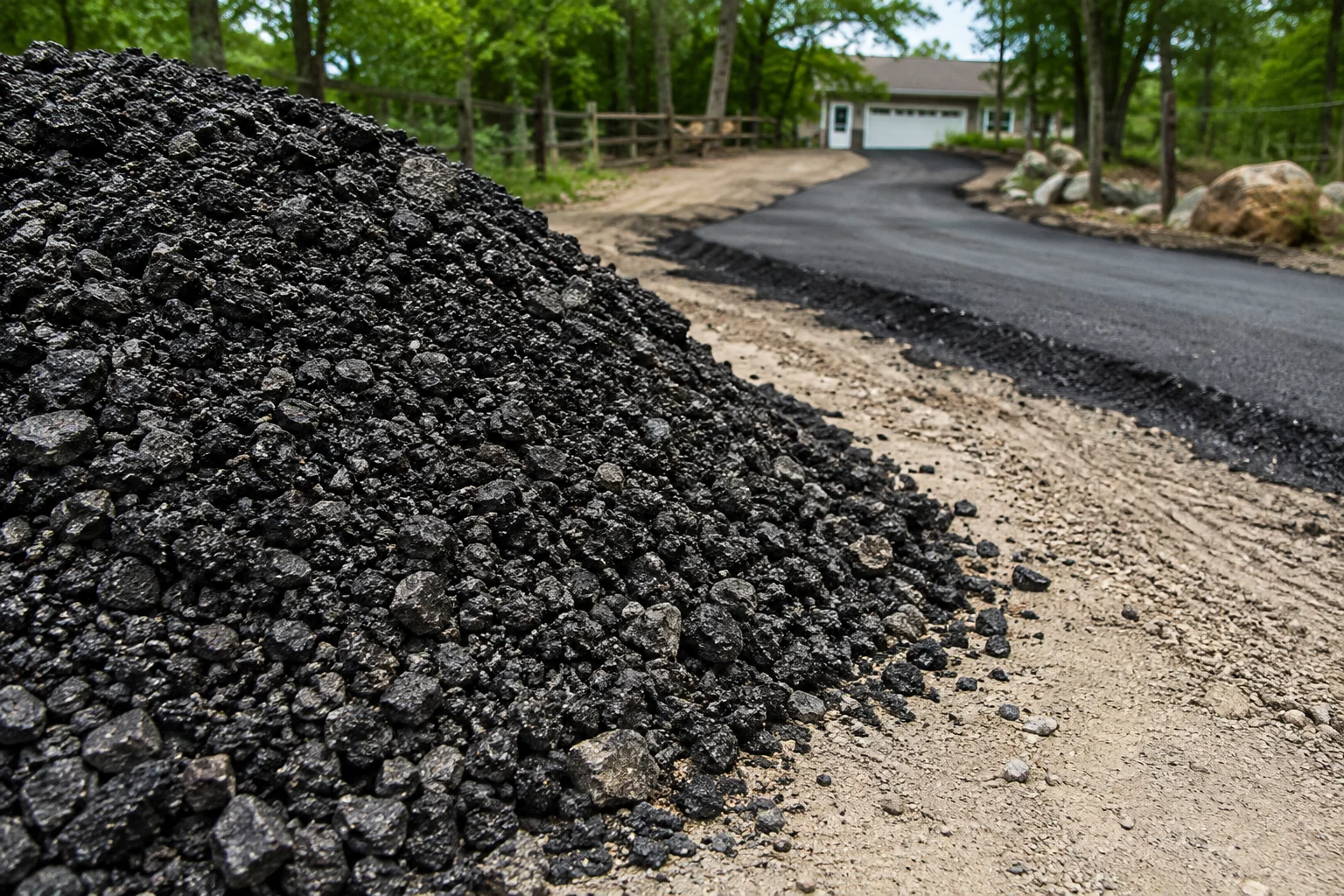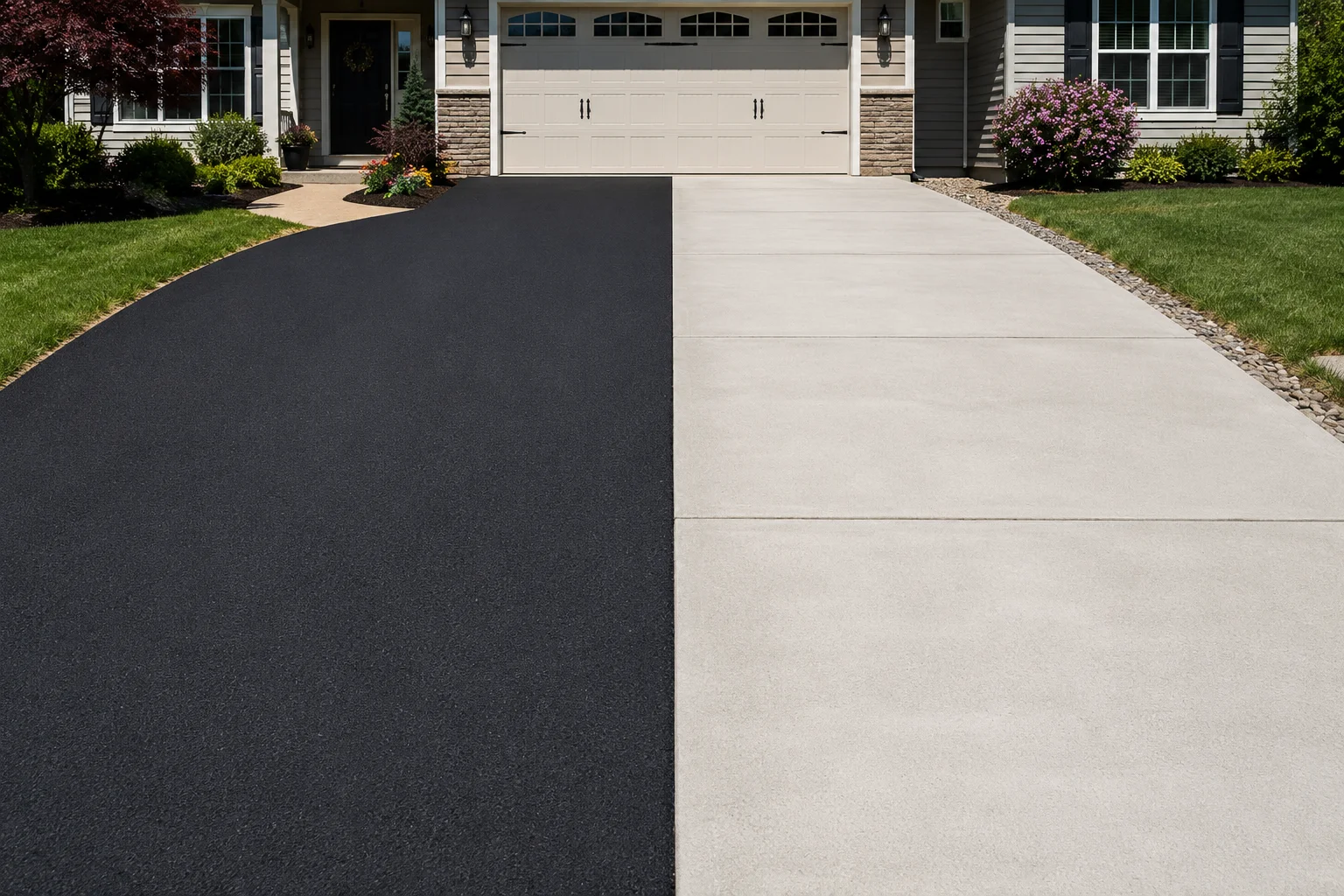
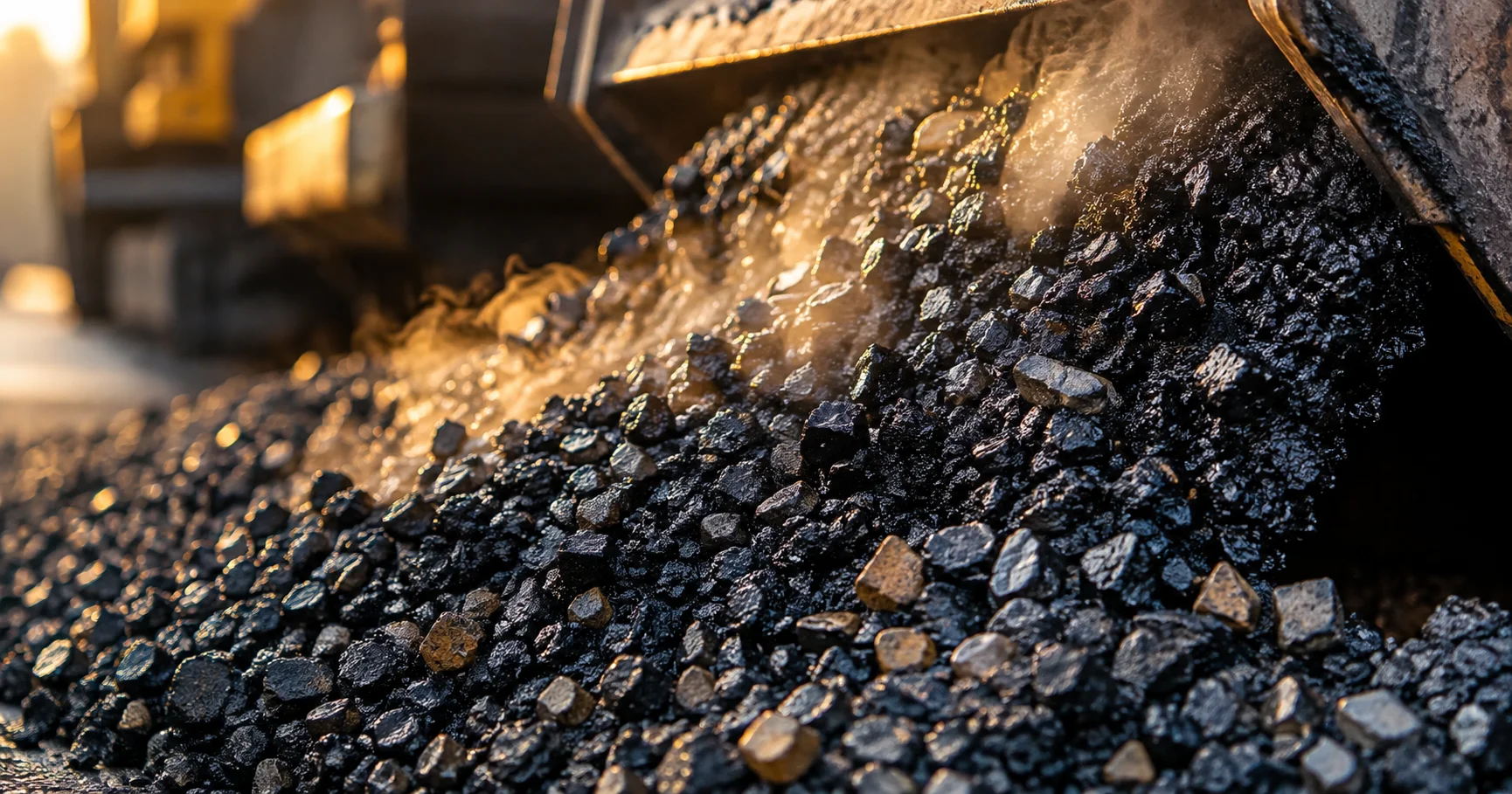
Asphalt is a paving material made from two ingredients: about 92% to 96% crushed stone aggregate by volume, bound together by roughly 5% asphalt binder (bitumen), a sticky byproduct of crude oil refining. Plants heat both to 300°F to 350°F, mix them, and pave the material hot, before it cools and locks into a solid road, driveway, or parking lot surface.
Asphalt (as used on this site)
The complete paving material: crushed stone aggregate bound together by asphalt binder (bitumen), mixed hot and compacted into pavement. That is the same material every calculator on this site estimates in tons, cubic yards, and cost, not the binder alone.
Every asphalt road, driveway, and parking lot starts with the same two ingredients, just in very different proportions: a lot of stone, and a little bit of sticky black glue to hold it together. Everything else, hot mix versus cold mix, driveway grade versus highway grade, new versus recycled, is a variation on that same two-part recipe.
What is asphalt made of?
Asphalt is roughly 92% to 96% aggregate by volume, bound together by about 5% asphalt binder by weight. Those are the planning ranges published in the Asphalt Institute's MS-2 mix design manual; the binder share can run 4% to 8% depending on mix design. The aggregate does the structural work. The binder is what makes it stick together and shed water.
| Ingredient | Typical share | What it does |
|---|---|---|
| Aggregate (crushed stone, sand, gravel) | 92% to 96% by volume | Structural bulk. Carries the load and resists deformation. |
| Asphalt binder (bitumen) | 4% to 8% by weight (about 5% typical) | The glue. Coats every aggregate particle and binds the mix together. |
| Air voids | About 4% by volume, by design | Small designed-in gaps that allow slight compaction and, in porous mixes, drainage. |
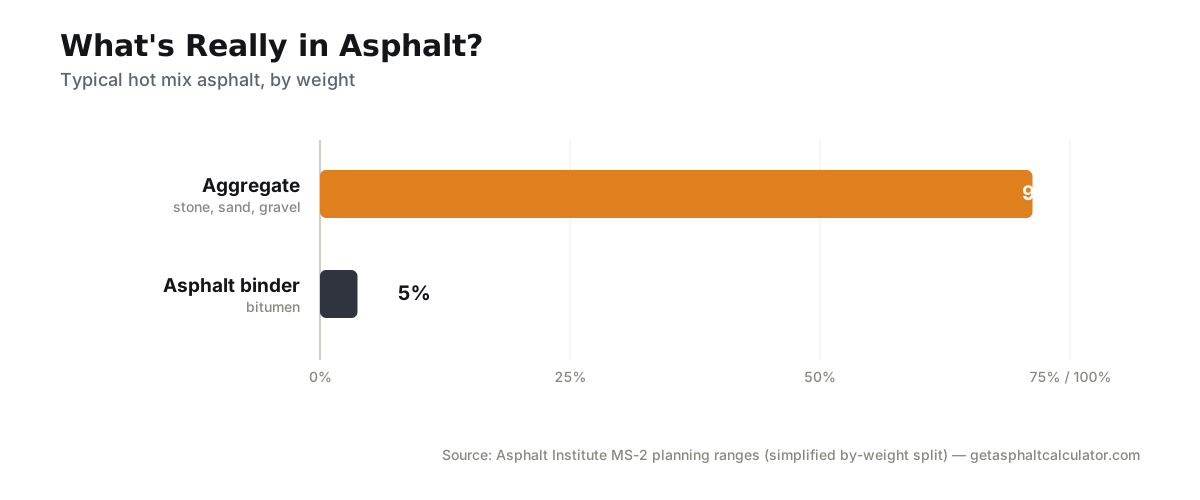
The aggregate is ordinary crushed stone, sand, and gravel, sometimes blended with recycled asphalt millings. The binder, called bitumen, is the heaviest fraction left over after crude oil is refined into gasoline, diesel, and other lighter products. On its own, bitumen is a thick, sticky, semi-solid material. Heated, it turns liquid enough to coat aggregate evenly, then it cools and re-solidifies once the mix is compacted.
How is asphalt made?
Hot mix asphalt plants heat the aggregate and the binder separately, then combine them at 300°F to 350°F (FHWA Warm Mix Asphalt program). That range is what it takes for the binder to coat every aggregate particle evenly. The mix has to stay hot from the plant to the roller, or it cannot be properly placed and compacted.
- Aggregate is dried and heated at the plant to remove moisture, since any trapped water would boil off later and weaken the bond.
- Binder (bitumen) is heated separately until it becomes liquid enough to coat aggregate evenly, typically in the same 300°F to 350°F range.
- The two are combined and mixed at the plant, coating every stone particle in a thin film of binder.
- The hot mix is trucked to the job site, usually arriving between 275°F and 300°F.
- A paver spreads the mix to the target depth while it is still workable.
- Rollers compact the mat while it is still hot, locking the aggregate into place before the mix cools and hardens into its final, solid form.
Warm mix asphalt follows the same recipe at a lower temperature, roughly 30°F to 120°F cooler than hot mix. That saves fuel and cuts emissions without changing the aggregate-to-binder ratio. Cold mix, the bagged product sold for pothole patching, trades some density and long-term durability for the convenience of not needing heat at all. For the density figures used to convert any of these into tonnage, see how much does asphalt weigh and how to calculate asphalt tonnage.
Asphalt vs. bitumen vs. blacktop: is there a difference?
Not really, once you know which word is doing which job. In everyday American usage, asphalt means the finished paved material: aggregate plus binder, the same thing this entire site calculates in tons and square feet. Stricter US engineering usage draws a finer line. Asphalt binder or asphalt cement refers to the sticky petroleum component alone. That is exactly what British English calls bitumen, while British English uses "asphalt" the same way Americans do colloquially, for the finished paved mixture.
"Blacktop" is simply the informal North American name for an asphalt surface, most often used for driveways and parking lots. It is not a separate product. If a contractor quotes "blacktop" and another quotes "asphalt paving," they are pricing the same material.
What is asphalt used for?
Asphalt surfaces 94% of the 2.27 million miles of paved roads in the United States, including 65% of the interstate highway system (National Asphalt Pavement Association). Outside of public roads, it is the standard surface for residential driveways, commercial parking lots, and airport runways and taxiways. It is also used in porous form for water-permeable surfaces where stormwater drainage matters.
| Application | Typical role |
|---|---|
| Public roads and highways | 94% of US paved roads, including most of the interstate system |
| Residential driveways | 2 to 4 inches compacted, see the [driveway thickness guide](/blog/how-thick-should-an-asphalt-driveway-be) |
| Commercial parking lots | Thicker structural sections for regular vehicle and truck traffic |
| Airport runways and taxiways | Heavy-duty mixes engineered for repeated, concentrated aircraft loads |
| Porous/permeable surfaces | Open-graded mixes that let stormwater pass through instead of running off |
One common mix-up worth clearing up: asphalt shingles, the roofing product, use a related bitumen-based coating but are manufactured and installed completely differently from paving asphalt. This site covers paving and calculation only, not roofing.
Types of asphalt (quick overview)
Every type below uses the same aggregate-plus-binder recipe; what changes is the mixing temperature, the aggregate gradation, or how much of the material is recycled.
- Hot mix asphalt (HMA) - the standard mix for roads, driveways, and parking lots, produced at 300°F to 350°F.
- Warm mix asphalt (WMA) - the same ratio, produced 30°F to 120°F cooler to save fuel and reduce emissions.
- Cold mix asphalt - a bagged product for pothole patching that skips the heating step, at the cost of some density and durability.
- Porous (open-graded) asphalt - built with extra air voids so water drains through instead of pooling.
- Stone Matrix Asphalt (SMA) - a denser stone skeleton designed for heavy, repeated traffic loads.
- Recycled asphalt (RAP/millings) - reclaimed pavement, ground up and reused as base material or, blended with new binder, as a new surface layer. See asphalt millings cost for pricing and use cases.
Asphalt has been paved in the US since 1870, when Belgian chemist E.J. DeSmedt laid the country's first true asphalt pavement on William Street in Newark, New Jersey, using natural asphalt shipped from Trinidad's Pitch Lake (Asphalt Institute). More than 150 years later, it is also the country's most recycled material. Producers reused 101.4 million tons of reclaimed asphalt pavement (RAP) in 2024, a recycling rate close to 100% (NAPA/FHWA, 2025).
At a glance: asphalt in six numbers
- 192% to 96% — aggregate share by volume, the structural bulk of every asphalt mix (Asphalt Institute MS-2).
- 2~5% — asphalt binder (bitumen) by weight, the glue holding the aggregate together.
- 3300°F to 350°F — the temperature hot mix asphalt is produced and mixed at the plant.
- 494% — the share of America's 2.27 million miles of paved roads surfaced with asphalt.
- 5101.4 million tons — reclaimed asphalt pavement reused in new mixes in 2024, keeping asphalt America's most recycled material by volume.
- 61870 — the year the first true asphalt street was paved, in Newark, New Jersey.
Sources and citations
- National Asphalt Pavement Association — All About Asphalt
- National Asphalt Pavement Association — Reclaimed Asphalt Pavement Nears 100% Recycling Rate
- Asphalt Institute — MS-2 Asphalt Mix Design Methods
- Asphalt Institute — E.J. DeSmedt, First US Asphalt Pavement (1870)
- Federal Highway Administration — Warm Mix Asphalt, Everyday Counts
- Asphalt Calculator (internal tool)
- Hot Mix Asphalt Calculator (internal tool)
- How Much Does Asphalt Weigh (internal guide)
- How to Calculate Asphalt Tonnage (internal guide)
- Asphalt Millings Cost (internal guide)
Frequently asked questions
Asphalt is made of two ingredients: crushed stone aggregate (sand, gravel, and crushed rock), which makes up about 92% to 96% of the mix by volume, and asphalt binder (bitumen), a sticky petroleum byproduct that makes up roughly 5% by weight and holds the aggregate together.
Not exactly. In everyday American usage, asphalt refers to the finished paved material (aggregate plus binder). Bitumen, in British English, refers specifically to the sticky binder component alone, what US engineers more precisely call asphalt binder or asphalt cement.
Yes. Blacktop is simply the common North American nickname for a paved asphalt surface, most often used for driveways and parking lots. It is not a different material or mix.
Hot mix asphalt is produced and mixed at the plant between 300°F and 350°F. By the time it arrives at the job site, it has typically cooled slightly to between 275°F and 300°F, still hot enough to be spread and compacted before it sets.
Beyond public roads, which make up 94% of US paved mileage, asphalt is the standard surface for residential driveways, commercial parking lots, airport runways and taxiways, and porous applications where stormwater needs to drain through the surface instead of running off.
Yes. Asphalt is America's most recycled material by volume. In 2024, the industry reused 101.4 million tons of reclaimed asphalt pavement (RAP) in new mixes and other applications, a recycling rate close to 100%, according to a 2025 National Asphalt Pavement Association and Federal Highway Administration survey.
The first true asphalt pavement in the United States was laid in 1870 on William Street in Newark, New Jersey, by Belgian chemist E.J. DeSmedt, using natural asphalt shipped from Trinidad's Pitch Lake. Trinidad asphalt was used again a few years later for a larger paving project on Pennsylvania Avenue in Washington, D.C.
Compacted hot mix asphalt weighs about 145 pounds per cubic foot, or roughly 3,915 pounds (1.96 tons) per cubic yard. For a full breakdown by mix type and thickness, see how much does asphalt weigh.